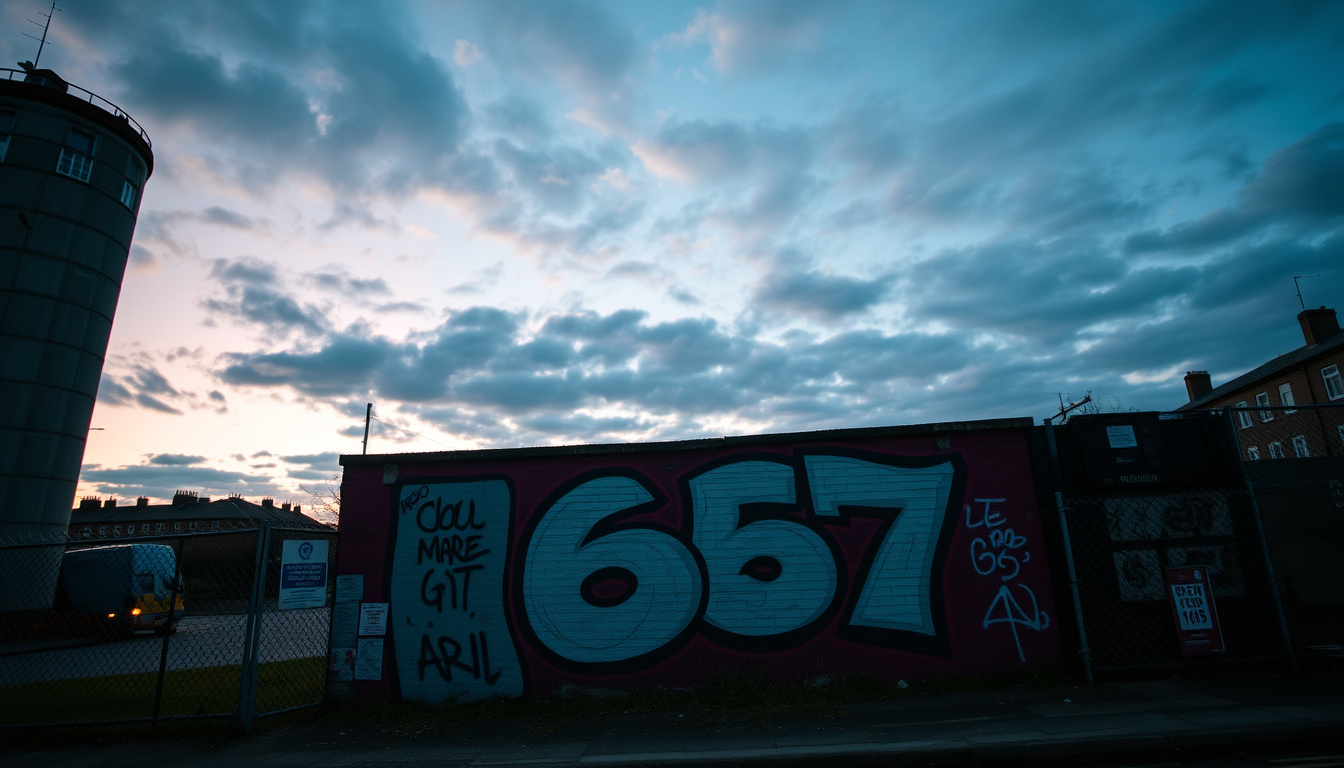

The term “67” (or “six-seven”) carries distinct meanings depending on whether it appears in UK drill music circles, broader internet culture, or street gang contexts. At its most specific, 67 refers to a pioneering UK drill rap collective from Brixton Hill, South London, formed in 2014, whose members include LD, Monkey, Dimzy, Liquez, ASAP, and SJ. The number has also evolved into Gen Z slang meaning something is acceptable, decent, or cool—a usage popularized through social media platforms like TikTok. Understanding these different layers requires examining where the term originated and how it has spread across communities.
This dual meaning creates confusion for those encountering “67” in music lyrics, online discussions, or news coverage. The UK drill context carries serious weight, as the group has been directly linked to criminal gang activity, multiple homicides, and ongoing legal scrutiny from the Metropolitan Police. Meanwhile, the casual internet usage has detached the number from its criminal associations, transforming it into a relatively harmless expression of approval. The gap between these interpretations reflects how slang terms evolve as they move from subcultures into mainstream vocabulary.
What Does 67 Mean? Core Definitions and Uses
The meaning of “67” shifts dramatically based on context, audience, and intent. In South London street culture, the number represents a specific postcode identifier for Brixton Hill, serving as both a geographic marker and a badge of identity for those affiliated with the area. Among UK drill listeners, “67” most commonly denotes the rap group itself or its members’ collective mindset—a lifestyle rooted in street loyalty, mutual protection, and territorial awareness. This meaning permeates the group’s discography, with tracks like “Let’s Lurk” (2016) reinforcing their distinctive brand of ominous, atmospheric rap.
UK drill collective / Brixton Hill gang / Gen Z approval term
Brixton Hill, South London (2014)
Music, street life, social media, news reports
“67 gang,” “that’s six-seven,” “LD from 67”
In online Gen Z vernacular, “67” has undergone significant drift from its criminal roots. The term now frequently appears in TikTok comments, Twitter discussions, and casual text messages to indicate that something is merely okay, passable, or mildly impressive. This usage emerged from a 2016 song by rapper Scrilla, who repeatedly emphasized the number in a way that resonated with younger audiences seeking casual expressions of approval. The transformation demonstrates how slang can be commodified and stripped of original context as it circulates through digital platforms.
Street-level usage in London remains the most charged interpretation. When appearing in police reports, news headlines, or court documents, “67” typically signals affiliation with the criminal gang operating from Brixton Hill. This meaning carries legal consequences, as authorities have explicitly labelled the collective a criminal organization. Understanding which interpretation applies requires reading surrounding context—song lyrics, social media posts, or official documents—because the same number can carry wildly different implications depending on who is speaking and to whom.
- UK drill rap collective from Brixton Hill, South London
- Street gang operating county lines drug operations
- Postcode identifier representing SW9 or SW2 territory
- Gen Z slang meaning “acceptable” or “decent”
- Symbol of crew identity, unity, and shared experience
- Label used in police and media coverage of gang activity
- Term appearing in drill track titles, lyrics, and music videos
| Fact | Details | Source Type |
|---|---|---|
| Primary Meaning | UK drill group / Brixton street gang | Wikipedia, news reports |
| Formation Year | 2014 | Wikipedia |
| Associated Groups | CT, 37/OJB, 150 (rivals) | Wikipedia |
| Popularized By | LD, Dimzy, Monkey, Liquez, ASAP, SJ | Wikipedia |
| Regions | Brixton Hill, South London; broader UK drill scene | Wikipedia, music sources |
| Legal Status | Labeled “criminal gang” by Metropolitan Police | News reports |
67 in UK Drill Culture: Origins and Evolution
UK drill emerged as a distinct subgenre in the early 2010s, borrowing heavily from Chicago’s drill scene while developing localized themes tied to London postcode rivalries. The 67 collective arrived in 2014 as one of the earliest drill groups to gain traction, establishing their base in Brixton Hill and quickly distinguishing themselves through atmospheric production, ominous delivery, and explicit references to street violence. Their breakthrough came with “Let’s Lurk” in 2016, a track that became so influential its instrumental was parodied in Big Shaq’s viral hit “Man’s Not Hot.”
The group’s mixtape “The Glorious Twelfth” (2017) peaked at number 71 on the UK charts, demonstrating that drill had crossed into mainstream consciousness despite—or perhaps because of—its controversial subject matter. The collective’s success spawned copycat groups and intensified postcode-based competition across South London. Members began accumulating criminal records while maintaining recording careers, creating an uncomfortable duality that both attracted and concerned young listeners drawn to the music’s raw authenticity.
Musical Style and Lyrical Content
67’s sonic approach centers on slow, menacing beats designed for confrontation rather than celebration. Production typically features minor-key samples, distorted 808 bass, and sparse arrangements that allow lyrical content to dominate. Tracks reference “lurking” (waiting with intent), opponent identification, and territorial claims that blur the line between artistic performance and operational communication. This ambiguity has proven legally significant, with prosecutors citing lyrics as evidence in gang-related prosecutions.
The collective has released numerous projects since 2014, with members continuing to record despite periods of incarceration. Current affiliates including AK, C Rose, and LAG (Grippa) maintain the group’s presence in the drill scene while founding members serve sentences or navigate legal restrictions on their activities. This continuity reflects drill’s embeddedness in specific communities—music and street life are genuinely intertwined rather than separate entertainment products.
British media outlets including the BBC and The Guardian have covered 67 extensively, framing the group primarily through the lens of gang violence and criminal activity. This coverage contrasts with how the collective is discussed in music circles, where technical production qualities, lyrical storytelling, and influence on UK drill’s development receive more attention. Both framings contain truth, though they emphasize radically different aspects of the same phenomenon.
67 and Chicago Drill: Shared Roots, Different Paths
UK drill’s foundational influence from Chicago’s drill scene is well-documented, with producers and artists explicitly acknowledging their debt to pioneers like Chief Keef, Lil Reese, and Fredo Santana. The Chicago drill tradition popularized block-specific identifiers—600 for O’Block, 700 for Tookaville—creating a model that UK artists adapted for London postcodes. However, no verified sources establish direct ties between 67 and Chicago’s 600 or 700 blocks. The UK collective operates within its own geographic framework, borrowing stylistic elements rather than forming cross-Atlantic affiliations.
The term “opps” (opponents or rivals) travels across both scenes, reflecting shared gang structures underlying drill music production. In Chicago, rivalries between 600 and 700 blocks have resulted in documented violence and retaliatory incidents that parallel London’s postcode feuds. UK drill borrowed this adversarial framework while localizing it entirely—London’s block equivalent is the postcode rather than the block number, and 67’s rivals are CT (Clapham-based), 37/OJB, and 150 rather than any Chicago-affiliated group.
Listeners encountering “67” in international hip-hop contexts should verify geographic markers before assuming criminal connections. The number appears in numerous songs, social media posts, and regional lexicons with meanings unrelated to London’s Brixton Hill collective. Cross-context confusion arises frequently because drill’s visual and sonic conventions—dark aesthetics, aggressive delivery, gang references—have been adopted by artists worldwide with varying degrees of authenticity or affiliation.
Global Drill’s Fragmentation
As drill music spread globally through streaming platforms and social media, regional variations multiplied faster than lexicons could document. Canadian drill, Australian drill, and African drill scenes have emerged with their own geographic identifiers and rivalries, creating a fragmented landscape where terms like “67” may carry scene-specific meanings entirely divorced from their UK origins. This evolution complicates authoritative definitions—slang terms function as shifting signifiers rather than fixed vocabulary.
When encountering “67” in unfamiliar contexts, consider the artist’s geographic origin, the track’s release date, and surrounding lyrical references. UK drill tracks referencing Brixton Hill, specific member names, or rival groups like CT or 37 almost certainly reference the 67 collective. Isolated usage in international hip-hop contexts may indicate something entirely different—or nothing gang-related at all.
The 67 Gang: Violence, Law Enforcement, and Public Controversy
The 67 collective’s relationship with violence has defined its public identity far beyond musical achievements. In 2015, a member of the group stabbed Dwayne Simpson (known as SQ) of rival group 150, initiating a feud that has produced multiple fatalities over subsequent years. The Metropolitan Police formally labelled 67 a “criminal gang” in 2017, citing evidence of coordinated violent crime, drug trafficking, and territorial intimidation. This designation triggered practical consequences, including event cancellations and increased surveillance of group members.
In 2019, Fernando Pope (known as Giant or G.I.) stabbed Cheyon Evans (Stompz) of the rival 37/OJB group, resulting in a 2020 conviction with a minimum 25-year sentence. Zeshaun Daley (VD) was also convicted that year for a separate homicide, receiving a life sentence with a 19-year minimum. These convictions came amid a broader crackdown that saw 16 67 affiliates arrested and sentenced to a combined 61 years for drug-related offenses. LD and ASAP each received 4.5-year sentences (LD released in 2021), illustrating how incarceration has interrupted but not ended the collective’s operations.
The 2022 police shooting of Chris Kaba, who was linked to 67, sparked renewed controversy when reports emerged that the collective allegedly offered a £10,000 bounty on the officer involved. The officer was ultimately acquitted, but the incident highlighted ongoing tensions between UK drill communities, law enforcement, and the justice system. Dimzy, a founding member, had previously published an open letter in 2018 accusing police and media of “scapegoating” the collective, arguing that coverage was disproportionate to actual criminal activity.
Form 696 and Event Restrictions
UK authorities have employed regulatory tools to restrict drill-related gatherings, most notably Section 52 of the Licensing Act 2003, commonly known as Form 696. This mechanism allows police to request event organizers provide risk assessments that include attendee demographics, anticipated artist performances, and security arrangements. In 2017, the Metropolitan Police used Form 696 to shut down 67’s first UK tour, citing credible threats of violence given the group’s known rivalries and recent criminal incidents.
The use of Form 696 against drill events has generated debate about whether regulatory tools are being applied equitably or deployed specifically to suppress a music genre associated with Black British youth. Critics argue that violence prevention should not target artistic expression, while authorities maintain that drill events function as coordination points for gang activity. This tension remains unresolved, with drill artists continuing to face event cancellations, venue restrictions, and intensified policing that rarely affects mainstream genres.
References to “67” in music lyrics, rap battles, or social media posts may constitute intimidation or threats under UK law, even when framed as artistic expression. UK courts have convicted individuals based partly on lyrical content, particularly when addressing specific rivals or describing planned violence. This legal environment affects how the collective’s music circulates and is interpreted by both authorities and audiences.
Key Events in 67’s History: A Timeline
Understanding how 67 evolved requires examining specific moments that shaped its trajectory, reputation, and relationship with broader British society. From formation through present day, the collective has navigated simultaneous success in music and entanglement with criminal justice systems. These events are documented through court records, news coverage, and statements from members themselves.
- 2014 — 67 established in Brixton Hill, South London, as one of the earliest UK drill collectives to form. Members begin releasing early recordings that establish core sonic and thematic elements.
- 2015 — A 67 member stabs Dwayne Simpson (SQ) of rival group 150, marking the beginning of an ongoing feud that will produce multiple fatalities over subsequent years.
- 2016 — Release of “Let’s Lurk” featuring Giggs. The track’s instrumental is later parodied by Big Shaq in “Man’s Not Hot,” becoming a viral sensation.
- 2017 — Mixtape “The Glorious Twelfth” peaks at #71 on UK charts. Member PR SAD (Andre Fleming) imprisoned for knife possession. Metropolitan Police formally designates 67 a “criminal gang.” First UK tour shut down under Form 696.
- 2018 — Police identify 67 as operating five county lines drug operations. Dimzy publishes open letter accusing police and media of “scapegoating.”
- 2019 — 16 affiliates arrested and sentenced to a combined 61 years for drug offenses. Members LD and ASAP each receive 4.5-year sentences. Fernando Pope (Giant/G.I.) stabs Cheyon Evans (Stompz), a rival from 37/OJB.
- 2020 — Pope convicted of Evans’s murder, receiving life with 25-year minimum. Zeshaun Daley (VD) and an associate convicted of a separate homicide (life, 19-year minimum).
- 2021 — LD released from prison after serving sentence.
- 2022 — Chris Kaba (24, linked to 67) shot by police in Streatham Hill. Reports emerge that 67 allegedly offered £10,000 bounty on the officer. Officer later acquitted.
What Is Confirmed Versus Uncertain About 67
Those researching 67 encounter a mix of documented facts and contested interpretations. Separating established information from speculation helps readers form accurate conclusions, though uncertainty remains significant given the secretive nature of gang operations and the deliberate ambiguity maintained in public statements.
| Confirmed Information | Uncertain or Contested Information |
|---|---|
| 67 formed in Brixton Hill, South London, in 2014 | Exact membership numbers and active rosters |
| Core members include LD, Dimzy, Monkey, Liquez, ASAP, SJ | Current activities and affiliations of incarcerated members |
| Designated a criminal gang by Metropolitan Police in 2017 | Nature and extent of ongoing county lines operations |
| Multiple members convicted of violence-related offenses | Whether bounty allegations in Kaba case are verified |
| Rivals include CT, 37/OJB, and 150 groups | Current state of rivalries and conflict activity |
| Gen Z usage as “okay” or “decent” is documented | Rate of adoption and future trajectory of casual usage |
| No verified ties to Chicago’s 600 or 700 blocks | Extent of international influence or collaboration |
Why 67 Matters: Context and Cultural Impact
67’s significance extends beyond their own recordings, having shaped how UK drill developed as a genre and how British audiences perceive street culture more broadly. The collective demonstrated that drill could achieve mainstream commercial success while maintaining street-level authenticity, opening pathways for subsequent artists while also attracting intensified scrutiny. Their model of collective identity—where group membership permeates individual artist’s identity—has been adopted by numerous UK drill groups seeking similar market positioning.
The group’s experiences also illuminate how young Black British men navigate spaces where music, community, commerce, and criminalization intersect. Dimzy’s open letter accusing authorities of scapegoating articulated frustrations shared across drill communities—frustrations that authorities often hear but rarely address substantively. The tension between artistic expression and operational communication in drill lyrics raises genuine questions about criminal justice, free speech, and the purposes music serves in marginalized communities.
From a language perspective, 67 exemplifies how subcultural slang evolves and fragments. The term’s journey from specific gang identifier to Gen Z approval expression demonstrates the commodification cycle that transforms underground terminology into mainstream vocabulary. Each transformation strips away original context while preserving surface meaning, creating potential confusion for those encountering terms without understanding their history.
Sources, Quotes, and External References
Researching 67 presents challenges given the gap between documented information, self-reported claims, and official designations. Primary sources include court records, police statements, and media coverage—all with their own limitations and perspectives. Music itself serves as both primary source and contested evidence, with lyrics cited in legal proceedings while artists claim they constitute performance rather than confession.
“We are being scapegoated for something that is happening all across London. The police focus on drill because it is what the public wants to see.”
— Dimzy, founding member of 67, in a 2018 open letter regarding police coverage
Wikipedia provides foundational chronology of the group’s formation, releases, and legal troubles, though coverage emphasizes negative incidents over musical achievements. News outlets including the BBC and The Guardian have covered specific events—homicides, arrests, court proceedings—with varying degrees of context about drill culture generally. Music journalism has been inconsistent, with some outlets providing substantive cultural analysis while others default to sensationalized coverage focused solely on violence.
Urban Dictionary entries capture casual usage patterns and represent the grassroots documentation of evolving slang. These sources are valuable for tracking how terms like 67 function in non-gang contexts but should not be treated as authoritative regarding criminal gang activity. The contrast between Urban Dictionary’s relatively benign definitions and law enforcement’s designation as a criminal organization illustrates the gap between popular understanding and official classification.
Summary: Key Takeaways About 67
The term “67” operates on multiple levels simultaneously, and understanding its meaning requires determining context before interpretation. In UK drill music, 67 refers to a pioneering collective from Brixton Hill, South London, whose members have achieved both commercial success and criminal convictions. In Gen Z vernacular, 67 has evolved into a casual expression meaning something is acceptable, decent, or cool. These meanings coexist but carry radically different weight depending on who uses them, where, and why.
The collective’s influence on UK drill cannot be overstated—they established models for collective identity, sound design, and lyrical content that subsequent groups have adopted and adapted. Simultaneously, their entanglement with gang violence, county lines drug operations, and law enforcement scrutiny has made them a lightning rod for debates about drill music’s social impact. Neither framing fully captures the phenomenon, which exists in productive tension between artistic achievement and community harm.
For those encountering 67 in research or conversation, verifying context before assuming meaning protects against miscommunication. The same number can signal criminal gang affiliation in one setting and casual approval in another—a linguistic complexity that reflects drill’s broader journey from underground subculture to mainstream cultural export.
Frequently Asked Questions
Is 67 a gang or a music group?
67 functions as both. The collective began as a music group producing UK drill recordings but was designated a criminal gang by the Metropolitan Police in 2017. Members maintain recording careers alongside involvement in gang activity, and these identities remain intertwined rather than separate.
Does 67 have connections to Chicago gangs?
No verified sources establish direct ties between 67 and Chicago’s 600 or 700 blocks. UK drill drew stylistic inspiration from Chicago drill, but 67 operates within London’s geographic framework and maintains its own network of rivals entirely based in the UK.
What does “67” mean in TikTok comments?
When appearing in casual social media contexts, “67” or “six-seven” typically means something is okay, decent, or passable. This usage emerged from Gen Z adoption of the term, which has drifted significantly from its origins in UK drill and gang culture.
Who are 67’s main rivals?
67’s primary opponents include CT (based in Clapham), 37/OJB, and 150. These rivalries have produced multiple homicides, including the 2015 stabbing of SQ and the 2019 killing of Stompz. Postcode disputes drive much of the ongoing conflict.
What happened to the 67 members in prison?
Members LD and ASAP each served 4.5-year sentences (LD released in 2021). Fernando Pope received life with a 25-year minimum for killing Cheyon Evans in 2019. Zeshaun Daley received life with a 19-year minimum for a separate homicide. Despite these absences, the collective has maintained ongoing affiliations.
Why did police shut down 67’s tour?
The Metropolitan Police used Form 696—the mechanism allowing event risk assessments—to shut down 67’s first UK tour in 2017. Authorities cited credible threats of violence given the group’s known rivalries, recent criminal incidents, and the potential for gatherings to escalate into gang conflicts.
What is the Chris Kaba connection to 67?
Chris Kaba, 24, was shot by police in Streatham Hill in 2022. He was linked to 67 through prior associations. The officer involved was later acquitted of wrongdoing. Reports emerged that 67 allegedly offered a £10,000 bounty on the officer, though this claim remains contested.
Can I listen to 67’s music legally?
67’s music is available on streaming platforms and can be listened to legally by general audiences. However, lyrics may be used as evidence in legal proceedings if they reference specific threats, rivals, or planned activities. UK courts have considered lyrical content in gang-related prosecutions.
Related stories



Thomas Hayes covers Westminster, councils and public policy across the United Kingdom.