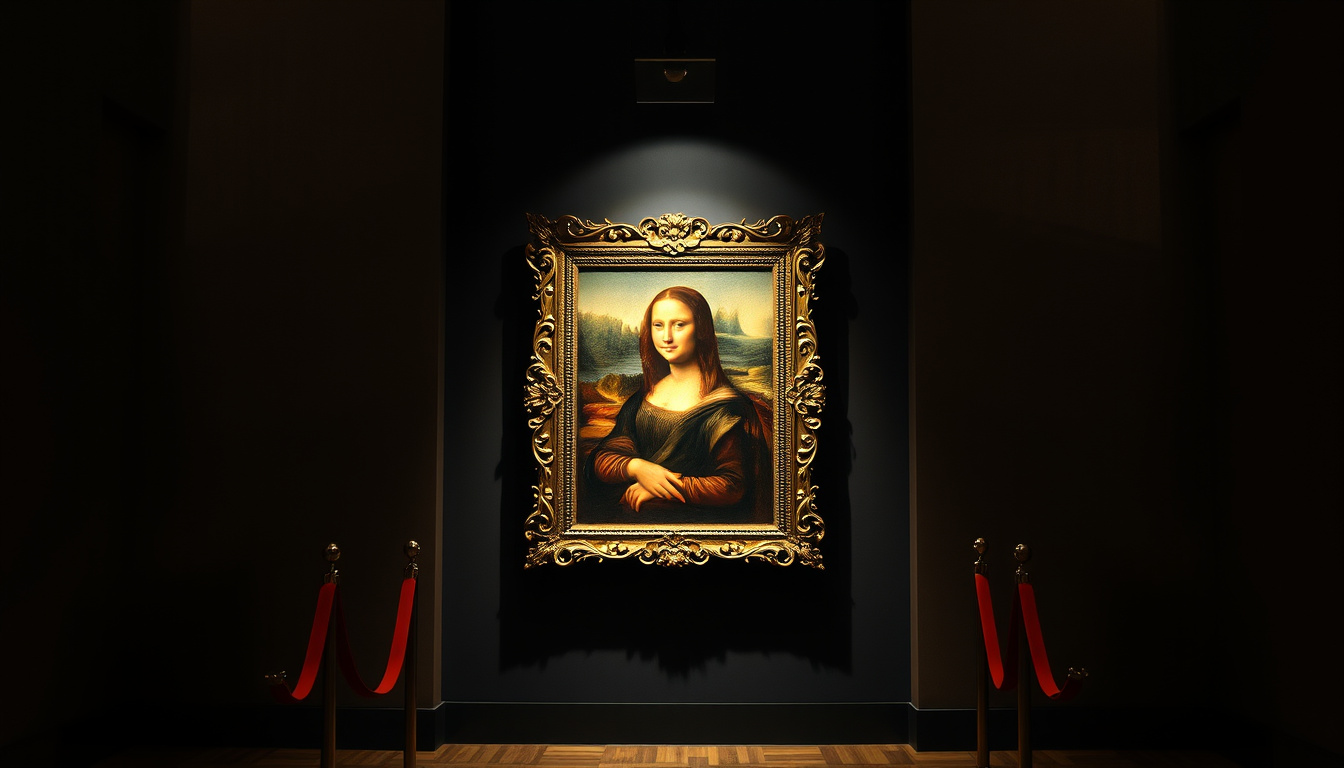
You know her smile. You’ve seen the crowds at the Louvre. But the real story of the Mona Lisa is less about artistic genius and more about a daring heist, a century of marketing, and a mystery that just won’t quit. This guide unpacks the facts, the value, and the legend behind the world’s most famous painting.
Artist: Leonardo da Vinci ·
Year painted: c. 1503–1519 ·
Medium: Oil on poplar panel ·
Dimensions: 30 in × 21 in (77 cm × 53 cm) ·
Location: Louvre Museum, Paris ·
Subject: Lisa Gherardini
Quick snapshot
- Painted by Leonardo da Vinci (c. 1503–1519) (Wikipedia)
- Subject is Lisa Gherardini, wife of Francesco del Giocondo (Britannica)
- Housed in the Louvre Museum, Paris (Louvre Museum official site)
- Exact year painting started (some say 1503, others 1506) (HISTORY)
- Why the subject lacks eyebrows (overcleaning vs. intentional) (Britannica)
- Meaning of the smile (multiple theories, no consensus) (BBC Culture)
- 1911: Stolen from the Louvre by Vincenzo Peruggia (HISTORY)
- 1913: Recovered in Florence (The New York Times)
- 1956: Damaged by acid attack, then rock thrown (History Hit)
- Remains on permanent display at the Louvre under bulletproof glass (Louvre Museum official site)
- Climate-controlled room installed in 2005 for preservation (The Art Newspaper)
Six key facts about the Mona Lisa, one pattern: most of what people think they know came after the theft, not before.
| Label | Value |
|---|---|
| Artist | Leonardo da Vinci |
| Year | c. 1503–1519 |
| Medium | Oil on poplar panel |
| Dimensions | 30 × 21 in (77 × 53 cm) |
| Location | Louvre Museum, Paris |
| Subject | Lisa Gherardini |
The Mona Lisa is simultaneously priceless and effectively unsellable. No legal market exists for it, yet its cultural value keeps climbing.
What is so special about Mona Lisa?
The Enigmatic Smile
- The smile is famously ambiguous: some see happiness, others melancholy (BBC Culture)
- Da Vinci used sfumato — a technique of blending tones so subtly that the edges blur (Britannica)
- Neuroscience studies suggest the smile appears to change depending on where you look (Nature)
Innovative Technique of Sfumato
- Sfumato literally means “evaporated” in Italian — Da Vinci applied dozens of thin, translucent layers (Britannica)
- This technique creates a lifelike, atmospheric quality that makes the subject appear to breathe (Smithsonian Magazine)
Cultural Icon Status
- The painting’s fame skyrocketed after the 1911 theft, turning it into a global news story (HISTORY)
- It has appeared in movies, songs, ads, and conspiracy theories, becoming a pop-culture shorthand for mystery (BBC Culture)
- The Louvre reports over 6 million visitors per year who come to see it (Louvre Museum official site)
The pattern: the Mona Lisa’s fame is as much a product of modern media as it is of Renaissance skill.
The theft transformed a respected Renaissance portrait into a global phenomenon. Without Vincenzo Peruggia walking out of the Louvre in 1911, the Mona Lisa might still be a niche art-history footnote.
The implication: the Mona Lisa’s specialness is as much about modern media as it is about Renaissance skill.
How much is the Mona Lisa painting worth?
Why the Mona Lisa Is Priceless
- The painting has never been sold and is generally considered priceless — it cannot legally leave French state ownership (History Hit)
- In 1962, it was valued at $100 million for insurance purposes — an enormous sum at the time (History Hit)
- Later inflation-adjusted estimates push that value past $800 million today (History Hit)
Comparison to Most Expensive Paintings
- The most expensive painting ever sold at auction is Salvator Mundi (attributed to Da Vinci) at $450.3 million in 2017 (Christie’s)
- Some online estimates put the Mona Lisa’s hypothetical value at $2–3 billion — but these are speculative (Bonjour Paris)
Insurance and Security Costs
- The painting is not currently insured — the premium would be prohibitively expensive (Smithsonian Magazine)
- Security includes bulletproof glass, climate control, and constant surveillance (Louvre Museum official site)
The catch: pricelessness means no buyer can ever own it, but the cost of keeping it safe falls entirely on the Louvre and French state.
The trade-off: pricelessness means no buyer can ever own it, but it also means the cost of keeping it safe falls entirely on the Louvre and French state.
What is the real story behind the Mona Lisa?
Commission and Subject
- The subject is widely accepted as Lisa Gherardini, the wife of Florentine silk merchant Francesco del Giocondo (Britannica)
- Italian scholar Giorgio Vasari wrote in 1550 that Da Vinci painted “a portrait of Mona Lisa” (Britannica)
- Some scholars debate whether the subject is truly Lisa Gherardini — alternative identities have been proposed (HISTORY)
Theft in 1911
- On August 21, 1911, the painting was stolen from the Louvre by Vincenzo Peruggia, a former Louvre handyman (HISTORY)
- The theft was discovered the next day when painter Louis Béroud arrived to sketch it (Wikipedia)
- The crime sparked a massive investigation, with suspects including poet Guillaume Apollinaire and Pablo Picasso (Wikipedia)
Vandalism and Protection
- In 1956, a man threw acid at the painting, damaging the lower portion (History Hit)
- Later that year, a rock was thrown, shattering the protective glass (History Hit)
- Since 2005, the painting has been housed in a specially designed, climate-controlled room behind bulletproof glass (The Art Newspaper)
Recovery and Reunification
- Peruggia hid the painting for about two years before trying to sell it through a Florentine art dealer (The Art Newspaper)
- It was recovered in December 1913 in Florence (The New York Times)
- Peruggia reportedly demanded 500,000 lire (about $100,000 at the time) for its return (Vanity Fair)
The pattern: every act of vandalism or theft has paradoxically increased the painting’s fame and security costs.
The 1911 theft is the single event that turned a respected painting into a global obsession — without it, the Mona Lisa’s fame would likely be a fraction of what it is today.
How old is Mona Lisa in real life?
Date of Birth of Lisa Gherardini
- Lisa Gherardini was born in 1479 in Florence (Britannica)
- She married Francesco del Giocondo at age 15 or 16 (HISTORY)
- She died in 1542 at the age of 63 (Britannica)
Age at Time of Painting
- If the painting started in 1503, she would have been about 24 years old (Britannica)
- Da Vinci worked on the portrait for over a decade, so she would have aged throughout the process (HISTORY)
Controversies About Her Identity
- Some theories suggest the painting may be a self-portrait of Da Vinci in disguise (Smithsonian Magazine)
- Others propose it could be a portrait of Duchess Isabella of Aragon (HISTORY)
- The scholarly consensus, however, firmly supports Lisa Gherardini as the subject (Britannica)
The catch: we know her birth year and death date, but the age she appears in the painting is still debated because the exact start year is uncertain.
What are 5 facts about the Mona Lisa?
Fact 1: The Painting Never Left France
- Leonardo da Vinci gave the painting to King Francis I of France shortly before his death in 1519 (Britannica)
- It has been in French royal or state possession ever since, except for the two years it was stolen (HISTORY)
Fact 2: It Has No Eyebrows
- The Mona Lisa lacks visible eyebrows — a feature that has puzzled art historians for centuries (Britannica)
- Possible explanations include overcleaning during restoration or an intentional stylistic choice (HISTORY)
- A French engineer claimed in 2007 that the Mona Lisa originally had eyebrows, based on high-resolution scans (BBC News)
Fact 3: Different Versions Exist
- An earlier version, known as the Isleworth Mona Lisa, exists and some argue it was also painted by Da Vinci (HISTORY)
- The vast majority of scholars consider the Louvre version the original and the Isleworth version a later copy (Britannica)
Fact 4: It Inspired a Song and a Movie
- Nat King Cole’s 1950 song “Mona Lisa” became a hit and won an Academy Award for best original song (Smithsonian Magazine)
- The painting has been referenced in countless films, including The Da Vinci Code (2006) (BBC Culture)
Fact 5: It Lives Behind Bulletproof Glass
- After the rock-throwing incident in 1956, the painting was placed behind bulletproof glass (History Hit)
- In 2005, the Louvre moved it to a new, climate-controlled room with state-of-the-art security (The Art Newspaper)
The implication: each of these facts adds a layer to the mythos, making the painting as much a cultural phenomenon as an artistic one.
Visitors to the Louvre will see a small, dark portrait behind thick glass — not a dazzling spectacle but a relic whose fame far exceeds its visual impact. The experience is about the story, not the paint.
Timeline signal of the Mona Lisa
- c. 1503–1519: Leonardo da Vinci paints the Mona Lisa (Britannica)
- 1519: Leonardo dies; painting enters French royal collection (Britannica)
- 1797: Mona Lisa is hung in the Louvre after the French Revolution (HISTORY)
- 1911: Painting stolen by Vincenzo Peruggia; missing for two years (HISTORY)
- 1913: Recovered in Florence; returned to Louvre (The New York Times)
- 1956: Subject to acid attack and later rock thrown; placed behind glass (History Hit)
- 2005: Moved to a specially designed, climate-controlled room (The Art Newspaper)
Clarity check: what we know and what remains unclear
Confirmed facts
- Mona Lisa was painted by Leonardo da Vinci (Britannica)
- Subject is Lisa Gherardini (consensus among major historians) (Britannica)
- Painting is housed in the Louvre Museum, Paris (Louvre Museum official site)
- It was stolen in 1911 and recovered in 1913 (HISTORY)
What’s unclear
- Exact year painting started (1503 vs. 1506) (HISTORY)
- Why the subject lacks eyebrows (overcleaning vs. intentional) (Britannica)
- Meaning of the smile (multiple theories, no consensus) (BBC Culture)
Perspectives from those who know the painting
“The picture was valueless in the hands of a private individual.”
— Louvre assistant curator (as quoted in Slate)
“The theft made the Mona Lisa famous.”
— HISTORY
“Over 6 million visitors per year come to see it at the Louvre.”
— Louvre Museum official site
theguardian.com, noiser.com, sortiraparis.com, history.com, pressipiste.fi
For a deeper look into the painting’s dramatic history, including the Mona Lisas theft and mystery, this guide offers a comprehensive account.
Frequently asked questions
Is the Mona Lisa a portrait of a real person?
Yes, the scholarly consensus is that the subject is Lisa Gherardini, the wife of Florentine silk merchant Francesco del Giocondo (Britannica).
Did Leonardo da Vinci paint the Mona Lisa?
Yes, the painting is universally attributed to Leonardo da Vinci, who worked on it from c. 1503 until 1519 (Britannica).
Why is the Mona Lisa protected by bulletproof glass?
After a rock-throwing incident in 1956, the painting was placed behind bulletproof glass for protection (History Hit).
Has the Mona Lisa ever been damaged?
Yes. In 1956, vandals threw acid and later a rock at the painting, causing minor damage to the lower portion and shattering the protective glass (History Hit).
How many people visit the Mona Lisa each year?
The Louvre reports over 6 million visitors per year, with most coming specifically to see the Mona Lisa (Louvre Museum official site).
What is the Mona Lisa’s real name?
The painting’s real subject is Lisa Gherardini, which is why the painting is sometimes called La Gioconda or Monna Lisa in Italian (Britannica).
How long did it take to paint the Mona Lisa?
Da Vinci worked on the painting from c. 1503 until his death in 1519 — roughly 16 years, though not continuously (Britannica).
For the Louvre, the Mona Lisa is both a priceless asset and a security headache — the cost of protecting it from vandals, thieves, and millions of selfie-takers is high, but the alternative would be a cultural disaster. Visitors face a choice: line up for a brief glimpse of a small, dark painting, or skip the queue and read about it instead — the experience is mostly in the story anyway.
Related stories





Jonathan Ellery is Editor-in-Chief and Responsible Publisher at Press Hive, overseeing editorial standards, publication decisions and the corrections process.