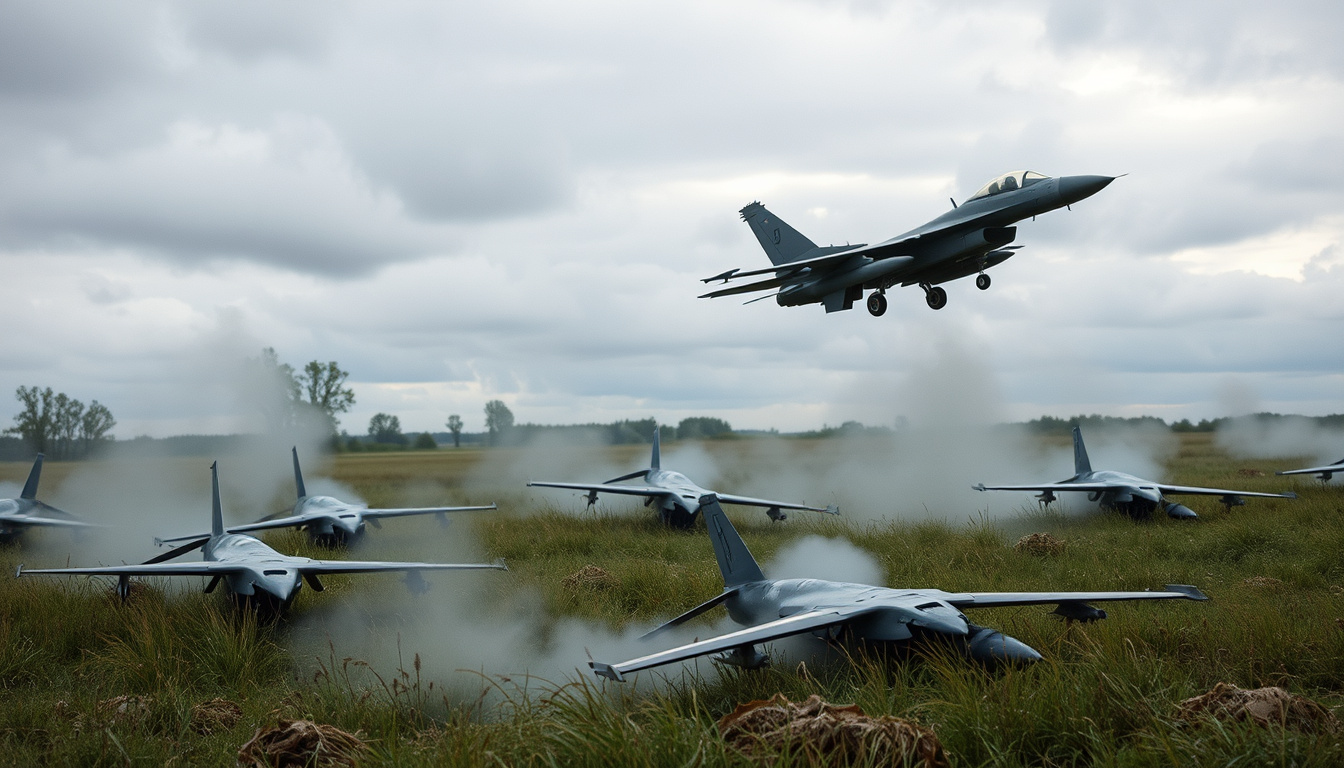

When a Ukrainian MiG-29 fires a JDAM-ER bomb at a Russian drone operator base 90 kilometers behind the front line, it is the clearest signal yet that NATO aircraft can do what Soviet jets were never designed for. Western-supplied F-16s have logged more than 1,300 interceptions since their July 2024 arrival, while Norway’s promised jets still sit in maintenance hangars awaiting repairs.
Russian drones launched overnight: 144 ·
Ukrainian air defenses neutralized: 124 ·
Killed in Russian attacks past day: At least 8 ·
Injured in Russian attacks past day: 21 ·
Russian strikes in Dnipro: At least 5 killed
Quick snapshot
- 124 drones neutralized (Kyiv Independent)
- 10 F-16s arrived July 31, 2024 (Wikipedia)
- Belgium pledged 30 F-16s (Wikipedia)
- Exact F-16 numbers currently operational
- Current MiG-29 fleet size
- Full combat readiness of Norwegian F-16s
- MiG-29 JDAM-ER strike on Novopetrivka base
- Norway PM statement April 15, 2026
- Belgium F-35 delivery mid-2025
- Norwegian F-16 repairs continuing
- Poland MiG-29 swap under discussion
- Additional F-16 deliveries possible 2026
| Metric | Value |
|---|---|
| Drones launched by Russia | 144 overnight |
| Intercepted by Ukraine | 124 |
| Fatalities from attacks | At least 8 |
| Injuries reported | 21 |
How many F-16s does Ukraine have left?
Ukraine’s F-16 fleet remains a number in flux, but the broad strokes are documented. The first batch of 10 aircraft arrived on July 31, 2024, with a total of 20 by year’s end, according to the F-16 training coalition data tracked by Wikipedia. The Netherlands pledged 18 jets in December 2023, while Belgium committed 30 more the following May.
Recent losses and deliveries
Belgium received its first F-35 in June 2025 and plans to phase out F-16s by 2028, which could free additional airframes for Ukraine in 2026, Euromaidan Press reports. Norway’s situation is less straightforward: Prime Minister Jonas Gahr Støre confirmed on April 15, 2026, that ownership transferred to Ukraine but the jets require extensive repairs, United24 Media documented. The best Norwegian aircraft were sold to Romania, leaving degraded airframes behind.
Air Force operational status
According to Pentagon assessments cited by Air & Space Forces Magazine, initial operating capability was expected by the end of 2024. Ukraine’s Air Force officially operates F-16s in combat since the 2022 invasion, with pilots trained at the 162nd Wing in Arizona and programs led by Denmark. Ukraine’s F-16s reportedly intercepted over 1,300 Russian missiles and drones since introduction, per footage analyzed by military analysts. The jets also reportedly destroyed more than 300 ground targets including command posts, ammunition depots, and UAV sites.
The implication: Ukraine’s F-16 numbers are growing but delivery timelines remain uneven. Belgium’s F-35 transition creates a window for additional aircraft, while Norway’s repair backlog underscores the gap between pledged and operational hardware.
How many MiG-29s does Ukraine have?
Ukraine inherited a substantial MiG-29 fleet from Soviet-era stocks, and these aircraft have evolved into precision-strike platforms rather than pure air-combat machines. The Ukrainian Air Force receiving F-16AM and Mirage 2000-5F for air superiority by 2026, as Kyiv Post reported, suggests the MiG-29 role is shifting toward ground attack.
Current inventory
Both Ukraine and Russia deployed MiG-29s early in the conflict for air superiority and ground attack roles. Polish MiG-29s have entered the picture: Poland proposes swapping its aging fighters for Ukrainian advanced drone and missile technology, per Defense Magazine. The proposal remains under discussion with no finalized timeline.
Recent combat use
Video evidence shows a Ukrainian MiG-29MU1 conducting a precision strike on a Russian drone operator base of the 114th motorized rifle regiment in Novopetrivka, Mykolaiv region, using a JDAM-ER bomb at ranges between 90 and 100 kilometers from the front line. Ukrainian drones also reportedly struck Russian air defense platforms including S-300V, Buk, Tor, Pantsir systems, radars, and electronic warfare Palantin equipment in the Zaporizhzhia region.
What this means: The MiG-29 has become a delivery system for Western precision munitions rather than a dogfighter. Whether Poland follows through on its swap proposal could determine whether Ukraine’s MiG-29 fleet grows or shrinks over the next 18 months.
Does Ukraine have any fighter jets?
Ukraine operates multiple fighter jet types simultaneously, a mix of aging Soviet designs and newer Western platforms. The fleet includes F-16AM variants, MiG-29s in various configurations, and incoming Mirage 2000-5F aircraft expected by 2026, Kyiv Post confirmed.
F-16 and MiG-29 fleets
Ukrainian pilots trained in the United States at the 162nd Wing in Arizona, with European training led by Denmark, according to Air & Space Forces Magazine. The transition from Soviet MiG and Sukhoi fighters to Western platforms required 5 to 9 months of training per pilot.
Operational readiness
Ukraine’s F-16s developed new tactics, reportedly flying low and using drones as decoys to evade Russian air defenses including MiG-31, Su-35, and Su-57 aircraft. Military Watch Magazine documented how Ukrainian pilots abandoned high-altitude NATO-style operations for low-flying, drone-screened missions. Russian air defenses appear vulnerable to low-speed, low-altitude drones that screen F-16 sneak attacks.
The pattern: Ukraine’s fighter fleet is smaller than Russia’s but more tactically adaptable. Western jets bring precision weapons; MiG-29s bring numbers and operational familiarity.
Is the Russian army stronger than Ukraine?
Raw numbers favor Russia, but capability gaps complicate the comparison. According to footage analyzed by military analysts, Russia has reportedly lost 434 planes and 347 helicopters since the February 2022 invasion, though Ukrainian sources have every incentive to inflate these figures and independent verification remains limited.
Manpower and equipment comparison
Russia retains numerical superiority in aircraft, armor, and artillery, but the quality of its forces has degraded. First Russian MiG-29 claimed destroyed by Ukraine since the full-scale invasion remains contested — The War Zone noted the target may have been a carrier-based version or a decoy, underscoring how difficult targeting attribution remains.
2026 projections
The F-16 coalition aimed for initial operating capability by 2024, per Pentagon official Celeste Wallander, Air & Space Forces Magazine reported. Whether Ukraine reaches full capability before Russian air defenses integrate newer systems will shape the balance through 2026.
The trade-off: Russia’s mass produces problems for Ukraine; Ukraine’s technology produces problems for Russia. Neither side can easily scale what the other has.
How weakened is Russia’s military?
Assessing Russian weakness requires separating confirmed losses from estimates. The footage of a MiG-29MU1 striking a Russian drone base in Novopetrivka, combined with Ukrainian drone operators stopping a Russian infantry assault on the Novopavlovsk direction after they tangled in wire obstacles, suggests Russian ground forces face tactical vulnerabilities even where they hold local superiority.
Casualties and losses
Ukraine’s Ministry of Finance claims Russia lost 434 planes and 347 helicopters since the invasion, per military analysts citing the data. The War Zone urges caution on individual claims, noting that some destroyed aircraft may have been decoys or non-combat variants.
Performance assessments
Russian air defenses have proven vulnerable to the low-speed, low-altitude drone tactics Ukraine employs. Ukrainian drones struck S-300V, Buk, Tor, Pantsir, and Palantin electronic warfare systems in Zaporizhzhia, per available footage. Whether Russia can replenish degraded systems faster than Ukraine can target them will determine whether Russian air defenses hold or collapse regionally.
Why this matters: Russia’s equipment losses are real but incomplete. The gap between “lost” and “replaced” determines whether attrition translates to tactical advantage. Ukraine’s targeting of air defenses suggests Kyiv is betting on the former.
| Platform | Origin | Primary role | Key capability | Status |
|---|---|---|---|---|
| F-16AM | USA / NATO donors | Air superiority / precision strike | JDAM-ER, AIM-120 missiles | Operational since July 2024 |
| MiG-29MU1 | Soviet-era stock | Ground attack / drone base strikes | JDAM-ER at 90-100km range | Active combat use |
| Mirage 2000-5F | France (expected) | Air superiority | Missile complement TBD | Delivery expected by 2026 |
| Norwegian F-16s | Norway | Multirole | Requires repairs before deployment | Delayed pending maintenance |
How strong is Russia’s military right now?
Russia maintains quantitative advantages in aviation, armor, and artillery, but these advantages shrink when quality matters. The Pentagon expected Ukraine’s F-16 initial operating capability by end of 2024, Air & Space Forces Magazine reported, and Ukrainian pilots have reportedly used F-16s as decoys to bait Russian missiles. If Russia cannot distinguish real F-16s from drone screens, its air defense economy suffers disproportionate wear.
The catch: Russia still fields Su-35 and Su-57 aircraft that outperform Ukrainian jets in sustained air combat. The MiG-29’s JDAM-ER reach gives Ukraine stand-off strike options, but without air superiority, those strikes require drone screening that consumes operational tempo.
What is Putin’s nickname in Ukraine?
President Vladimir Putin is widely referred to as “the war criminal” or “the aggressor” in Ukrainian official communications, though this reflects political characterization rather than a standardized nickname. Ukrainian media and government statements consistently frame Putin by his actions rather than by a specific moniker.
The catch: Names carry weight in wartime. Ukraine’s refusal to use traditional honorifics reflects the degree to which Putin’s invasion severed personal and national relations.
Is SU-35 better than F-35?
The SU-35 and F-35 are fundamentally different aircraft serving different doctrinal purposes. The SU-35 is a heavily upgraded Soviet-era design optimized for air superiority within visual-range combat envelopes, while the F-35 is a stealth multirole platform designed to detect and engage adversaries before they know it is present. Ukraine does not operate F-35s; its F-16 fleet consists of older Block 15/20 variants without stealth features.
Why this matters: Comparing SU-35 to F-35 misses the point — Ukraine flies F-16s against Russian SU-35s under conditions where detection range, tactics, and support systems matter more than airframe generation.
What happened to Putin’s wife?
Vladimir Putin’s wife, Lyudmila, announced their divorce in 2014 after three decades of marriage. She has maintained a low public profile since then, and reports from Russian opposition media suggest she resides in Russia with limited involvement in political affairs.
The paradox: While Ukrainian media documents battlefield developments, personal details about the Russian leadership remain largely peripheral to operational analysis. Military capability matters more than marital status.
Why does Putin walk differently?
Public speculation about Putin’s gait has circulated in Western media, with various theories ranging from muscle disorders to scripted performance. No clinical information has been officially confirmed, and the Kremlin has not addressed health rumors directly.
The trade-off: Analyzing a foreign leader’s physical presentation risks substituting gossip for substance. Military analysts focus on capability, not character — what a leader can command matters more than how they walk.
Ukraine breaking news today
Today’s operational picture shows Russia launching 144 drones overnight, with Ukrainian air defenses neutralizing 124 of them. Attacks in the Dnipropetrovsk region claimed at least eight lives and injured 21 others. The MiG-29 strike on the Russian drone base at Novopetrivka and ongoing Norwegian F-16 maintenance delays represent the two threads that will determine Ukraine’s air capacity through 2026.
The implication: For Ukraine’s Air Force, the path forward is clear: accelerate F-16 operations while preserving MiG-29s as low-risk strike platforms. For Norway and Belgium, the choice between timely transfers and operational readiness has become an open question their defense ministries have yet to answer.
Upsides
- 124 of 144 Russian drones intercepted overnight
- F-16s have intercepted over 1,300 missiles and drones since July 2024
- MiG-29 JDAM-ER strikes extend Ukrainian reach to 90-100 kilometers
- Belgium F-35 delivery opens potential 2026 F-16 transfer window
Downsides
- Norwegian F-16s delayed by repairs with degraded airframes
- Exact current F-16 operational count unconfirmed
- Russia retains numerical aircraft superiority
- Polish MiG-29 swap proposal unresolved
We are aiming to provide an initial operating capability for Ukraine with its F-16 program in 2024.
Celeste Wallander (Pentagon Assistant Secretary, as cited by Air & Space Forces Magazine)
The aircraft have officially been transferred to Ukrainian ownership and are currently undergoing extensive repairs.
Jonas Gahr Støre (Norwegian Prime Minister, April 15, 2026)
Ukraine’s F-16s were supposed to arrive as equals to NATO standards. Instead, pilots rebuilt them into low-flying decoys and drone-screening platforms that Russia’s advanced radars struggle to track. The adaptation cost months but may prove more durable than high-altitude doctrine ever would.
Poland’s MiG-29 swap proposal has not progressed since initial reports, and no timeline exists for Ukrainian drone technology transfers in exchange. If resolved, the deal could add a dozen MiG-29s to the fleet without diverting F-16 maintenance capacity.
For Ukraine’s defense planners, the arithmetic is straightforward: every delivered F-16 adds intercept capacity, every MiG-29 strike preserved extends bomb tonnage without risking Western jets. For NATO donors, the question is whether aircraft condition matters more than delivery speed. Belgium’s F-35 transition and Norway’s maintenance backlog have made that question suddenly practical.
Ukraine’s air war is no longer just about drones — it is a test of whether donated fighter jets can tip a grinding stalemate. The MiG-29 strike on Novopetrivka demonstrates that Soviet-era airframes can still deliver NATO-precision effects, while F-16s prove that Western hardware, despite arriving late and in modest numbers, can still shift operational calculus.
How strong is Russia’s military right now?
Russia maintains numerical advantages in aircraft, armor, and artillery, but quality degradation and drone-vulnerable tactics have exposed operational limits. Air defenses have shown susceptibility to low-altitude drone attacks, and estimated aircraft losses of 434 planes and 347 helicopters since 2022 remain contested but significant.
What is Putin’s nickname in Ukraine?
Ukrainian official communications refer to Vladimir Putin as “the war criminal” or “the aggressor,” reflecting political characterization rather than a standardized nickname. Ukrainian media consistently frames the Russian president by actions rather than a specific moniker.
Is SU-35 better than F-35?
The comparison is doctrinally misaligned. SU-35 is a Soviet-era air-superiority platform; F-35 is a stealth multirole fighter. Ukraine flies F-16 Block variants without stealth features, making direct comparisons to Russian Su-35s about tactics, support systems, and pilot training rather than airframe generation.
What happened to Putin’s wife?
Vladimir Putin’s wife Lyudmila announced their divorce in 2014 after three decades. She has maintained a low public profile since, with reports suggesting residence in Russia. Personal details about the Russian leadership remain peripheral to military operational analysis.
Why does Putin walk differently?
Public speculation about Putin’s gait includes theories of muscle disorders or scripted performance. No clinical information has been officially confirmed. Military analysts focus on command capability rather than physical presentation.
Ukraine breaking news today
Russia launched 144 drones overnight with 124 intercepted; MiG-29 strike on Novopetrivka demonstrated extended Ukrainian strike range. Norwegian F-16 maintenance delays continue to affect delivery timelines.
Related reading: Europe Countries and Regions · Is England a Country
Amid F-16 fleet enhancements and MiG-29 strikes, Ukrainian forces countered with key frontline advances while reclaiming over 480 square kilometers in key sectors.

Amelia Blackwell covers the economy, business and consumer affairs for Press Hive.