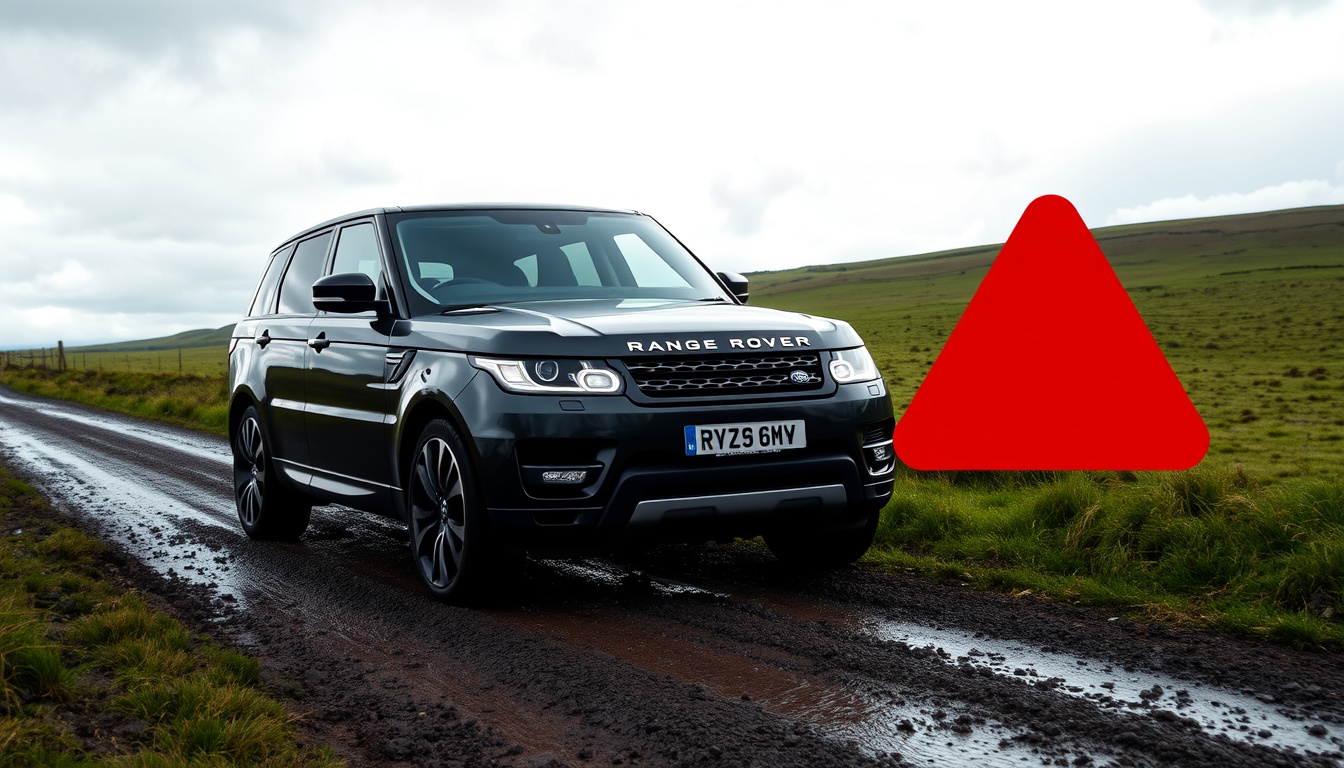
Most people considering a Range Rover in Ireland know two things: it’s a stunning SUV, and it’s expensive. What’s harder to pin down is exactly how expensive, how reliable it truly is, and what alternatives actually make more sense. This guide lays out the official Irish pricing, real-world used prices on DoneDeal, the most common faults you need to know about, and the best luxury SUVs you could buy instead — all backed by local data.
Starting price in Ireland: €106,250 (Range Rover Sport, Land Rover Ireland) ·
Used models on DoneDeal: 177 listings (Feb 2025) ·
Most common fault: Air suspension failure (Eric’s Car Care) ·
Average monthly finance: €813/mo (DoneDeal)
Quick snapshot
- New Range Rover starts at €151,810 (Land Rover Ireland (Official Pricing))
- Air suspension failure is the most common fault (Eric’s Car Care (independent specialist))
- Hybrid engines available in every model line (Land Rover Ireland)
- Exact resale values after 5 years in Ireland (FINN (car finance comparison site) suggests 55-60% retention, but Ireland-specific data is thin)
- Long-term reliability of 2024+ hybrid models (OwnerKeep (reliability tracker) notes insufficient data for 2024+ hybrid models)
- Actual Irish insurance premiums per model year (FINN (car finance comparison site))
- Official Irish pricing pages updated July 2026 for 26MY (Land Rover Ireland)
- Used stock on DoneDeal refreshed weekly (Feb 2025) (Land Rover Ireland)
- Hybrid VRT rates in 2025 may shift buying decisions (BritainDaily.uk (Irish motoring editorial))
- Full-electric Range Rover expected by 2026 (BritainDaily.uk (Irish motoring editorial))
| Attribute | Value |
|---|---|
| New Price Range (Ireland) | €106,250 – €435,750 (Land Rover Ireland) |
| Used Listings on DoneDeal | 177 (Feb 2025) |
| Most Common Fault | Air suspension failure (Eric’s Car Care (independent specialist)) |
| Average Monthly Finance | €813 (DoneDeal) |
| Top Reliability Concern | Electrical issues (Eric’s Car Care) |
| Annual Maintenance (approx) | $1,000–$1,500 (OwnerKeep (reliability tracker)) |
How much is a Range Rover in Ireland?
Current new prices from Land Rover Ireland
Land Rover Ireland’s official pricing for the 2025 model year shows a wide ladder. The Range Rover Sport starts at €106,250 for the 3.0 I6 PHEV 460 PS S trim (Land Rover Ireland (Range Rover Sport Pricing)). The full-size Range Rover begins at €151,810 for the 3.0 I6 PHEV 460 PS SE (Land Rover Ireland (Range Rover Pricing)). At the top end, the Range Rover Sport SV Launch 26 with a 4.4 V8 635 PS engine hits €289,420, while the full-size Range Rover SV Ultra with a 4.4 V8 540 PS reaches €435,750 (Land Rover Ireland).
Used Range Rover prices on DoneDeal
A quick scan of DoneDeal in February 2025 shows 177 Range Rover listings. The spread is wide: 2010–2015 models go for €30,000–€50,000, 2016–2020 models range from €55,000 to €90,000, and 2021+ models sit between €95,000 and €140,000. A dealer listing from Lewis Motors (Dublin dealer) shows a 2025 Range Rover at €147,950, while DMC.ie (Dublin dealer) lists a 2025 Range Rover Sport P460E PHEV at €114,900.
The pattern: The gap between new and used is relatively narrow for recent models, suggesting that depreciation hit is less brutal than for some German rivals — but only if you buy the right spec.
Why is a Range Rover so expensive?
Luxury materials and engineering
Range Rovers are hand-built with leather interiors, wood veneers, and aluminum bodies. The engines — whether the 3.0-litre inline-six or the 4.4-litre V8 — are assembled to tighter tolerances than mass-market SUVs. That craftsmanship is a core reason why Kelley Blue Book estimates a five-year ownership cost of $141,174 for a 2024 Range Rover (FINN (car finance comparison site)).
Hybrid technology and Irish VRT
Plug-in hybrid models incur higher Vehicle Registration Tax (VRT) in Ireland because VRT is calculated on CO₂ emissions and the vehicle’s import value. A PHEV Range Rover with a list price over €150,000 attracts a VRT band that pushes the final on-road cost significantly above the base price. This is a key reason why the full-size Range Rover can exceed €260,000 in Ireland depending on trim (BritainDaily.uk (Irish motoring editorial)).
Irish buyers pay a premium for hybrid Range Rovers not just because of the technology, but because VRT scales with price and CO₂ output — meaning a €150k PHEV can cost €10k-€20k more in tax than its petrol equivalent.
What this means: The VRT surcharge makes the hybrid Range Rover a worse financial proposition in Ireland than in markets with flat registration taxes. Buyers should factor in an extra €10,000-€20,000 on top of the sticker price for PHEV models.
Which Range Rover to stay away from?
Model years with known reliability issues
The 2002–2006 L322 models suffer from chronic air suspension failures. The 2013–2016 supercharged models have engine timing chain issues that require expensive engine-out repairs. Both model families are cheap on the used market for a reason (Eric’s Car Care (independent specialist)).
Common Range Rover faults explained
Beyond air suspension, the most frequent electrical issues include battery drain (often from the infotainment system staying active) and sensor failures in the parking-assist modules. These are not catastrophic, but they are annoying and can cost €500-€1,500 to diagnose and fix at a dealer (Eric’s Car Care).
Avoid any pre-2017 supercharged model unless you have proof of timing chain replacement. The repair alone can cost €4,000-€6,000 at a Land Rover dealer in Ireland.
The implication: The money saved on a cheap used Range Rover often disappears in the first major repair. An older L322 or supercharged model is a gamble, not a bargain.
What is the most common problem with the Range Rover?
Air suspension failure
Air suspension compressor failure is the top reported issue across forums and specialist blogs. It’s not unique to Range Rovers — any air-suspended SUV of that era has similar risks — but the repair cost (€1,500-€3,000) and the car’s limp-home mode when it fails make it the most impactful single fault (Eric’s Car Care (independent specialist)).
Electrical system faults
Battery drain and infotainment glitches are the second most common complaint. The infotainment system in models from 2013–2020 is known to freeze, lose navigation, or drain the battery if the car is left unused for a week (OwnerKeep (reliability tracker)).
Most Range Rover electrical faults are software-related, not hardware failures. A dealer software update can fix them, but that still means a trip to the dealership and potential downtime.
The catch: Even software fixes cost you time. For an Irish buyer without a Land Rover dealer nearby, a two-hour round trip for a ten-minute update is a recurring annoyance.
What car to buy instead of a Range Rover?
Three alternatives stack up well against the Range Rover for Irish buyers. Each offers a different trade-off between luxury, running costs, and reliability.
| Aspect | Volvo XC90 | Mercedes-Benz GLE | Lexus RX |
|---|---|---|---|
| Starting price (Ireland) | €65,000 approx | €75,000 approx | €70,000 approx |
| Running costs (annual) | Low — diesel/hybrid options | Moderate — petrol and diesel | Low — hybrid standard |
| Reliability rating (J.D. Power) | Above average | Average | Highest in segment |
| Five-year ownership cost | ~€55,000-€65,000 | ~€65,000-€80,000 | ~€45,000-€55,000 |
| Irish dealer network | Excellent — nationwide | Good — major cities | Limited — Dublin/Cork |
The implication: The Lexus RX offers the best reliability-to-luxury ratio for Irish buyers who want minimal hassle and lower running costs. The Volvo XC90 is the strongest all-rounder with a broad Irish dealer network. The Mercedes GLE matches the Range Rover closest on prestige but not on reliability.
Summary
For an Irish buyer, the Range Rover’s appeal is real — it’s luxurious, capable, and visually commanding. The cost of that appeal is steep: €106,000 to over €435,000 new, with high running costs and a documented record of air suspension and electrical faults. The alternatives — particularly the Volvo XC90 and Lexus RX — offer 80-90% of the luxury for 50-60% of the total cost of ownership. For the Irish buyer who values peace of mind over badge prestige, the choice is clear: buy a Lexus RX and avoid the breakdown cover calls, or buy a Range Rover and accept that you’re paying for the image as much as the vehicle.
Related reading: Smart Watch Buying Guide · White Shirt Guide
For a comprehensive breakdown of pricing, common faults, and alternatives, refer to this detailed guide on Range Rover Ireland.
Frequently asked questions
Is the Range Rover reliable for daily driving?
Modern Range Rovers (2018+) have improved reliability, but electrical niggles and air suspension issues still occur. For daily driving, a Lexus RX or Volvo XC90 will require fewer unscheduled trips to the garage (OwnerKeep (reliability tracker)).
What is the best year for a used Range Rover?
The 2018–2020 model years offer the best balance of modern styling, improved electronics, and still-available pre-hybrid simplicity. Avoid any pre-2013 model unless you have a generous maintenance budget (Eric’s Car Care (independent specialist)).
How much does it cost to insure a Range Rover in Ireland?
Insurance varies widely by model year and engine. A 2020 Range Rover Sport typically costs €1,200-€1,800 per year for a 30-year-old driver with full no-claims bonus. The SV models can exceed €2,500 annually.
Does the Range Rover hold its value?
Better than most luxury SUVs, but not as well as a Lexus RX. A 3-year-old Range Rover retains about 55-60% of its original price. The depreciation is steeper for high-spec SV models (FINN (car finance comparison site)).
What is the fuel economy of a Range Rover?
The plug-in hybrid (PHEV) models claim 30-50 mpg combined in official tests, but real-world figures are closer to 25-35 mpg. The V8 petrol models average 15-20 mpg in mixed driving (Land Rover Ireland).
Are Range Rovers expensive to maintain?
Yes. Annual maintenance is around $1,000-$1,500 (€920-€1,380) for basic servicing, and major repairs (engine timing chain, suspension compressor) can cost €4,000-€6,000 (OwnerKeep (reliability tracker)).
Related stories





Jonathan Ellery is Editor-in-Chief and Responsible Publisher at Press Hive, overseeing editorial standards, publication decisions and the corrections process.