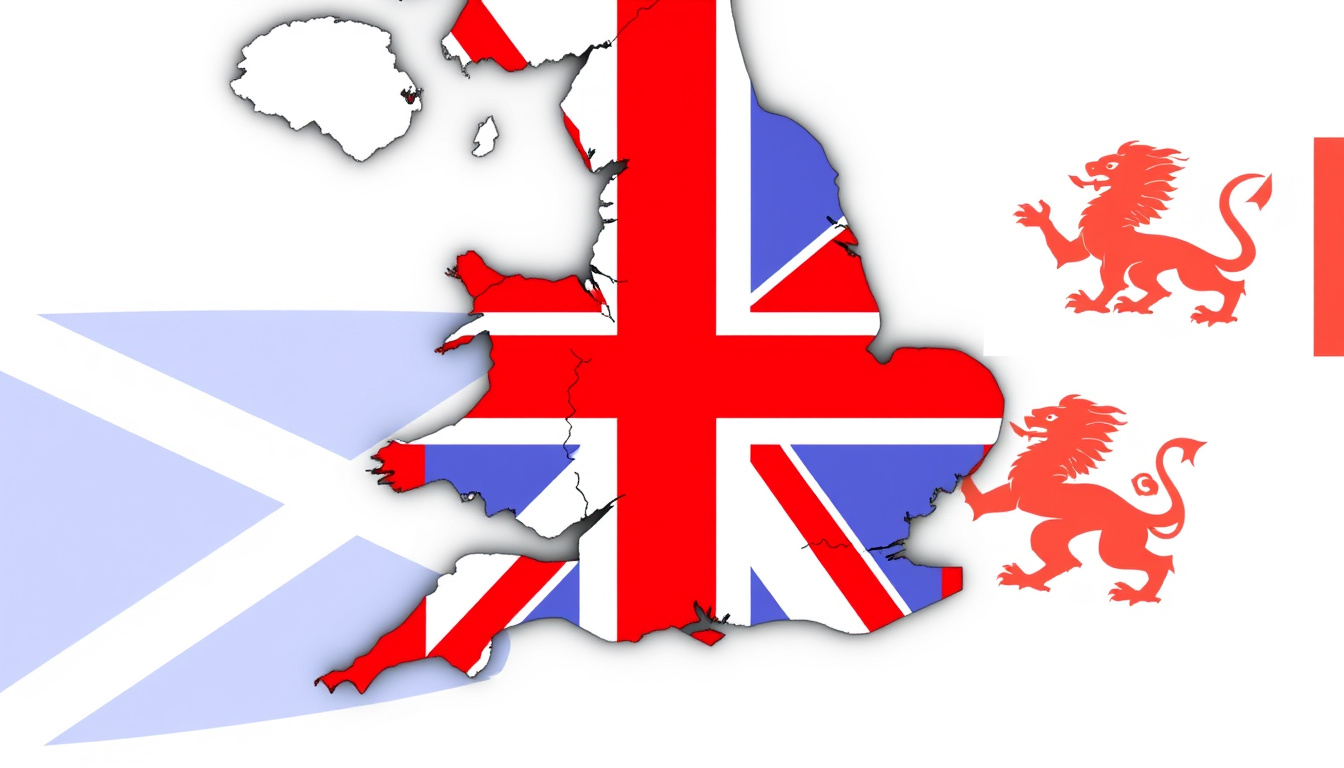

The question of whether England qualifies as a country generates considerable confusion. England occupies a distinctive position in global political geography—it functions as a country in contexts ranging from international sporting competitions to cultural identity, yet it does not possess the sovereignty that typically defines independent states. Understanding this distinction requires examining the structures of the United Kingdom, Great Britain, and the historical unions that shaped the modern political landscape.
England serves as the largest component of the United Kingdom, home to roughly 57 million residents. While the term “country” commonly suggests an independent sovereign nation-state, England’s situation involves shared sovereignty with three other territories under a single parliamentary system. This arrangement stems from centuries of political union, beginning with the 1603 Union of the Crowns and culminating in formal legislative mergers that created the political entity now recognised internationally as the United Kingdom of Great Britain and Northern Ireland.
Is England a Country?
The straightforward answer requires nuance. England possesses country status according to multiple international standards and cultural conventions, yet it lacks the sovereignty that characterises independent nation-states. Under the ISO 3166-2 standard, England receives the subdivision code GB-ENG, acknowledging its distinct territorial identity within the United Kingdom framework.
England qualifies as a constituent country—a term describing territories with distinct cultural and historical identities that operate within a larger sovereign state. This differs from independent countries such as France or Germany, which hold full sovereignty over their affairs.
Key Facts About England’s Status
- England participates independently in major sporting competitions, including FIFA World Cup qualifiers and the Commonwealth Games, using its own national teams.
- The English language, legal system, and cultural traditions represent distinct national characteristics recognised internationally.
- England lacks a separate parliament—governance occurs through the UK Parliament at Westminster.
- Sovereignty ultimately resides with the UK Parliament, which holds authority over foreign affairs, defence, and major fiscal policy.
- While not sovereign, England holds recognised status as one of four constituent countries within the United Kingdom.
- The relationship between England and the UK involves shared governance rather than subordination in traditional colonial terms.
| Entity | Type | Sovereign State? | Approximate Population |
|---|---|---|---|
| England | Constituent Country | No (UK part) | 57 million |
| Scotland | Constituent Country | No (UK part) | 5.5 million |
| Wales | Constituent Country | No (UK part) | 3.1 million |
| Northern Ireland | Constituent Country | No (UK part) | 1.9 million |
| Great Britain | Island/Geographic Term | N/A | 65 million |
| United Kingdom | Sovereign State | Yes | 68 million |
How Many Countries Are in the UK?
The United Kingdom comprises exactly four constituent countries: England, Scotland, Wales, and Northern Ireland. This structure developed through a series of political unions spanning several centuries, with each territory maintaining distinct legal traditions, educational systems, and cultural characteristics while sharing unified governance in matters of national importance.
The Four Nations of the United Kingdom
Each constituent country occupies a specific position within the UK framework. Scotland joined through the Acts of Union 1707, bringing its own legal system and church governance that persist to the present day. Wales experienced legislative incorporation into England through the Laws in Wales Acts 1536–1543, effectively dissolving the Principality of Wales as a separate legal entity while maintaining its cultural distinctiveness.
Northern Ireland’s position emerged following the partition of Ireland in 1921. The Anglo-Irish Treaty of that year created the Irish Free State, while the six counties of Antrim, Armagh, Down, Fermanagh, Londonderry, and Tyrone remained within the United Kingdom, forming Northern Ireland.
The term “United Kingdom” technically refers to the sovereign state established in 1922 following Irish independence. Prior to this, the official name was the United Kingdom of Great Britain and Ireland. The current designation, the United Kingdom of Great Britain and Northern Ireland, reflects the territorial changes that occurred in 1922.
The Distinction Between Sovereignty and Devolution
Devolution represents a fundamental aspect of UK governance, granting limited legislative powers to Scotland, Wales, and Northern Ireland on matters including health services, education, transportation, and local government. The UK Parliament retains supreme authority over foreign policy, national defence, macroeconomic policy, and major taxation decisions.
This arrangement means that while Scottish, Welsh, and Northern Irish voters elect representatives to their respective devolved legislatures, ultimate sovereignty resides at Westminster. England has no equivalent devolved parliament—its governance falls entirely under the UK Parliament.
What Is the Difference Between England and the UK?
The distinction between England, Great Britain, and the United Kingdom represents one of the most common sources of confusion regarding UK political geography. These terms refer to different concepts, and their careful differentiation proves essential for accurate understanding.
Understanding Great Britain
Great Britain constitutes a geographical term describing the largest island in the British Isles, encompassing the territories of England, Scotland, and Wales. Following the Acts of Union 1707, this term acquired political significance as the name of the newly formed kingdom combining England and Scotland. Wales, having been legislatively incorporated into England during the sixteenth century, formed part of this arrangement from its inception.
The Britannica encyclopedia notes that Great Britain specifically excludes Northern Ireland, which only joined the political union following the 1801 Act of Union and remained part of the UK after Irish independence in 1922.
Many people incorrectly use “Great Britain” and “United Kingdom” interchangeably. Great Britain refers exclusively to the island containing England, Scotland, and Wales, while the United Kingdom includes Northern Ireland as well.
The United Kingdom as Sovereign Entity
The United Kingdom functions as the sovereign state recognised internationally, holding membership in the United Nations, European Union (prior to Brexit), NATO, and the Commonwealth of Nations. This sovereign status grants the UK independent authority over foreign relations, defence capabilities, and international treaties.
The ISO 3166-1 standard assigns the code GB to the United Kingdom, while constituent countries receive subdivision codes: GB-ENG for England, GB-SCT for Scotland, GB-WLS for Wales, and GB-NIR for Northern Ireland. This coding system acknowledges the distinct territorial identities within the sovereign UK framework.
Is Scotland (or Wales) a Country?
Scotland and Wales occupy positions analogous to England within the UK structure. Like England, neither Scotland nor Wales constitutes an independent sovereign state. Both possess devolved legislatures with powers varying in scope and depth, yet both remain subject to UK Parliament sovereignty in fundamental matters.
Scotland’s Position
Scotland joined the political union through the Acts of Union 1707, which dissolved the Scottish Parliament and created a unified legislature at Westminster. The Treaty of Union, agreed on 22 July 1706, established the terms of this merger, including provisions preserving Scots law and the Church of Scotland.
Devolution returned a separate Scottish Parliament in 1999, granting legislative authority over health, education, transportation, and civil law matters. The 2014 independence referendum saw Scottish voters reject separation by a 55 to 45 percent margin, with 55.7 percent choosing to remain within the United Kingdom.
Wales’ Status
Wales experienced a different historical trajectory. The Laws in Wales Acts 1536–1543 formally incorporated Wales into the English legal system, eliminating Welsh law and governance structures. This integration differed fundamentally from Scotland’s union, which preserved distinct legal traditions.
The Welsh Senedd, established in 1999, exercises devolved powers over areas including local government, education, health, and Welsh language affairs. The Senedd’s authority continues evolving through subsequent legislation expanding Welsh legislative competence.
Does England Have Its Own Government?
England operates without a separate devolved parliament, placing it in a distinctive position compared to Scotland, Wales, and Northern Ireland. All matters pertaining to England—including health services through the National Health Service, education policy, and transportation—fall under the jurisdiction of the UK Parliament at Westminster.
This arrangement generates what political observers term the “West Lothian question”—the anomaly whereby Scottish, Welsh, and Northern Irish MPs in Westminster can vote on matters affecting only England, while English MPs possess no equivalent influence over the exclusively devolved matters of other constituent countries.
The English Votes for English Laws Procedure
Attempts to address this imbalance led to the introduction of the English Votes for English Laws (EVEL) procedure in 2015. Under this mechanism, bills affecting solely English constituencies require explicit approval from English MPs before proceeding to final vote. However, critics argued the procedure remained incomplete, and the mechanism was abolished in 2021.
The fundamental governance structure means England relies entirely on the UK Parliament for legislation, with no separate chamber capable of passing laws applicable only to English territory. The New Mpox Strain England – Clade Ib Cases, Risks and UK Response provides current examples of how UK-wide responses operate across all constituent countries.
England’s Capital and Administrative Structure
London serves as England’s capital city, a role it has held since the medieval period. Beyond being the seat of English and UK government, London functions as a global financial centre and the largest urban area in the United Kingdom. Regional governance in England operates through combined authorities and local councils rather than a unified regional parliament structure.
A Timeline of UK Formation
The political entity now known as the United Kingdom emerged through a series of legislative unions and subsequent partitions. Understanding this chronological development illuminates why England occupies its current ambiguous position within the UK structure.
- 1603 – Union of the Crowns: James VI of Scotland ascended to the English throne following Elizabeth I’s death, creating a personal union between the two kingdoms under shared monarchy.
- 1707 – Acts of Union: The Parliaments of England and Scotland each ratified the Treaty of Union, effective 1 May 1707. This legislative merger created the Kingdom of Great Britain, dissolving both predecessor parliaments and establishing Westminster as the unified legislature.
- 1801 – Act of Union with Ireland: Effective 1 January 1801, this legislation united Great Britain with the Kingdom of Ireland, creating the United Kingdom of Great Britain and Ireland. The merger incorporated Ireland’s parliamentary representation into Westminster structures.
- 1922 – Partition of Ireland: Following the Anglo-Irish Treaty and subsequent Irish War of Independence, twenty-six Irish counties gained independence as the Irish Free State. The remaining six counties formed Northern Ireland, and the UK assumed its current designation as the United Kingdom of Great Britain and Northern Ireland.
- 1998 – Devolution: The Scotland Act 1998, Government of Wales Act 1998, and Northern Ireland Act 1998 established separate devolved legislatures for Scotland, Wales, and Northern Ireland, granting limited legislative powers while maintaining Westminster sovereignty.
The historic documents from 1707 and 1801 remain foundational to understanding UK constitutional arrangements. The Treaty of Union’s terms, including the retention of Scots law and the Church of Scotland’s independence, continue influencing contemporary governance structures.
What Is Clear and What Remains Uncertain
Examining what established sources confirm versus what remains subject to interpretation helps clarify discussions about England’s status and UK governance structures.
Established Information
- England is one of four constituent countries within the United Kingdom.
- The UK operates as a sovereign unitary state under international law.
- Sovereignty rests with the UK Parliament at Westminster.
- England has no separate devolved parliament.
- Great Britain specifically excludes Northern Ireland.
- Devolved legislatures in Scotland, Wales, and Northern Ireland exercise limited powers.
- The ISO assigns GB as the UK country code and GB-ENG for England.
Areas Requiring Nuance
- The precise legal definition of “country” varies across international frameworks.
- Debates continue regarding English governance within the UK structure.
- Independence movements in Scotland and Northern Ireland introduce future uncertainty.
- Post-Brexit dynamics affect devolution balances in complex ways.
- The status of the Crown Dependencies and Overseas Territories falls outside standard constituent country frameworks.
Historical and Political Context
England’s position within the UK reflects centuries of political evolution rather than deliberate constitutional design. The Acts of Union 1707 emerged primarily from economic considerations and dynastic necessity following the death of Queen Anne’s successor, creating arrangements that participants could not have fully anticipated would persist for over three centuries.
The 1707 union dissolved the Parliaments of England and Scotland, yet notably preserved Scotland’s distinct legal system, educational institutions, and religious establishment. This preservation of particularity within unity characterises the UK constitutional approach that continues influencing governance arrangements.
Independence movements persist within the UK framework. Scotland’s 2014 referendum represented the most significant challenge to UK unity, with 55.3 percent choosing to remain part of the United Kingdom. Northern Ireland’s position remains complicated by the legacy of the Troubles and ongoing tensions surrounding the border with the Republic of Ireland following Brexit.
Sources and References
The information presented draws from multiple authoritative sources documenting UK constitutional arrangements and historical records of legislative unions.
The Acts of Union 1707 were two parliamentary acts—one from the Parliament of England and one from Scotland—ratified in 1707 and effective May 1, 1707, implementing the Treaty of Union (agreed July 22, 1706).
— Wikipedia, Acts of Union 1707
The United Kingdom consists of four constituent countries (sometimes called nations), each with distinct identities but under UK sovereignty.
— U.S. Department of State, Background Note: United Kingdom
Sovereignty resides with the UK Parliament, described as incorporating unions where pre-union parliaments ceased to exist; no constituent country holds independent sovereignty.
— Britannica, Acts of Union
Additional authoritative sources include Office for National Statistics demographic data, ISO country codes documentation, and UK Parliament resources on union governance.
Summary
England qualifies as a country under multiple international frameworks and maintains distinct cultural, sporting, and historical identity. However, England does not constitute an independent sovereign state. Sovereignty rests with the UK Parliament at Westminster, which governs all four constituent countries on matters including foreign affairs, defence, and macroeconomic policy.
The United Kingdom combines four territories—England, Scotland, Wales, and Northern Ireland—under a single sovereign framework. Great Britain refers specifically to the island containing the first three. Devolution grants Scotland, Wales, and Northern Ireland limited legislative powers, while England operates entirely under Westminster governance.
This arrangement produces confusion because the word “country” carries different meanings across contexts. In sporting competitions and cultural discussions, England functions as a nation in its own right. In constitutional and international law terms, England operates as a constituent component of a sovereign state.
For further information about Welsh Water Contact Number – Official 2025 Customer Lines and related governance matters, exploring devolved administration contact channels provides practical context for how constituent countries interact with UK-wide services.
Frequently Asked Questions
Does England have its own government?
England does not possess a separate devolved parliament. Governance falls under the UK Parliament at Westminster, though Scotland, Wales, and Northern Ireland each maintain their own devolved assemblies with varying legislative powers.
What is the capital of England?
London serves as the capital city of England and simultaneously functions as the capital of the United Kingdom. The city has held this administrative role since the medieval period.
Is Great Britain a country?
Great Britain is a geographical term referring to the largest island containing England, Scotland, and Wales. It is not a country or sovereign state, though the term acquired political significance following the 1707 Acts of Union.
How many countries are in the United Kingdom?
The United Kingdom comprises four constituent countries: England, Scotland, Wales, and Northern Ireland. Each possesses distinct cultural identities and varying degrees of devolved governance.
Is England a sovereign state?
England is not a sovereign state. Sovereignty rests with the UK Parliament at Westminster, which holds authority over foreign policy, defence, and major taxation. England participates in international contexts as part of the broader UK framework.
What happened to the Scottish Parliament?
The Acts of Union 1707 dissolved the Scottish Parliament, creating a unified legislature at Westminster. A separate Scottish Parliament returned in 1999 following devolution, exercising limited legislative powers over domestically scoped matters.
Why isn’t England a separate country?
England’s position within a union emerged historically through dynastic succession and subsequent legislative merger. The Acts of Union 1707 and 1801 created a unified sovereign state, with sovereignty remaining at Westminster rather than devolving to individual constituent territories.
Can the constituent countries of the UK become independent?
While no current independence referenda are scheduled, Scotland held such a vote in 2014 and Northern Ireland has experienced periodic discussions regarding unification with the Republic of Ireland. The constitutional framework permits such changes through legislative process or referendum.
Related stories





Thomas Hayes covers Westminster, councils and public policy across the United Kingdom.