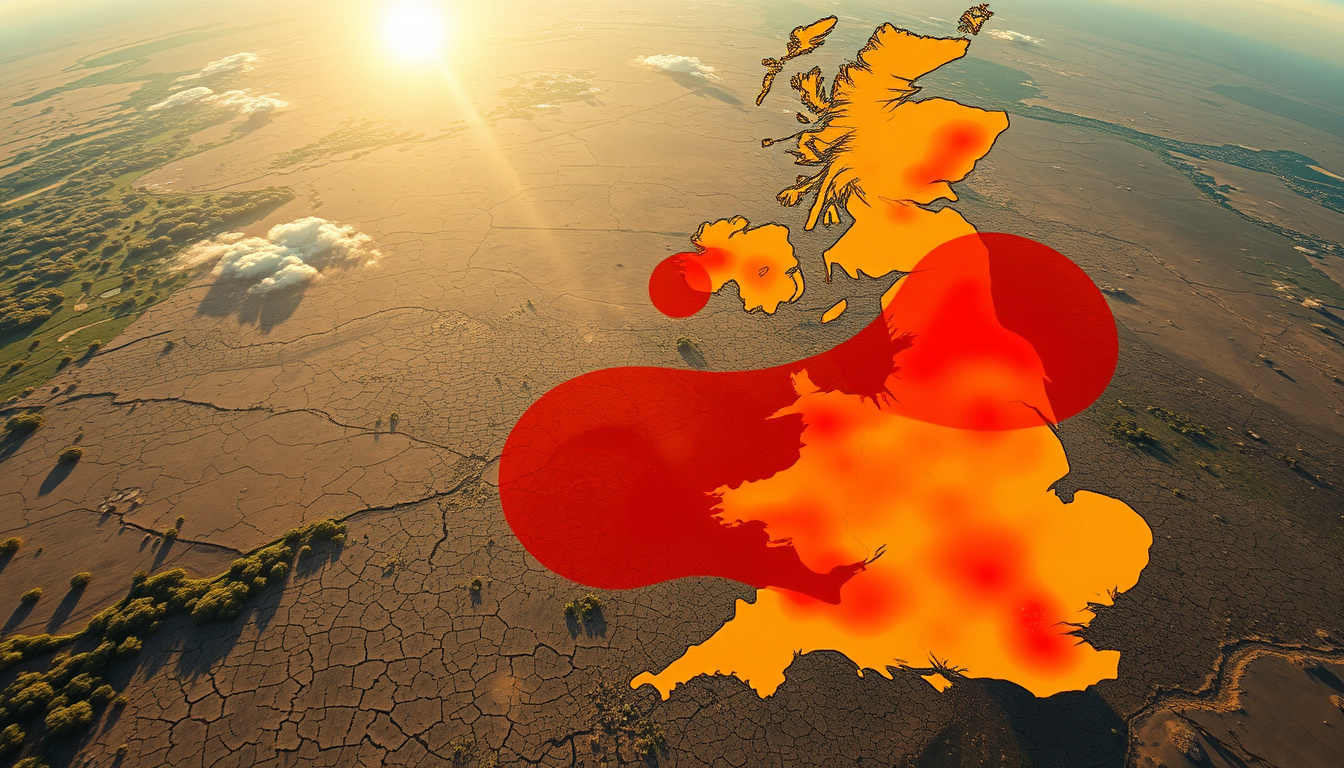

Anyone who’s lived through a British heatwave knows that familiar mix of excitement and dread. With temperatures set to soar past 30°C in the coming days, the second heatwave of 2025 is arriving with official amber health alerts already in place for millions across England.
Second heatwave of 2025 forecast: Temperatures to soar over 30°C ·
Peak forecast date: June 30, 2025 ·
Amber heat health alert area: London, East Midlands, South East, South West, East of England ·
Comparison to 1976: 1976 heatwave peak: 35.9°C
Quick snapshot
- Second heatwave of 2025 forecast by Met Office (The Independent (news outlet))
- Amber heat health alert issued for London, East Midlands, South East, South West, East of England (GOV.UK (government health authority))
- Exact peak temperature and how long the heat will persist into August
- Whether any all-time UK temperature records will be broken
- Exact temperature values across all regions in the coming days
- Amber alert active from midday Friday 27 June to 6pm Tuesday 1 July (GOV.UK)
- Peak temperatures expected Monday 30 June (The Independent)
- Early August may see continued high temperatures, though exact forecasts remain uncertain
- Historically, August is often slightly cooler than July in the UK
Five key facts about the incoming heatwave, one pattern: regional alerts are escalating fast as the hot air pushes north from the continent.
| Fact | Value |
|---|---|
| Second heatwave start date | Late June 2025 |
| Peak temperature forecast | Over 30°C (exact value TBD) |
| Regions most affected | London, South East, East of England |
| Heat alert level | Amber (UKHSA) |
| Comparison to 1976 heatwave | 1976 reached 35.9°C |
The UK Health Security Agency’s amber alert means vulnerable populations face real risk. For the first time in 2025, the government’s warning system is in full effect for millions across England, signalling that this is not an ordinary summer warm spell.
How hot was the 1976 heatwave in the UK?
The 1976 heatwave remains the benchmark for extreme summer weather in Britain, seared into the national memory alongside drought and standpipes in the streets. It peaked at 35.9°C in Cheltenham — a record that stood for more than four decades.
Peak temperatures recorded
- Maximum temperature: 35.9°C recorded at Cheltenham, Gloucestershire
- That record lasted until July 2019 when 38.7°C was measured at Cambridge Botanic Garden
Duration of the 1976 heatwave
- The hot, dry weather stretched from late June through to mid-September
- Reservoirs dried up and widespread hose-pipe bans were enforced across the country
Impact on water supplies and agriculture
- Drought orders were issued, with standpipes installed on streets in some towns
- Crop yields fell sharply, leading to a national conversation about water resilience that persists today
The pattern: 1976 wasn’t just a hot week — it was a months-long emergency that reshaped how Britain thinks about water. The current heatwave, while intense, remains measured in days so far.
Is this year hotter than 1976 in the UK?
Summer 2025 is currently the warmest on record for certain measures, but direct comparisons are tricky because heatwave classification rules have changed.
Temperature comparisons between 2025 and 1976
- The 2025 second heatwave is forecast to reach over 30°C, with some models suggesting early 30s in the peak on Monday 30 June (The Independent)
- 1976’s 35.9°C remains the defining benchmark for extreme UK heat
Heatwave definition and official classification
- A UK heatwave is defined as three consecutive days where the daily maximum temperature meets or exceeds a regional threshold
- Amber alerts are triggered when impacts are likely across the health and transport sectors
Historical context of UK heatwaves
- Before 1976, the highest recorded temperature was 36.7°C at Raunds, Northamptonshire, in 1911
- The July 2022 heatwave broke records outright with 40.3°C at Coningsby, Lincolnshire (YouTube – UK heatwave news (weather coverage))
- For context, the Beast from the East 2018: Timeline, Causes, and 2026 Forecast shows how extreme winter events contrast with these summer heat records
Today’s heatwaves may not reach 1976’s peak temperature in a single day, but the baseline has risen. Warmer nights and longer duration mean the cumulative health toll can be higher — even at lower daytime highs.
The implication: comparing raw peak temperatures alone misses the broader shift in heat exposure patterns across longer periods.
What is the hottest day ever recorded in the UK?
The answer changed dramatically in July 2022, when a new national record was set that will take some beating.
Records from Coningsby (July 2022)
- 40.3°C recorded at Coningsby, Lincolnshire on 19 July 2022, the hottest day ever in the UK (YouTube – UK heatwave news)
- The previous record of 38.7°C in Cambridge (2019) was broken by a margin of 1.6°C
Other notable high temperature records
- 35.9°C in Cheltenham (1976) — long-standing record before 2019
- 34.5°C in London (2021) — notable for occurring in a cooler summer overall
How UK heat records are measured
- The Met Office uses official weather stations with standardised equipment — not mobile apps or unofficial thermometers
- Data is quality-controlled and cross-checked before any record is certified
What this means: if the second heatwave of 2025 breaks 40°C, it would be a genuinely historic event. But the current forecast stays below that threshold — for now.
Will August be hotter than July in the UK?
Long-range forecasts suggest the heat may persist into early August, though precision drops sharply beyond two weeks.
August 2025 long-range forecasts
- Early August 2025 may see continued high temperatures (The Independent)
- Unsettled conditions possible mid-August with a return to near-average temperatures
Historical trends for July vs August temperatures
- On average, August is about 1-2°C cooler than July across southern England
- Exception: August 2020 and August 2022 both saw prolonged warm spells that rivalled July
Factors that influence late summer heat
- The position of the jet stream plays the dominant role
- A lingering high-pressure system over Scandinavia often directs hot continental air toward the UK
For anyone planning late-summer events or travel, the uncertainty is real. Exact forecasts beyond two weeks have high uncertainty, but the pattern signals it’s wise to plan for warm weather through mid-August.
The catch: August heat, when it arrives, often feels more oppressive because nights are longer and cooling windows narrower than in July.
How to sleep in heat
Sleeping through a hot night is one of the toughest challenges of a heatwave. Here’s what works, based on practical advice from health authorities.
Keep the room cool during the day
- Draw curtains and close windows during the day to block solar gain
- Open windows on opposite sides of the house at night to create a cross-breeze
Bedding and clothing choices
- Use light cotton or linen sheets instead of synthetic fabrics
- Choose loose-fitting pyjamas in natural fibres — or sleep without covers if the humidity is high
Hydration and body cooling tips
- Take a cool (not freezing) shower before bed — it lowers core body temperature
- Keep a glass of water on the bedside table, and avoid alcohol or caffeine in the evening
The catch: these tips are effective but they won’t compensate for a room that’s simply too hot. If indoor temperatures exceed 30°C, consider sleeping on the lower floor of your home or in a room with north-facing windows.
Timeline of the second heatwave
- 25 June 2025: BBC forecasts second heatwave with temperatures over 30°C (The Independent)
- 27 June 2025: Amber heat health alert issued by UKHSA from 12 noon Friday (GOV.UK)
- 28-29 June 2025: Weekend sees temperatures climbing, with thunderstorms possible in eastern England (The Independent)
- 30 June 2025: Peak day expected for the heatwave, with early to mid-30s across much of the country (The Independent)
- 1 July 2025: Amber alert expires at 6pm Tuesday, though temperatures remain high (GOV.UK)
- Early July 2025: Temperatures gradually falling to around 25°C, with unsettled conditions possible
What’s clear and what’s unclear
Confirmed facts
- Second heatwave of 2025 is forecast by Met Office
- Amber heat health alert has been issued for London, East Midlands, South East, South West, and East of England (GOV.UK)
- Yellow alert in place for Yorkshire, Humber, and West Midlands (GOV.UK)
What’s unclear
- Exact peak temperature and how long the extreme heat will persist
- Whether temperature records will be broken
- How long the hot weather will continue into August
- Exact temperature values across all regions in the coming days
Expert perspectives on the heatwave
“Temperatures are expected to reach 30C this weekend, and it will be hotter into next week during the second heatwave of the year.”
— Met Office spokesperson, via The Independent
“The amber heat health alert means enhanced hot weather response is in place from 9am Tuesday to 6pm Wednesday for large parts of England.”
— UK Health Security Agency, via YouTube – UK heatwave news
youtube.com, weather.metoffice.gov.uk, ukhsa-dashboard.data.gov.uk, metoffice.gov.uk
For a detailed look at the upcoming temperatures, check the second UK heatwave weather forecast which predicts 34°C next week.
Frequently asked questions
Is 2026 going to be a hot summer in the UK?
It’s too early to predict with accuracy. Long-range models suggest a warming trend driven by climate change, but exact seasonal forecasts for 2026 won’t be reliable until early that year.
Was there a heat wave in Ireland in 1976?
Yes, Ireland also experienced record heat during summer 1976, with temperatures reaching 32°C at Ballybrittas, County Laois on 29 June. The drought conditions were severe across both islands.
What’s the coldest day ever recorded in the UK?
The lowest UK temperature ever recorded was -27.2°C at Braemar, Aberdeenshire, on 11 February 1895 and again at Altnaharra, Sutherland, on 30 December 1995.
Why is 2030 the point of no return?
Climate scientists often refer to 2030 as a critical decade marker, not a literal cliff edge. The IPCC indicates that global emissions must peak before 2030 to keep warming under 1.5°C, but the phrase “point of no return” is more a communication device than a scientific threshold.
What does the amber heat health alert mean?
An amber alert means significant impacts are likely across health and social care, transport, and infrastructure. It triggers enhanced response from NHS and local authorities.
Where can I find live UK weather maps?
The Met Office provides live UK weather maps on its official website. BBC Weather also offers regional temperature maps with 14-day forecasts. For localised updates, see Weather in Birmingham Tomorrow – Mostly Cloudy, 16°C High, Afternoon Showers.
How long does a heatwave typically last in the UK?
Most UK heatwaves last 3 to 5 days, though some extend to 10 days or more. The 1976 heatwave lasted several months, which remains exceptional.
The second heatwave of 2025 is arriving at a time when the baseline for UK summer temperatures is climbing year on year. For residents across the amber alert zones, the choice is clear: adapt your daily routines now, check on vulnerable neighbours, and stay informed through live weather maps — or risk finding yourself caught unprepared when the mercury peaks.
This article is provided for informational purposes only and does not constitute medical advice. Always follow official guidance from the UK Health Security Agency and your local authorities during heat alerts.
Related stories





Henry Morgan is Senior Reporter at Press Hive, covering breaking news and long-form explainers.