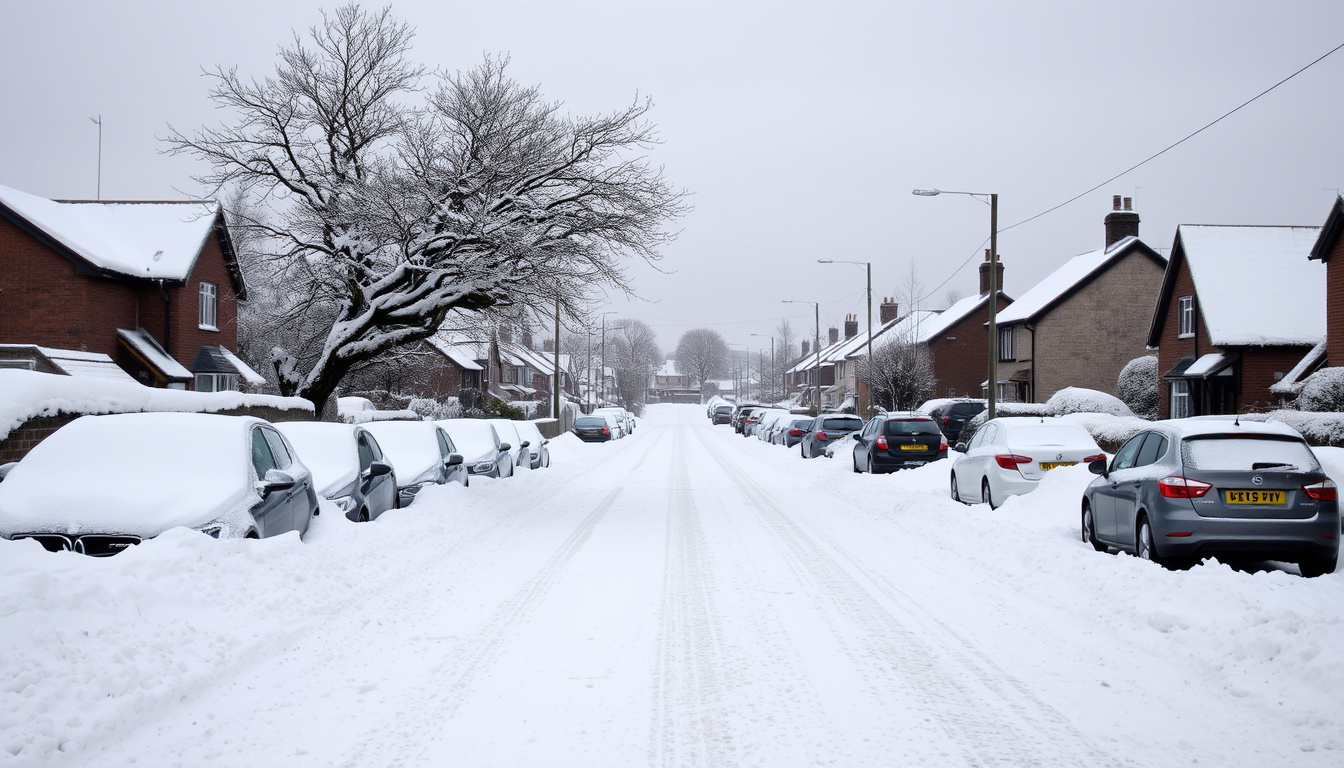

If you lived in Ireland during late February 2018, you likely remember the moment the sky turned grey and the snow started piling up. For two weeks, the country was gripped by a deep freeze that became known as the Beast from the East – a rare combination of meteorological forces that exposed how vulnerable modern infrastructure can be to polar air.
Event Name: Beast from the East (Anticyclone Hartmut) ·
Start Date: 22 February 2018 ·
End Date: 5 March 2018 ·
Lowest Temperature in Ireland: -10°C ·
Snow Depth: Up to 40 cm ·
Fatalities (Europe): At least 80
Quick snapshot
- Beast from the East occurred in Feb–Mar 2018 (Wikipedia)
- It was caused by a sudden stratospheric warming event (Met Éireann (Ireland’s national meteorological service))
- Anticyclone Hartmut was the official name (Wikipedia) (Wikipedia)
- Whether a similar event will occur in 2026
- Exact predictions for future cold spells
- 22 Feb 2018: Onset of cold air (Weather & Radar)
- 28 Feb 2018: Heaviest snowfall (Maynooth University)
- 2–3 Mar 2018: Storm Emma landfall (British Isles Climate Analysis)
- 5 Mar 2018: Thaw begins (no confirmation yet) (Weather & Radar)
- Met Éireann notes cold and wintry conditions in January 2026 (Met Éireann)
- No confirmed Beast from the East yet but possibility exists
Six key facts paint the picture of the 2018 cold wave:
| Label | Value |
|---|---|
| Event Name | Beast from the East (Anticyclone Hartmut) |
| Start Date | 22 February 2018 |
| End Date | 5 March 2018 |
| Lowest Temperature in Ireland | -10°C |
| Snow Depth | Up to 40 cm |
| Fatalities (Europe) | At least 80 |
When was the Beast from the East in Ireland?
The Beast from the East began on 22 February 2018, when a cold air mass from Siberia moved westward under the influence of Anticyclone Hartmut, according to meteorological records compiled by Wikipedia (volunteer-edited encyclopedia). The cold wave lasted into early March, with the most intense phase occurring between 27 February and 4 March. Storm Emma, which made landfall on 2–3 March 2018, amplified the snowfall across southern Ireland and southwest England, as confirmed by Met Éireann (Ireland’s national meteorological service).
Timeline of the cold spell
- 22 February 2018: Cold air begins to move into Ireland (Wikipedia)
- 25 February 2018: Storm Emma approaches
- 28 February 2018: Met Éireann issues first red status warning for entire country (British Isles Climate Analysis (independent weather blog))
- 1 March 2018: An Taoiseach Leo Varadkar urges people to stay indoors from 4pm to 3pm the next day (British Isles Climate Analysis)
- 5 March 2018: Temperatures rise, thaw begins
The implication: The event lasted roughly 12 days, but the peak disruption occurred during a five-day window when both the Siberian cold front and Storm Emma overlapped.
How long did the 2018 Beast from the East last?
The cold wave endured approximately 12 days, from 22 February to 5 March 2018, according to Weather & Radar (meteorological news outlet). The most severe conditions occurred between 27 February and 4 March, when widespread snowfall covered the country and temperatures struggled to rise above freezing. Research from Maynooth University (Irish academic research) notes that the greatest temperature anomaly on 1 March 2018 was -9°C below climatology for Ireland.
Exact duration in days
- Start: 22 February 2018
- End: 5 March 2018
- Peak intensity: 27 February – 4 March
The pattern: The length of the event was driven by the persistence of the blocking high over Scandinavia, which kept the cold air feeding into Ireland until the anticyclone finally broke down.
Is Ireland getting snow in 2026?
As of early 2026, Met Éireann has noted cold and wintry conditions in January 2026, but no official confirmation of a Beast from the East exists. Forecasts suggest a possibility of easterly winds returning, but the exact predictions for future cold spells remain uncertain. According to Met Éireann (Ireland’s national meteorological service), the conditions are being monitored, but a repeat of the 2018 event would require the same rare combination of sudden stratospheric warming and a blocking high.
The trade-off: While short-term forecasts show some chilly signals, the long-term predictability of such extreme cold waves is low. Irish residents should stay informed via official warnings but need not prepare for an imminent 2018-level freeze.
What caused the Beast from the East in 2018?
The primary trigger was a sudden stratospheric warming (SSW) event that occurred on 12 February 2018, according to Met Éireann. This warming weakened the polar vortex, allowing cold air from Siberia to spill westward. At the same time, a persistent area of high pressure (Anticyclone Hartmut) sat over Scandinavia, acting as a barrier that forced the cold air toward the British Isles.
Sudden stratospheric warming
- SSW on 12 February 2018 disrupted the polar vortex (Met Éireann)
- Cold air mass then drifted west across Europe
- Interaction with Storm Emma on 1–3 March brought heavy snow (Met Éireann)
Why this matters: The SSW and blocking high are natural atmospheric patterns, but their coincidence produced a rare and severe event. Climate change is altering such patterns, though the exact influence on future Beast from the East events remains an active research area.
The same mechanics could happen again, but the combination of a strong SSW and a Scandinavian blocking high is statistically uncommon. Irish agriculture and transport sectors face the biggest consequences if it does recur.
What this means: The same mechanics could happen again, but the combination remains rare.
Was 2018 hotter than 1976?
This question refers to the summer heatwaves, not the cold wave. The summer of 2018 was one of the hottest on record in Ireland and the UK, according to Maynooth University (Irish academic research). The 1976 heatwave remains iconic, with a UK record of 35.9°C. While 2018 reached 35.3°C in the UK, the Irish summer of 2018 also saw prolonged high temperatures and drought conditions. Both summers were extreme, but 1976 holds the edge in peak temperature.
The catch: The Beast from the East and the summer 2018 heatwave are linked – the same year featured both extremes, demonstrating how compound events can strain water resources and agriculture.
What was the worst storm ever to hit Ireland?
The Night of the Big Wind (6–7 January 1839) is widely considered the most destructive storm in Irish history, according to Wikipedia (volunteer-edited encyclopedia). It caused catastrophic damage across the island, with thousands of buildings destroyed and many lives lost. By comparison, Storm Emma (2018) was severe but not in the same league: it brought the most significant widespread snowfall since December 2010, as noted by Maynooth University, but fatalities were far lower.
The pattern: While the Beast from the East was a cold wave, not a storm in the traditional sense, its combination with Storm Emma created a multi-hazard event that still ranks among Ireland’s most disruptive weather episodes.
Comparison: Beast from the East vs Other Extreme Events
Four events, one pattern: extreme cold, heavy snow, or both – but with very different scales of impact.
| Event | Type | Peak Impact in Ireland | Fatalities (Ireland/UK) |
|---|---|---|---|
| Beast from the East (2018) | Cold wave + snow | -10°C, 40 cm snow | 17 in UK (at least 80 Europe) |
| Storm Emma (2018) | Winter storm | Heaviest snow since Dec 2010 | Part of above |
| Night of the Big Wind (1839) | Hurricane-force storm | Widespread destruction | Hundreds (estimated) |
| Summer 1976 Heatwave | Heatwave | 35.9°C in UK; drought | Significant (heat-related) |
What this means: Each event had distinct causes and impacts, but the 2018 cold wave remains a recent benchmark.
Timeline of the Beast from the East
- 22 February 2018: Cold air begins to move into Ireland (Wikipedia)
- 25 February 2018: Storm Emma approaches
- 28 February 2018: Met Éireann issues red warning for entire Ireland (British Isles Climate Analysis)
- 1 March 2018: Leo Varadkar urges stay-at-home order
- 2–3 March 2018: Storm Emma landfall, heaviest snowfall
- 5 March 2018: Temperatures rise, thaw begins
The pattern: The timeline shows the rapid escalation from cold air arrival to the peak of Storm Emma, followed by a gradual thaw.
Confirmed facts
- Beast from the East occurred in Feb–Mar 2018 (Wikipedia)
- It was caused by a sudden stratospheric warming event (Met Éireann)
- Anticyclone Hartmut was the official name (Wikipedia)
What’s unclear
- Whether a similar event will occur in 2026
- Exact predictions for future cold spells
Expert perspectives
“Met Éireann has noted cold and wintry conditions in January 2026, but no confirmed Beast from the East yet. The possibility exists but remains uncertain.”
— Met Éireann forecasters (Ireland’s national meteorological service)
“The mechanics of a Beast from the East involve a sudden stratospheric warming that weakens the polar vortex, allowing cold air to spill out from Siberia.”
— Met Office (UK’s national weather service)
For Irish residents, the consequence of the 2018 event is clear: accurate forecasting and preparation are critical, but the risk of a repeat in any given winter is low. The choice for policymakers is to invest in infrastructure resilience, or face the same disruptions again.
Related reading: Weather in Birmingham Tomorrow · What Happened in Liverpool Today
Meteorologists have compared the 2018 event to the the 2018 Beast from the East when analyzing potential return patterns.
Frequently asked questions
What is the Beast from the East?
A cold wave that affected Ireland and the UK in February–March 2018, caused by a sudden stratospheric warming and a blocking high over Scandinavia, bringing Siberian air and heavy snow.
How does the Beast from the East differ from a normal cold front?
A normal cold front passes in a day or two; the Beast from the East lasted 12 days because a blocking high prevented the cold air from moving away.
Can the Beast from the East happen again?
Yes, the same atmospheric setup can occur, but it is rare. Current forecasts for 2026 show some cold signals but no confirmed repeat.
What should I do to prepare for a Beast from the East?
Stock up on food and warm supplies, check on vulnerable neighbours, and stay updated via Met Éireann warnings.
How long did the snow last in Ireland during 2018?
Widespread snow cover remained from around 27 February until 5 March, with drifts persisting in some areas for several more days.
Was the Beast from the East a storm or a cold wave?
It was primarily a cold wave, but it interacted with Storm Emma, making it a compound event of extreme cold and heavy snowfall.

Sophie Marlowe covers culture, lifestyle and society stories across the UK.