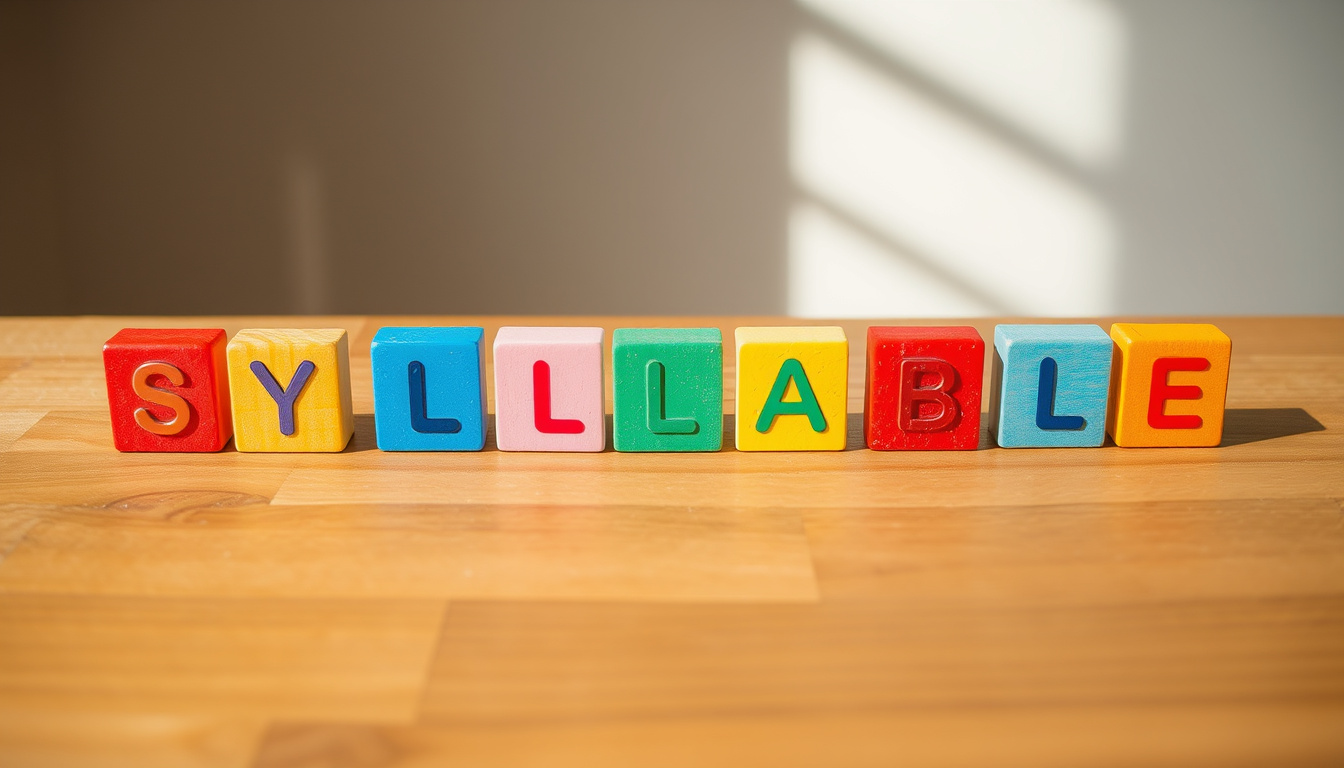

A syllable is a chunk of sound in a word with one vowel sound—the beat you hear when speaking. Kids learn to hear these beats by clapping, tapping, or humming through words, turning an abstract concept into something they can feel.
Core Definition: Unit of pronunciation with a vowel sound ·
Example: Book: 1 syllable ·
Example: Reading: 2 syllables ·
Example: Banana: 3 syllables
Quick snapshot
- A syllable always contains one vowel sound (Hooked on Phonics)
- There are six distinct syllable types taught in elementary school (Begin Learning)
- All words contain at least one syllable (Twinkl)
- Dialect variations can affect how speakers perceive syllable boundaries in edge cases
- Regional accents may shift vowel quality within syllables without changing count
- Open (ends in vowel: go, me)
- Closed (ends in consonant: cat, bed)
- Vowel-consonant-e “magic e” (line, cute)
- Vowel pair (beach, rain)
- R-controlled (her, fur, ear)
- Consonant-le (maple, purple)
These examples span from single beats to five-syllable words, illustrating how syllable count and word length don’t always track together.
| Term | Details |
|---|---|
| Standard Definition | Nucleus with vowel sound |
| Single Syllable Example | Book |
| Two-Syllable Examples | Window, butter |
| Three-Syllable Examples | Banana, vacation, computer |
| Four-Syllable Examples | Calculator, avocado |
| Five-Syllable Examples | Electricity, activity |
| Kids Method | Count beats by clapping |
| Teaching Grade Level | Elementary school introduction |
What is a syllable with example?
A syllable is a unit of pronunciation that contains a single vowel sound. Think of it as one beat in a word—the chunk of sound you say in one breath without pausing. “Book” has one syllable: you say it all at once. “Window” has two beats: win-dow. The technical term for “one syllable” is monosyllabic; two syllables is disyllabic, and three is trisyllabic (Twinkl Teaching Wiki).
Definition from sources
Educators simplify this further for children: a syllable always has one vowel sound, and it may include surrounding consonants. According to Begin Learning, “a syllable is an uninterrupted segment of speech consisting of a vowel sound, a diphthong, or a syllabic consonant, with or without preceding or following consonant sounds” (Begin Learning). Hooked on Phonics describes a syllable as “a single, unbroken sound unit within a word containing at least one vowel sound (a, e, i, o, u, sometimes y)” (Hooked on Phonics).
Simple examples
One-syllable words include bat, fox, tree, book, shoe, and frog. Two-syllable words include window, butter, mountain, and freeway. Three-syllable words include banana, vacation, computer, and afternoon (Begin Learning). Four-syllable words include calculator, avocado, television, and California. Five-syllable words include electricity and activity.
How do you explain a syllable to a child?
The key to teaching syllables to kids is making it physical and auditory rather than abstract. Children learn best when they can move, hear, and play with concepts—and syllable counting fits that perfectly.
Kid-friendly definition
Tell kids: “A syllable is a piece of a word that has a sound like ‘a’, ‘e’, ‘i’, ‘o’, ‘u’, or sometimes ‘y’ in it. When you say a word slowly, each piece you hear before you take a breath is one syllable.” Twinkl explains that syllables are called the “beats” of a word that form its rhythm, which gives kids a concrete image to latch onto (Twinkl Teaching Wiki).
Fun counting steps
Here are three hands-on methods for kids to count syllables:
- Clapping: Say the word naturally, then clap once for each syllable. Try clapping for “mommy” (2 claps), “daddy” (2 claps), “apple” (2 claps), “pizza” (2 claps), “banana” (3 claps) (Begin Learning)
- Finger tapping: Touch each finger to your thumb for each syllable you hear. Fox needs one tap; window needs two taps: win-dow. This kinesthetic method builds muscle memory for syllable patterns (Study.com)
- Humming: Hum through a word and count each distinct hum. Each hum equals one syllable. This works well for quieter settings like a car ride or bedtime
Physical methods like clapping and tapping convert an abstract concept into something kids can feel. Once they associate the physical motion with the sound pattern, syllable counting becomes automatic.
What are 5 syllables examples?
Five-syllable words are less common in everyday speech, but they show up in longer academic vocabulary and compound words. Finding them helps students recognize that syllable count and word length don’t always correlate.
Common 5-syllable words
Electricity (e-lec-tri-ci-ty) has five syllables—it’s often used in syllable-counting exercises precisely because it’s long but straightforward. Activity (ac-ti-vi-ty) also has five syllables. Other five-syllable words include opportunity, educational, and geographical. Reading Rockets confirms that syllables are “the basic parts or pieces of words; some words have one, others several” (Reading Rockets).
Pronunciation tips
When pronouncing five-syllable words, break them into chunks mentally: el-ec-tri-ci-ty. Pausing between chunks helps your mouth and brain process each vowel sound separately. This chunking strategy also helps with spelling, since students in grades 3-6 learn to split two-syllable words visually (like splitting “Monday” into Mon-day) (Twinkl Teaching Wiki).
Long words feel less intimidating once kids realize they’re just combinations of shorter syllable chunks they’ve already mastered in simpler words.
Is banana 3 syllables?
Yes, banana has exactly three syllables: ba-na-na. If you say it slowly and feel your jaw drop three times, each drop represents a separate vowel sound—and therefore a separate syllable.
Banana breakdown
Say “banana” and notice what happens: your mouth moves three distinct times. First you say “ba” (with an ‘a’ sound like “bat”), then “na” (with another ‘a’ sound), then “na” again (third ‘a’ sound). No consonant cluster blocks any of these—they each stand alone, which is why banana is easy to break into syllables.
Smile, by contrast, has just one syllable. You don’t pause or break when saying it—it’s a single smooth sound from start to finish. Book is also one syllable. These words don’t have multiple vowel sounds to separate.
Other common words
Tie (1), rescue (2: res-cue), alphabet (3: al-pha-bet), and electricity (5) follow the same logic: count the vowel sounds, and you have the syllable count (Twinkl Teaching Wiki). Word length doesn’t determine syllable count—”straight” has one syllable despite its length, while the short word “over” has two (Begin Learning).
How many syllables are in 77?
The number 77 is pronounced “se-ven-ty se-ven,” which gives it four syllables total. This matters for poets and students learning syllable patterns because number pronunciation differs from digit count.
Numbers and syllables
Most single-digit numbers are one syllable: one, two, three, four, five, six, seven, eight, nine, ten. Double-digit numbers typically have three or four syllables: fourteen (3), seventy-four (4), ninety-nine (4). When children learn to spell two-syllable words, they apply the same skill adults use when deciding how to break “77” for poetic meter.
Haiku structure tie-in
This connects to haiku writing, which follows a 5-7-5 syllable pattern per line. If you tried to write “77 flowers” in a haiku, you’d need to account for four syllables (se-ven-ty se-ven) plus one for “flow-ers”—five syllables total for that phrase alone. Understanding syllable counts in numbers helps poets plan meter and helps students count syllables in any spoken word accurately.
How to count syllables step by step
Counting syllables doesn’t require special tools—just your ears and a few simple techniques. Here’s a step-by-step approach for beginners:
- Listen first: Say the word at normal speed, then say it slowly. Notice where your voice naturally pauses or where your jaw drops.
- Clap or tap: As you say the word slowly, clap or tap once for each beat. Each clap equals one syllable.
- Count vowel sounds: Look at the word and count how many vowel letters (a, e, i, o, u—sometimes y) appear. This usually matches the syllable count, though some letter combinations share sounds.
- Test with familiar words: If you know the syllable count for “window” is two, apply the same method to “pillow” (2), “arrow” (3), or “tomorrow” (4).
- Play syllable games: Hide objects around a room. Say the object’s name, count the syllables, and hop that many times. Key (1), jacket (2), potato (3) (Begin Learning).
-
The catch
Silent letters can trick you—”make” looks like one syllable but the “e” is silent, leaving just the single “a” sound, so it’s still one syllable. Focus on vowel sounds you hear, not letters you see.
Once kids internalize this sequence—listen, move, count—they can tackle any word without a manual.
What we know and what we don’t
Confirmed facts
- A syllable always contains a vowel sound
- Six syllable types are taught in elementary school
- Clapping and tapping help kids count syllables
- Word length doesn’t determine syllable count
- Banana has 3 syllables; smile has 1
- The number 77 has 4 syllables
What’s unclear
- Regional dialect variations in syllable boundaries for edge cases
- Whether accent shifts affect perceived syllable count in casual speech
“In much simpler terms, we can describe a syllable as always having one (and only one) vowel sound.”
Begin Learning (Educational Resource)
“A syllable is a single, unbroken vowel sound within a spoken word, typically with a vowel and accompanying consonants.”
Twinkl Teaching Wiki
“Syllables are the very basic parts or pieces of words.”
Study.com (Educational Platform)
Related reading: Biff, Chip and Kipper books · What is 6 7 meaning
Frequently asked questions
What is a syllable in grammar?
In grammar and linguistics, a syllable is the smallest unit of pronunciation—a chunk of sound containing one vowel sound that forms part of a word. Syllables combine to create complete words and determine rhythm, meter, and pronunciation patterns.
What are syllable words?
“Syllable words” typically refers to words categorized by how many syllables they contain. One-syllable words (monosyllabic) include book, cat, and dog. Two-syllable words (disyllabic) include window, butter, and apple. Three-syllable words (trisyllabic) include banana, vacation, and computer.
What is a 5 7 5 syllable sentence?
A 5-7-5 syllable sentence follows the haiku structure: the first line has 5 syllables, the second line has 7 syllables, and the third line has 5 syllables. This traditional Japanese poetic form uses syllable counting as its structural backbone.
How many syllables does “electricity” have?
Electricity has five syllables: e-lec-tri-ci-ty. It’s often used in classroom exercises to practice counting syllables in longer words.
Is smile 1 syllable or 2?
Smile has exactly 1 syllable. You say it in a single breath without any pause or break—it’s one unbroken vowel sound (“i”) surrounded by consonants.
How to explain syllables to kids?
Tell kids that syllables are like beats or chunks in a word. Have them clap or tap fingers each time their voice “jumps” when saying a word slowly. Words like “mommy” (2 claps) and “banana” (3 claps) make the concept concrete and fun.
What are the six types of syllables with examples?
The six syllable types are: open syllables ending in a vowel (go, me); closed syllables ending in a consonant (cat, bed); vowel-consonant-e “magic e” syllables (line, cute); vowel pair syllables (beach, rain); R-controlled syllables (her, fur, ear); and consonant-le syllables (maple, purple, table). Children encounter all six types as they advance through elementary reading instruction.
Related stories




Amelia Blackwell covers the economy, business and consumer affairs for Press Hive.