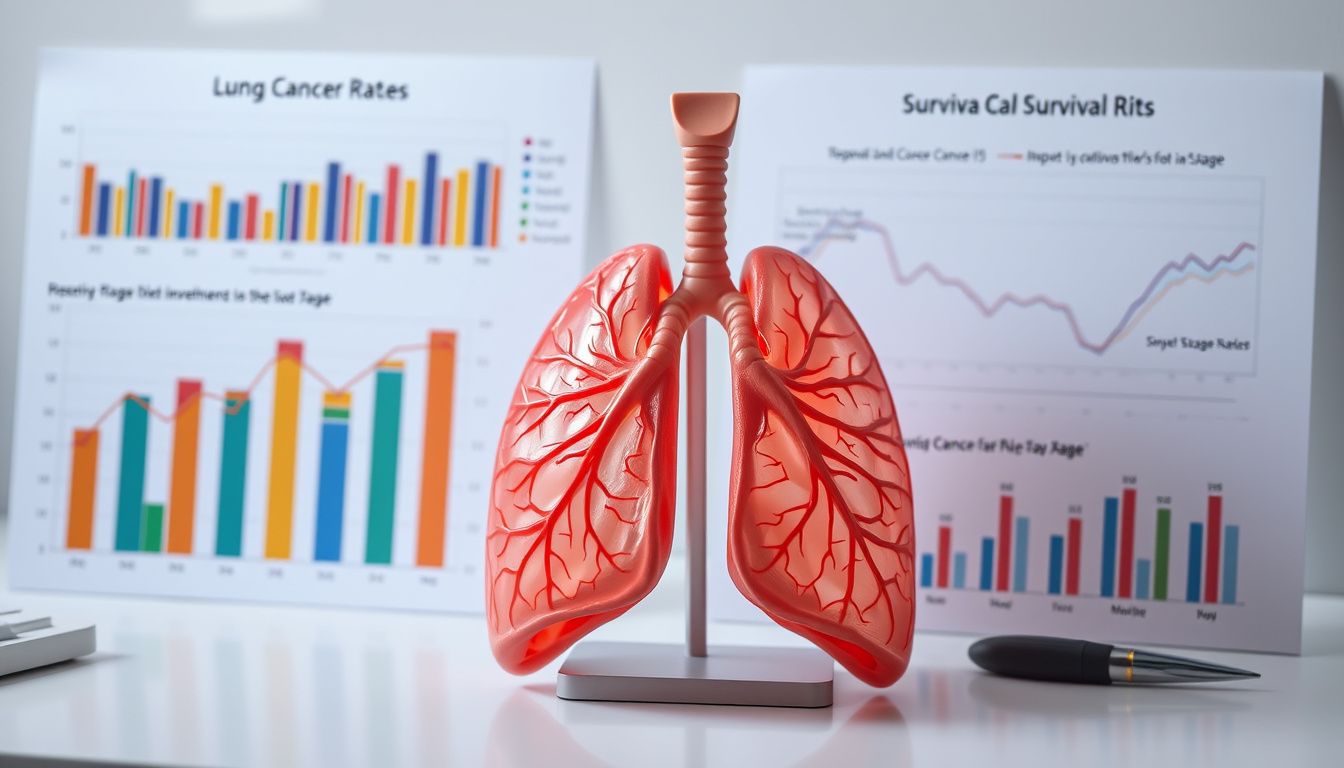

If you or someone you care about has just heard the words “lung cancer,” the numbers floating around can feel overwhelming—or not informative enough. The truth is, survival statistics aren’t a crystal ball, but they help patients and families understand what they’re facing and what options exist at each stage. This guide breaks down 5-year survival rates by stage and age, drawing from the most current data available from cancer registries and major health organizations.
Overall 5-year survival rate: 29.7% · Stage 1 5-year survival rate: Almost 65% · Early-stage treated: 60-70% · Ireland net 5-year survival rate: 15.3% · Women vs men: Women higher
Quick snapshot
- Stage-specific 5-year rates from SEER and ACS show localized cancer at 64.7%, regional at 37.1%, and distant at 9.7% (SEER Cancer Statistics)
- NSCLC has 32% overall 5-year survival; SCLC drops to 9% (American Cancer Society)
- National US average hit 29.7% in recent years, up 26% from five years prior (American Lung Association)
- Individual prognosis varies wildly without knowing personal factors like comorbidities, smoking history, and genetic markers
- Exact progression speed from early-stage to stage 4 differs significantly between patients
- Most current US registry data reflects diagnoses through 2023; 2024-2025 figures are still being compiled
- National 5-year survival has climbed 26% over the past five years (American Lung Association)
- New immunotherapy and targeted therapy approvals continue improving outcomes, particularly for advanced-stage patients (American Lung Association)
- Early detection push via low-dose CT screening aims to shift more diagnoses from “distant” to “localized” (American Lung Association)
- For patients diagnosed at stage 1 or 2, surgery often offers the best chance at curative outcomes
- Stage 3 patients typically receive combined chemotherapy, radiation, and immunotherapy
- Stage 4 treatment focuses on controlling cancer, managing symptoms, and maintaining quality of life
| Measure | Value | Source |
|---|---|---|
| Localized (stage 1-2) 5-year survival | 64.7% | SEER/NCI Registry |
| Regional (stage 3) 5-year survival | 37.1% | SEER/NCI Registry |
| Distant (stage 4) 5-year survival | 9.7% | SEER/NCI Registry |
| NSCLC all stages combined | 32% | American Cancer Society |
| SCLC all stages combined | 9% | American Cancer Society |
| US national average 5-year | 29.7% | American Lung Association |
| Under 50 years old | 41.6% | Lung Cancer Group (SEER data) |
| 65 years and older | 26.5% | Lung Cancer Group (SEER data) |
| UK stage 1 | Almost 65% | Cancer Research UK |
| Chinese cohort stage I (7,311 patients) | 76.9% | PMC Study |
What is your life expectancy with lung cancer?
The overall 5-year relative survival rate for lung cancer sits at 29.7% nationally, according to the American Lung Association, though this figure masks enormous variation depending on stage at diagnosis and a patient’s age. Cancer that is caught early — when it remains localized to the lungs — shows a 64.7% 5-year survival rate, the National Cancer Institute’s SEER registry data shows. The challenge is that most lung cancers (52% of cases) are not diagnosed until they’ve spread to distant organs, where the 5-year rate drops to just 9.7%.
Overall survival statistics
Survival statistics typically measure “relative survival,” comparing cancer patients to the general population to account for other causes of death. The American Cancer Society explains that this approach gives a cleaner picture of cancer-specific outcomes.
- Localized (confined to original site): 64.7% of cases represent 23% of diagnoses, with 5-year survival around 64.7%
- Regional (spread to nearby lymph nodes or structures): 21% of diagnoses at 37.1% 5-year survival
- Distant (metastasized to distant organs): 52% of diagnoses at 9.7% 5-year survival
- Unknown stage: 16.5% 5-year survival
The earlier lung cancer is caught, the better chance a patient has of surviving five years after diagnosis. This is why screening with low-dose CT scans for high-risk individuals (typically ages 50-80 with significant smoking history) is so critical — it shifts diagnoses from “distant” toward “localized” where treatment options are far more effective.
Factors influencing life expectancy
Beyond stage, several key factors shape individual prognosis. The cancer type matters enormously: non-small cell lung cancer (NSCLC), which accounts for roughly 84% of all lung cancers, carries an overall 32% 5-year survival rate per ACS data. Small cell lung cancer (SCLC) is far more aggressive, with only a 9% overall 5-year survival rate, dropping to 4% for distant-stage disease.
NSCLC and SCLC behave differently. SCLC grows quickly and often responds dramatically to initial chemotherapy and radiation, but it almost always recurs. NSCLC tends to be slower-growing but more amenable to targeted therapies and immunotherapies, especially when specific genetic mutations (like EGFR or ALK) are present.
- Age at diagnosis: Patients under 50 show 41.6% 5-year survival versus 26.5% for those 65 and older
- Cancer cell type: Adenocarcinoma (the most common NSCLC subtype) has 43.3% 5-year survival; squamous cell carcinoma has 36.9%
- Treatment response: Patients who can undergo surgery (typically early-stage) or respond well to targeted therapies show substantially better outcomes
- Comorbidities: Heart disease, COPD, and other conditions common in former smokers affect treatment tolerance and survival
— SEER Cancer Statistics (National Cancer Institute), on why localized detection dramatically improves outcomes
What is stage 1 lung cancer survival rate?
Stage 1 lung cancer refers to tumors confined to the lung that have not spread to lymph nodes or distant organs. At this stage, the cancer is often discovered incidentally during imaging for other conditions, or through screening programs targeting high-risk individuals. The survival outlook at stage 1 is considerably better than the overall lung cancer statistics suggest.
Survival by age for stage 1
Age significantly impacts survival even for early-stage disease. WebMD reports detailed sub-stage breakdowns for NSCLC: Stage IA1 shows 90% 5-year survival, IA2 shows 85%, IA3 shows 80%, and Stage IB shows 73%. These numbers reflect patients who received appropriate treatment, which typically means surgical resection for early-stage NSCLC.
- Patients under 50 with stage 1 disease who undergo treatment show 5-year survival rates between 60-70%
- Younger patients more often qualify for aggressive treatment approaches, including surgery combined with adjuvant therapy
- Cancer Research UK reports that almost 65 out of 100 people diagnosed with stage 1 lung cancer in the UK will survive their cancer for 5 years or more
Treatment impacts
For stage 1 NSCLC, surgery to remove the tumor (lobectomy or segmentectomy) is the standard curative approach. Five-year survival rates for surgically treated stage 1 NSCLC patients regularly exceed 70%, with some series showing 80-90% for the most favorable sub-stages. When surgery isn’t possible due to patient health or tumor location, stereotactic body radiation therapy (SBRT) offers an alternative with strong outcomes.
Stage 1 SCLC (limited stage) shows 34% 5-year survival per ACS data, notably better than advanced SCLC. However, only about one-third of SCLC patients are diagnosed at limited stage because the cancer tends to spread early.
What is stage 2 lung cancer survival rate?
Stage 2 lung cancer has grown larger or has spread to nearby lymph nodes, but remains within the chest area. This stage requires more aggressive treatment than stage 1 and typically involves combinations of surgery, chemotherapy, and sometimes radiation.
Signs and prognosis
Signs of stage 2 may include persistent cough, coughing up blood, chest pain that worsens with deep breathing, recurrent infections, and unexplained weight loss. However, some stage 2 tumors cause no symptoms at all, particularly if they’re located in peripheral areas of the lung.
- Stage 2 NSCLC shows 50-60% 5-year survival for surgically treated patients
- Moffitt Cancer Center data indicates combination therapy (surgery plus chemotherapy) improves outcomes for stage 2 patients
- Stage 2 SCLC (limited stage) shows approximately 20% 5-year survival
By age breakdown
Age impacts stage 2 survival through treatment tolerance and cancer biology. Patients in their 50s and 60s generally handle combination therapy better than those over 75, though chronological age alone doesn’t determine treatment eligibility. Fitness level, organ function, and personal preference all factor into treatment decisions.
— American Cancer Society, on how survival rates depend on individual factors
What is stage 3 lung cancer survival rate?
Stage 3 lung cancer describes tumors that have spread to lymph nodes in the middle of the chest or to other structures within the chest, but not to distant organs. This stage is more challenging to treat than earlier stages because the cancer involves a larger area, and it requires coordinated multi-modality therapy.
Stage 3 by age
Survival for stage 3 NSCLC varies widely based on the specific lymph node involvement, tumor size, and patient fitness for aggressive treatment. The SEER registry reports 37.1% 5-year survival for regional-stage disease, which includes stage 3. However, this average masks a wide range: some stage 3A patients achieve 5-year survival above 40% with trimodality therapy, while stage 3C patients face rates closer to 12%.
- Patients under 65 tend to receive more aggressive combined therapy and show better outcomes
- Those 65 and older may face more challenging treatment courses, particularly if they have reduced organ reserve
- The Chinese cohort study showed 32.6% 5-year survival for stage III patients in that population
Progression factors
Stage 3 represents a critical window where curable treatment is still possible, but the window can close quickly. The cancer may progress to stage 4 (distant spread) within months to years, depending on tumor biology. Faster-growing cancers (like SCLC or high-grade NSCLC) tend to progress more quickly than slower-growing tumors.
Stage 3 patients face a race against time. Aggressive combined treatment — typically chemotherapy, radiation, and immunotherapy — can achieve durable responses, but the treatment burden is significant and not all patients are strong enough candidates. Choosing a treatment center with expertise in thoracic oncology matters enormously at this stage.
What is stage 4 lung cancer survival rate by age?
Stage 4 lung cancer, also called metastatic lung cancer, means the disease has spread to distant organs such as the liver, bones, brain, or the opposite lung. This is the most advanced stage, and treatment shifts from curative intent to controlling cancer growth, managing symptoms, and maintaining quality of life.
Symptoms of stage 4
Stage 4 symptoms vary based on where the cancer spreads. Common presentations include bone pain (suggesting bone metastasis), neurological symptoms like headaches or weakness (brain metastasis), liver involvement causing jaundice or abdominal pain, and constitutional symptoms like severe fatigue, weight loss, and loss of appetite. Some patients experience no symptoms from the metastases themselves but have significant primary tumor symptoms like cough, chest pain, or shortness of breath.
Metastasis and life expectancy
The 5-year survival rate for distant-stage NSCLC is 12% per ACS data, though this figure includes all distant-stage patients regardless of age or treatment. Age dramatically shifts these numbers. According to SEER data reported by the Lung Cancer Group, stage 4 patients under 50 show approximately 21% 5-year survival, while those 65 and older show around 8%.
- Stage 4 NSCLC patients under 50: ~21% 5-year survival
- Stage 4 NSCLC patients 65+: ~8% 5-year survival
- Distant-stage SCLC: 4% 5-year survival per ACS
- Younger patients more often qualify for aggressive clinical trial treatments that can extend survival
For stage 4 patients, quality of life often matters as much as quantity. Aggressive chemotherapy near the end of life may buy weeks or months but at the cost of side effects and hospital time. Palliative care — focused on symptom management and psychological support — has been shown to not only improve quality of life but actually extend survival in some studies, making early integration of palliative services a key consideration.
Where does lung cancer first spread?
Lung cancer most commonly metastasizes to the adrenal glands, liver, bones, and brain, in that order of frequency. The lungs have extensive blood supply and connect directly to the systemic circulation, making distant spread relatively efficient. The first sign of metastasis is sometimes discovered through imaging, but often patients present with symptoms from the metastatic site before the primary lung tumor is diagnosed.
Upsides
- 5-year survival has climbed 26% nationally over the past five years
- Early-stage lung cancer (stages 1-2) is often curable with surgery
- Targeted therapies and immunotherapies have dramatically improved outcomes for patients with specific genetic mutations
- Screening with low-dose CT can catch cancer at localized stage before symptoms develop
- Women tend to show higher survival rates than men across all stages
Downsides
- Most lung cancers (52%) are diagnosed at distant stage where survival drops below 10%
- Symptoms often appear only after the cancer has progressed beyond early stage
- Treatment for advanced disease carries significant side effects and may require hospitalization
- Age significantly impacts survival, with patients over 65 showing lower rates
- Survival varies dramatically by state (22.7% in Alabama vs 37.6% in Rhode Island), suggesting access disparities
Related reading: stage 4 cancer survival rates
Survival rates climb to 65% in stage 1 when patients recognize early lung cancer symptoms like persistent cough or finger clubbing promptly.
Frequently asked questions
Is lung cancer usually terminal?
“Terminal” cancer typically refers to disease that cannot be cured and will directly cause death, usually within months. While lung cancer has a lower overall survival rate than many other cancers, early-stage disease (stages 1-2) is often curable, particularly with surgical treatment. Even stage 3 patients can achieve long-term survival with aggressive combined therapy. Only stage 4 lung cancer is generally considered life-limiting, and even then, patients may live for years with modern treatments that control the cancer’s growth. The word “terminal” should be discussed directly with an oncologist who understands the individual patient’s specific situation.
How quickly does lung cancer progress?
Progression speed varies by cancer type and individual biology. Small cell lung cancer (SCLC) is the fastest-growing type, potentially doubling in size within days and progressing from early to advanced stage within weeks to months if untreated. Non-small cell lung cancer (NSCLC) tends to grow more slowly — months to years for early-stage tumors to progress to advanced disease. The time from first abnormal cell to detectable tumor is typically several years, but once symptoms appear and diagnosis occurs, the cancer’s behavior becomes more predictable. Treatment can significantly slow progression or halt it entirely.
What is the 2-week rule for lung cancer?
In the UK, the 2-week wait referral pathway allows general practitioners to refer patients with suspected lung cancer for specialist evaluation within two weeks if they meet certain criteria. These criteria include unexplained symptoms like persistent cough, coughing blood, chest pain, breathlessness, weight loss, or fatigue lasting more than three weeks in patients over 40. This rapid referral pathway aims to catch cancer earlier when treatment is more effective. Similar expedited evaluation pathways exist in other healthcare systems, including the US Veterans Affairs system and several private insurance programs.
Where does lung cancer first spread?
Lung cancer most commonly metastasizes first to the adrenal glands, followed by the liver, bones, and brain. The lungs’ extensive vascular network and direct connection to the body’s circulatory system facilitate spread to distant organs. Many patients already have small metastases at the time of diagnosis that are too small to detect on standard imaging. This is why staging workups for suspected lung cancer typically include PET scans and sometimes MRI of the brain to evaluate for metastatic disease before treatment decisions are made.
What happens after you’re diagnosed with lung cancer?
After diagnosis, patients typically undergo additional testing to determine the cancer’s stage and type — this is called staging workup. For lung cancer, this usually includes PET-CT scanning, brain MRI, and often biopsies of lymph nodes or other suspicious areas. Once staging is complete, a multidisciplinary team including surgeons, medical oncologists, and radiation oncologists discusses the case and recommends a treatment plan tailored to the specific stage, cancer type, and patient preferences. For early-stage cancer, surgery is often first-line. For advanced disease, systemic therapy (chemotherapy, targeted therapy, or immunotherapy) is typically recommended alongside or before radiation.
What part of the body hurts when you have lung cancer?
Lung cancer itself doesn’t cause pain in its early stages, which is why it often goes undetected. As the disease progresses, patients may experience chest pain (particularly with deep breathing or coughing), shoulder blade pain if nerves are involved, bone pain if cancer has spread to bones, or headaches if brain metastases are present. The primary tumor in the lung typically causes chest discomfort, shortness of breath, or a persistent cough rather than sharp pain. Widespread pain, especially in the back, hips, or skull, suggests metastatic disease and warrants urgent evaluation.
How long does it take lung cancer to turn to stage 4?
There’s no fixed timeline for progression from early-stage to stage 4 lung cancer. Small cell lung cancer can progress within weeks to months if untreated, while non-small cell lung cancer may take months to years, depending on the tumor’s biology and the patient’s baseline health. With treatment, progression can often be stopped or significantly delayed for years. Some aggressive NSCLC tumors that lack actionable mutations may progress more rapidly despite treatment, while others with favorable biology may remain stable for extended periods. Regular imaging surveillance during and after treatment helps detect progression early.
For patients navigating a lung cancer diagnosis, the numbers in this article represent population averages — not individual destinies. Younger patients with early-stage disease who are strong treatment candidates regularly beat the odds shown here, while some older patients with advanced disease and favorable tumor biology achieve years of meaningful survival with targeted therapy. The most important takeaway: survival rates improve dramatically with early detection, which means if you have a significant smoking history and are eligible for screening, scheduling that low-dose CT scan may be the most consequential health decision you make this year. For those already facing a diagnosis, the most important next step is ensuring you’re evaluated by a multidisciplinary thoracic oncology team that can offer both conventional and clinical trial treatment options.
Related stories





Amelia Blackwell covers the economy, business and consumer affairs for Press Hive.