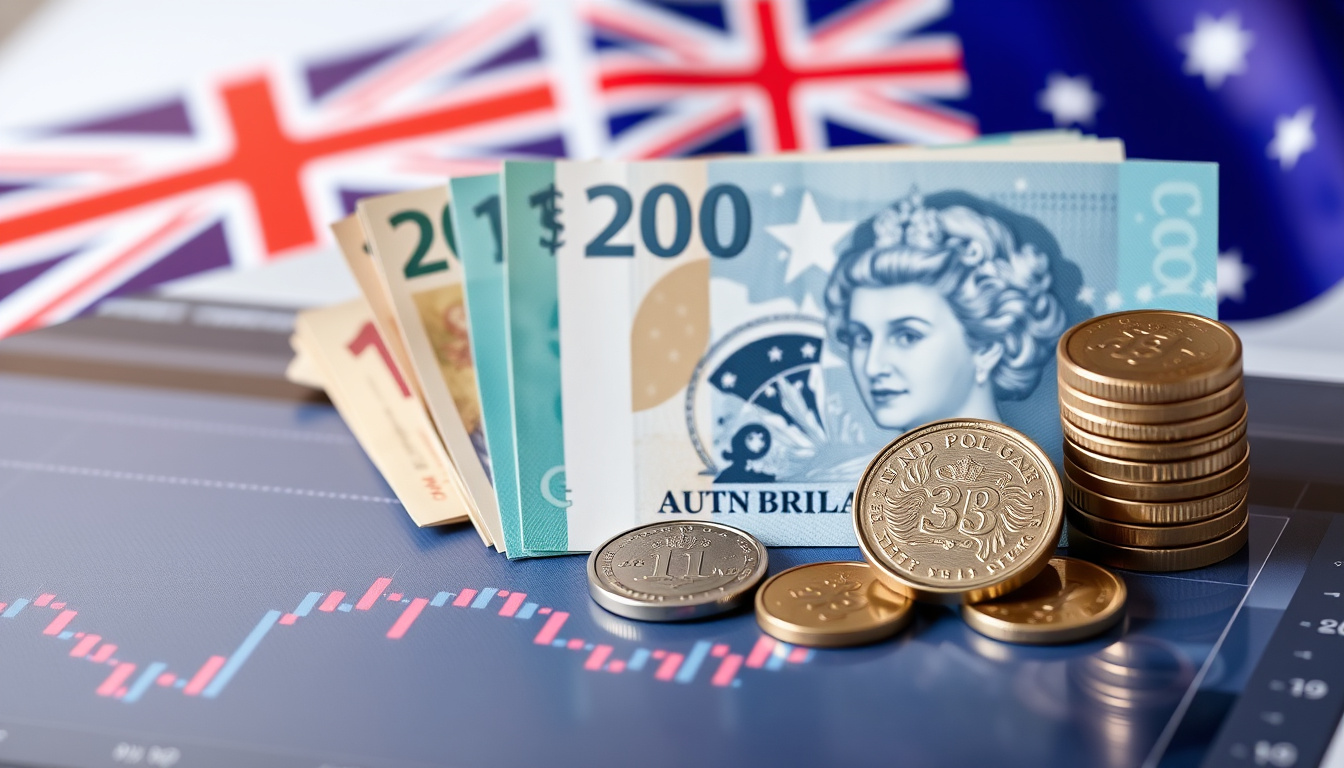
The Australian dollar has been punching above its weight against the British pound in 2026 — and that strength isn’t a fluke. Right now, one Australian dollar buys roughly 0.5309 pounds, driven by RBA rate hikes and commodity tailwinds that show no sign of fading. Here’s what that means for transfers, travelers, and anyone watching this overlooked pair.
Current Mid-Market Rate: 1 AUD = 0.5309 GBP ·
30-Day High: 0.5311 ·
30-Day Low: 0.5175 ·
30-Day Average: 0.5260 ·
Top Converter: Wise.com
Quick snapshot
- Mid-market: 0.5309
- 30-day change: +1.3%
- High: MoneyTransfer 0.5311 (30-day)
- Low: 0.5175 (MoneyTransfer)
- Average: 0.5260 (MoneyTransfer)
- 2026 AUD/GBP: NAB/Westpac £0.50–0.52 range expected by major banks
- GBP/AUD: Cambridge Currencies A$1.88–2.04 band
| Label | Value |
|---|---|
| Base Currency | AUD |
| Quote Currency | GBP |
| Current Rate | 0.5309 |
| 30-Day High | 0.5311 |
| 30-Day Low | 0.5175 |
Why is AUD so weak against GBP?
The question sounds counterintuitive — the Australian dollar has actually been gaining on the pound in 2026, not losing ground. The real story is a gradual narrowing of the historical premium the pound has held over AUD.
“The biggest shift of 2026 is the Reserve Bank of Australia’s reversal of its 2025 easing cycle.”
— Cambridge Currencies, analyst
Factors impacting AUD strength
Three forces are pushing AUD higher against GBP. First, the Reserve Bank of Australia (RBA) has swung into tightening mode — hiking rates twice in early 2026 and reaching 4.10% by March, with a further hike to 4.35% possible if Q1 inflation stays elevated (Cambridge Currencies). Second, commodity tailwinds are strong: gold, silver, and copper hit all-time highs in January 2026, and commodity exports make up more than 25% of Australia’s GDP (Key Currency). Third, USD weakness — driven by US Fed rate cuts — is lifting tradeable currencies like the Australian dollar (Bendigo Bank).
Recent trends vs GBP
The rate differential is the key metric. While the Bank of England (BoE) sits at 3.75% in April 2026, the RBA is at 4.10% — a 35 basis-point gap that supports AUD against GBP (Cambridge Currencies). The RBA raised its cash rate by 0.25% to 3.85% on February 3, 2026, explicitly responding to Australian inflation hitting nearly 4% in December data (Key Currency). The March 2026 hike that pushed rates to 4.10% passed by a 5-4 vote (Cambridge Currencies).
“The strength of the Australian dollar is likely to persist, supported by its prior undervaluation, the RBA’s position as the first major central bank to begin tightening after a rate‑cutting cycle.”
— AMP, economist
The pattern: where BoE is cutting rates as UK inflation cools, the RBA is hiking as Australian prices stay sticky. That divergence is structural, not temporary, and it’s pulling AUD/GBP higher.
What is $100 Australian dollars in pounds?
At the current mid-market rate of 0.5309, conversion is straightforward arithmetic — but the numbers matter for anyone moving real money across the Tasman.
Live conversion calculator
Using the live mid-market rate:
- 100 AUD → 53.09 GBP
- 500 AUD → 265.45 GBP
- 1,000 AUD → 530.90 GBP
- 130,000 AUD → 69,017 GBP
Examples: 100, 500, 130000 AUD to GBP
These figures use the mid-market rate as a baseline. Actual transfers through Wise, XE, or Revolut will reflect their real-time rates, which include their specific spreads. The 30-day range of 0.5175 to 0.5311 shows you could have received anywhere from £51.75 to £53.11 per 100 AUD in recent weeks (MoneyTransfer).
The 2026 average sits at 0.5061, with a high of 0.5229 on February 11, 2026, and a low of 0.4954 on January 1, 2026 (MoneyTransfer). If you’re comparing providers for a transfer, always check the live rate on the day — the difference between 0.4954 and 0.5309 on a £50,000 transfer is roughly £1,775.
Five conversion examples, one consistent takeaway: rates move daily, and the margin between providers can easily outweigh the rate fluctuation within a single day.
Is it a good time to buy Australian dollars with British pounds?
“Good time” depends on your direction. If you’re selling GBP to buy AUD — a British traveler heading to Australia, a UK importer, or an investor reducing sterling exposure — the answer is increasingly yes.
Current rate analysis
Two factors make this a relatively favorable window for GBP sellers. The RBA’s tightening cycle is more advanced than the BoE’s easing cycle — RBA at 4.10% versus BoE at 3.75% creates a structural support for AUD (Cambridge Currencies). And commodity prices — gold, silver, copper at all-time highs in January 2026 — provide a sustained tailwind for Australia’s commodity-linked currency (Key Currency).
The RBA’s tightening cycle is running ahead of the BoE’s easing cycle — a structural advantage for AUD that shows no sign of reversing in 2026.
Best exchange rates
For the best actual transfer rate, use platforms that offer mid-market rates with transparent fees:
- Wise: Uses mid-market rate; small flat fee
- XE: Live rates; no hidden markup
- Revolut: Real-time rate for app-based transfers
Westpac and NAB forecast AUD/GBP in the £0.50–0.52 range over the next 12 months from late 2025 (Arielle), suggesting the current rate of 0.5309 is near the top of that band — a decent entry point for GBP sellers.
The implication: if you need to buy Australian dollars from pounds in 2026, now sits on the favorable side of the range. Waiting for a better rate carries genuine risk if the AUD continues strengthening.
Upsides
- Rate differential favors AUD: RBA at 4.10% vs BoE at 3.75% in April 2026 (Cambridge Currencies)
- Commodity tailwinds: gold, silver, copper at all-time highs in January 2026
- USD weakness supports tradeable currencies like AUD
Downsides
- RBA rate hikes risk dampening Australian growth outlook
- China slowdown risks eroding AUD via trade impacts
- Volatility after the rapid 2026 rally could push rates lower short-term
Is AUD expected to rise or fall in 2026?
Most financial analysts expect AUD to remain firm against GBP through 2026, though the range of forecasts is wide.
Pound to AUD forecast
The majority view points to continued AUD strength. Key Currency forecasts GBP/AUD edging lower toward A$1.92 in early 2026 (Key Currency), while Pound Sterling Live suggests the pair could drop toward 1.8825 given oil price pressures benefiting Australia as a net gas producer (Pound Sterling Live). Cambridge Currencies sets a base case of A$1.91–1.95 (Cambridge Currencies), with the pair trading between A$1.88 and A$2.04 across bullish and bearish scenarios.
Business impacts
The stronger AUD is a double-edged sword for Australian businesses. It acts as “stealth tightening,” dampening imported inflation but acting as a headwind to export-heavy industries (AMP). For UK businesses importing from Australia, the rising AUD means your Australian suppliers get more pounds per dollar earned — a net positive on the revenue side, but watch for pass-through pricing adjustments.
Watch the RBA’s June 2026 decision: a hike to 4.35% if Q1 CPI data stays elevated would further widen the rate gap with the BoE, pushing AUD/GBP higher. A hold or cut would signal the tightening cycle has peaked.
The catch: forecasts cluster around two scenarios — a base case of gradual AUD/GBP appreciation toward £0.52 by year-end (NAB, Westpac) and a more bullish path to £0.5728 if commodity prices and USD weakness persist (CoinCodex). Both scenarios favor GBP sellers.
Is the pound likely to rise against the Australian dollar?
The structural forces working against GBP in 2026 outweigh the case for a rebound.
Strength comparisons
The BoE is in an easing cycle while the RBA tightens — a 35 basis-point gap in favor of AUD that widens further if the US Fed continues cutting rates, pushing USD lower and supporting commodity currencies (AMP). The 10-year GBP/AUD average sits around A$1.75, well below the current A$1.90–1.92 — meaning GBP is trading above its long-term average against AUD (Cambridge Currencies).
Strongest currencies context
GBP is not among the world’s top three strongest currencies by any standard measure — but that’s the wrong comparison. The question is whether GBP strengthens relative to AUD specifically, and the answer is no. The divergence in monetary policy, commodity tailwinds for Australia, and USD headwinds all point the other way. XS.com forecasts GBP/AUD equilibrium near 1.9855 by 2030 (XS.com), suggesting a long-term path that doesn’t favor GBP recovery to historical norms.
“War is just another reason to keep selling [GBP/AUD] this week.”
— Pound Sterling Live, editor
The pattern: GBP commands a premium today because of its global reserve status, but that premium is being eroded by policy divergence. For anyone converting pounds to Australian dollars in 2026, the window for a better rate is closing.
Related reading: 20 USD to GBP · Union Jack Oil share price
bendigobank.com.au, ledge.com.au, exchangerates.org.uk, coincodex.com, mufgresearch.com
Complementing options like Wise, this live AUD/GBP converter tracks the Australian dollar’s recent strength to 0.5349 GBP alongside diverging 2026 forecasts.
Frequently asked questions
What factors affect the AUD to GBP exchange rate?
The rate depends on interest rate differentials between the RBA and BoE, commodity prices (especially metals and energy, which make up over 25% of Australia’s GDP), USD strength or weakness, and broader global risk sentiment. In 2026, the RBA’s tightening cycle is the dominant driver pushing AUD higher against GBP.
How has the Australian dollar to GBP trended recently?
Over the past 30 days, AUD/GBP has ranged from 0.5175 to 0.5311, averaging 0.5260. The 2026 high is 0.5229 (February 11) and the low is 0.4954 (January 1). The current rate of 0.5309 sits near the top of the recent range, reflecting RBA rate hikes and commodity tailwinds.
What is the best exchange rate for GBP to AUD?
Wise, XE, and Revolut offer live mid-market rates with transparent fees. Avoid bureau de change and most bank transfers — their spreads can add 2-3% to the cost. For large transfers (over £10,000), specialist providers like OFX or Key Currency typically offer better rates than retail platforms.
What is 1 EUR to 1 AUD?
EUR/AUD typically trades around 1.60–1.75 depending on the period. For real-time rates, check XE or Wise — cross rates involving EUR, AUD, and GBP fluctuate based on each currency’s movement against the US dollar, which serves as the primary intermediary in most currency markets.
Which are the strongest currencies globally?
The Kuwaiti dinar, Bahraini dinar, and Omani rial typically rank highest by value per unit. GBP sits in the top tier of commonly traded currencies, alongside USD and EUR, but not among the top three by nominal value. The stronger comparison for GBP is its purchasing power and reserve currency status, where it ranks third globally after USD and EUR.
Is the Australian dollar historically weak or strong against GBP?
Currently, GBP/AUD at A$1.90–1.92 is above the 10-year average of approximately A$1.75 — meaning the pound is relatively strong by historical standards. AUD/GBP historically hit lows of 0.551 during the pandemic and 0.601 during the Global Financial Crisis. The current 0.5309 level reflects significant AUD recovery, with the pair well above GFC lows.
When should I avoid exchanging AUD for GBP?
If you’re an Australian business receiving GBP payments, waiting may improve your rate as AUD strengthens. However, if you need the funds quickly or have a contractual payment deadline, the cost of waiting can exceed the potential rate gain. Forward contracts or currency options can lock in a rate while you wait for a more favorable entry point.
How do RBA and BoE rate decisions affect the AUD/GBP pair?
Rate decisions create immediate market reactions. The RBA’s February 2026 hike to 3.85% and March hike to 4.10% pushed AUD higher against GBP within days (Key Currency). Conversely, any signal that the BoE might pause or reverse its easing cycle would narrow the rate gap and could support GBP. The current 35 basis-point differential (RBA 4.10% vs BoE 3.75%) is the primary fundamental driver.

Amelia Blackwell covers the economy, business and consumer affairs for Press Hive.