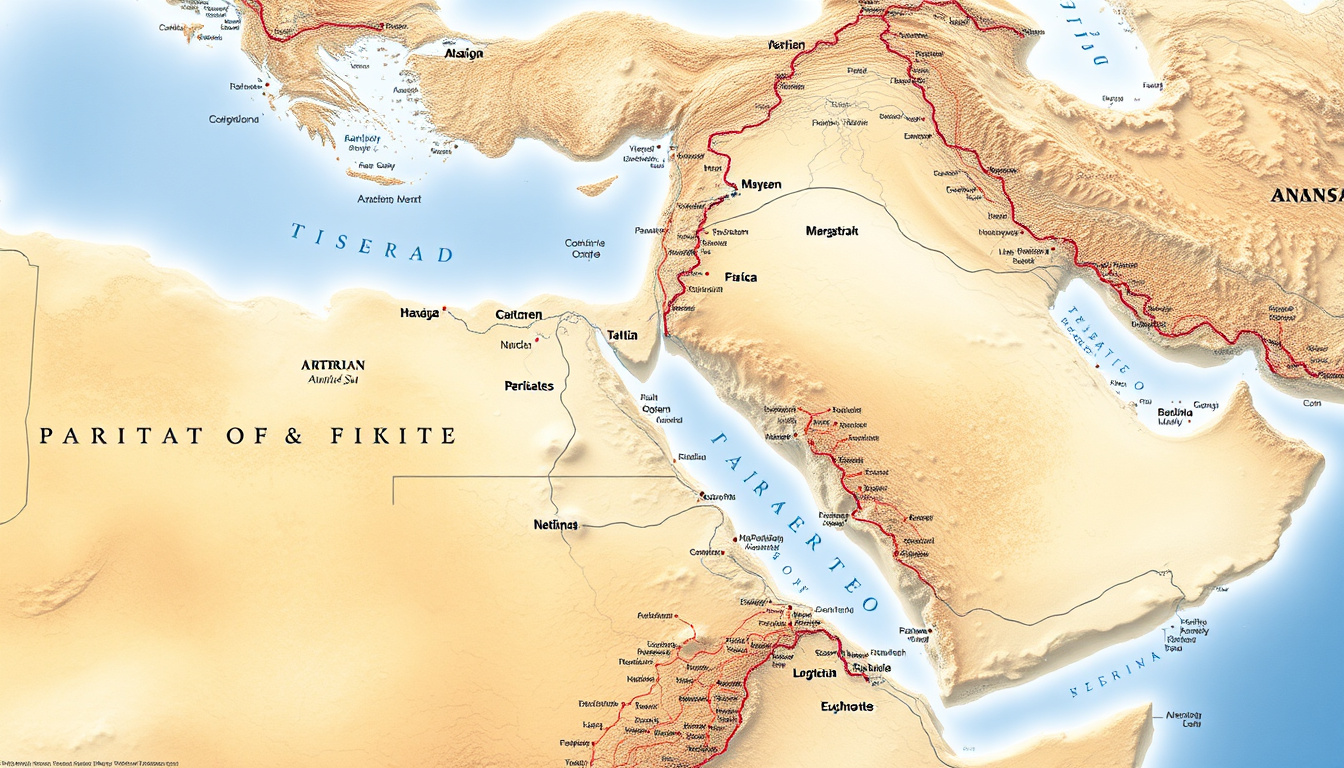
Few maps are as charged with history, politics, and shifting borders as the map of the Middle East. For travelers, students, and analysts, understanding this region means grappling with 17 countries, disputed territories, and a landscape that stretches from the Dead Sea’s depths to the Zagros Mountains.
Countries in the Middle East: 17 recognized sovereign states ·
Total area: Approximately 7.3 million sq km ·
Population: Over 410 million (2025 est.) ·
Highest point: Mount Damavand, Iran (5,610 m) ·
Smallest country: Bahrain (780 sq km)
Quick snapshot
- The Middle East is a transcontinental region most commonly centered on Western Asia (Encyclopaedia Britannica (authoritative reference)).
- Seventeen UN-recognized countries make up the standard list (GIS Geography (educational mapping resource)).
- Physical maps highlight the Arabian Desert, Zagros Mountains, and Tigris-Euphrates river system (Encyclopaedia Britannica (historical geography)).
- The exact boundaries of the Middle East are loosely defined; some definitions include Turkey fully, others only part (Encyclopaedia Britannica (definitional nuance)).
- The status of Palestine is disputed; not a UN member but recognized by many states (GIS Geography (country list discussion)).
- Whether Cyprus is considered part of the Middle East varies by source (Encyclopaedia Britannica (regional scope)).
- The Sykes-Picot Agreement (1916) divided Ottoman territories into British and French mandates (Encyclopaedia Britannica (historical treaty)).
- The 1948 Arab-Israeli war redrew borders of Palestine (Encyclopaedia Britannica (conflict overview)).
- Post-2003 Iraq and Syrian civil war (2011–present) created de facto autonomous regions (Encyclopaedia Britannica (Iraq profile)).
- Ongoing Israel-Hamas conflict (2023–2024) continues to reshape the map of Palestinian territories (Encyclopaedia Britannica (current conflict)).
- Debate over Turkey’s full inclusion in Middle East definitions may impact future map conventions (Encyclopaedia Britannica (regional definition)).
Seven key measurements define the region’s scale: area, country count, extremes of elevation and river length.
| Label | Value |
|---|---|
| Total area | ~7.3 million sq km |
| Number of countries | 17 (commonly counted) |
| Largest country by area | Saudi Arabia (2.15 million sq km) |
| Smallest country by area | Bahrain (780 sq km) |
| Longest river | Euphrates (approx. 2,800 km) |
| Highest point | Mount Damavand, Iran (5,610 m) |
| Lowest point | Dead Sea (approx. -430 m) |
Which countries are in the Middle East?
Commonly included countries
- Seventeen UN-recognized states are commonly mapped: Saudi Arabia, Iran, Iraq, Israel, Jordan, Lebanon, Syria, Turkey, Egypt, Yemen, Oman, United Arab Emirates, Qatar, Kuwait, Bahrain, Cyprus, and Palestine (GIS Geography (standard list)).
- Britannica’s treatment includes Turkey, Iran, Egypt, Saudi Arabia, Iraq, Syria, Israel, Jordan, Lebanon, Kuwait, Bahrain, Qatar, UAE, Oman, Yemen, Cyprus, and often Palestine (Encyclopaedia Britannica (regional scope)).
Disputed members (e.g., Turkey, Cyprus, Palestine)
- Turkey is fully included in some definitions, only partially in others; Cyprus’s inclusion varies by source (Encyclopaedia Britannica (definitional boundaries)).
- Palestine is not a UN member but is recognized by many states and shown on many maps (GIS Geography (county list context)). Travelers should also be aware of safety risks; see Turkey Travel Warning: Paragliding Safety Risks 2025.
Capitals and key facts per country
- Standard maps label capitals such as Riyadh (Saudi Arabia), Tehran (Iran), Baghdad (Iraq), Jerusalem (Israel), Amman (Jordan), Beirut (Lebanon), Damascus (Syria), Ankara (Turkey), Cairo (Egypt), Sanaa (Yemen), Muscat (Oman), Abu Dhabi (UAE), Doha (Qatar), Kuwait City (Kuwait), Manama (Bahrain), Nicosia (Cyprus), and Ramallah (Palestine Encyclopaedia Britannica (capital listing)).
The implication: the country list is widely agreed, but the exact membership of Turkey, Cyprus, and Palestine remains a cartographic gray area.
What does a map of the Middle East show?
Political boundaries and capitals
- Political maps emphasize country borders and capitals (ZetSIM (map type guide)).
- Color-coded by nation, they include major cities and administrative divisions (World Atlas (reference maps)).
Physical features: deserts, mountains, rivers
- Physical maps highlight the Arabian Desert, Zagros Mountains, and the Tigris–Euphrates river system (Encyclopaedia Britannica (Mesopotamia geography)).
- The Arabian Peninsula is a central physical feature, usually shown with Saudi Arabia, Yemen, Oman, UAE, Qatar, Bahrain, and Kuwait (World Atlas (Arabian Peninsula overview)).
Conflict zones and disputed territories
- Conflict maps often denote areas like Gaza Strip, West Bank, Golan Heights, and Kurdish regions (Encyclopaedia Britannica (conflict regions)).
A single map type can’t capture the region’s complexity. Political maps show where sovereignty ends; physical maps reveal ancient travel routes; conflict maps show where those boundaries break down.
The pattern: each map type answers a different question — borders, terrain, or instability.
How has the map of the Middle East changed over time?
Post–World War I border drawing (Sykes-Picot)
- The Sykes-Picot Agreement (1916) divided Ottoman territories into British and French mandates (Encyclopaedia Britannica (historical treaty)).
Creation of Israel (1948) and subsequent wars
- The 1948 Arab-Israeli war redrew borders of Palestine (Encyclopaedia Britannica (conflict history)).
- Later wars (1967 Six-Day War, 1973 Yom Kippur War) further altered boundaries (Encyclopaedia Britannica (Six-Day War)).
Post-2003 Iraq and Syrian civil war boundaries
- The 2003 Iraq War and 2011 Syrian civil war led to de facto autonomous regions (Encyclopaedia Britannica (Iraq profile)).
The map of the Middle East is never static. Each generation sees new borders drawn by war, treaties, or local autonomy movements. For map readers, this means today’s printed atlas may already be outdated.
The trade-off: historical maps provide context, but current maps require frequent updates to reflect on-the-ground realities.
What are the major geographical features of the Middle East?
Deserts
- The Arabian Desert covers much of the Arabian Peninsula (Encyclopaedia Britannica (Arabian Desert)).
- The Rub’ al Khali (Empty Quarter) is the largest continuous sand desert in the world (Encyclopaedia Britannica (Rub’ al Khali)).
Mountain ranges
- The Zagros Mountains run from Iran through Iraq and Turkey (Encyclopaedia Britannica (Zagros Mountains)).
- The Taurus Mountains in southern Turkey and Alborz Mountains in northern Iran are also prominent (Encyclopaedia Britannica (Taurus Mountains)).
Major rivers
- The Tigris and Euphrates rivers converge in Iraq to form the Shatt al-Arab (Encyclopaedia Britannica (Mesopotamia geography)).
- The Nile River also touches the region, flowing through Egypt (Encyclopaedia Britannica (Nile River)).
Bodies of water
- The Persian Gulf lies at the center of the Middle East, giving the region its distinctive map outline (World Atlas (regional geography)).
- The Red Sea separates northeastern Africa from the Arabian Peninsula (Encyclopaedia Britannica (Red Sea)).
- The Strait of Hormuz is a major choke point connecting the Persian Gulf to the Gulf of Oman (Encyclopaedia Britannica (Strait of Hormuz)).
Why this matters: the region’s geography controls trade routes, water access, and strategic military positions — which is why maps of the Middle East are never just about borders.
How does the Middle East relate to Europe and Asia?
Geopolitical definition vs. continental boundaries
- The Middle East is not a continent; it spans parts of Asia and Africa (Study.com (geographic classification)).
Transcontinental countries (Turkey, Egypt)
- Turkey is transcontinental, lying partly in Europe and Asia (Encyclopaedia Britannica (Turkey geography)).
- Egypt is transcontinental, with the Sinai Peninsula in Asia (Encyclopaedia Britannica (Egypt geography)). For a detailed breakdown of European countries and regions, see our guide to Europe Countries and Regions.
The catch: many Middle East maps include Turkey and Egypt, even though they straddle multiple continents — the region is defined by culture, politics, and history, not pure geology.
Where can I download a free map of the Middle East?
Printable PDF maps from UN and educational sites
- The United Nations provides official, free PDF maps of the Middle East (United Nations Geospatial Section (official cartography)).
- World Atlas offers printable maps for classroom use (World Atlas (printable resources)).
Interactive online maps (Google Maps, Britannica)
- Google Maps allows custom interactive views with labels (Google Maps (interactive mapping)).
- Britannica provides interactive political and physical maps (Encyclopaedia Britannica (online atlas)).
High-resolution images for reference
- High-resolution map images are available from GIS Geography (GIS Geography (downloadable maps)).
The implication: authoritative cartographic sources provide multiple formats, from free PDFs to interactive layers, making it easy to study the region at any scale.
Timeline of key events shaping the Middle East map
- : Sykes-Picot Agreement divides Ottoman lands into British and French spheres (Encyclopaedia Britannica (historical treaty)).
- : Creation of Israel; first Arab-Israeli war redraws boundaries of Palestine (Encyclopaedia Britannica (conflict history)).
- : Iranian Revolution; Iran–Iraq War begins (1980–1988) (Encyclopaedia Britannica (Iran-Iraq War)).
- : Gulf War; Iraq invades Kuwait; coalition forces expel Iraq (Encyclopaedia Britannica (Gulf War)).
- : US-led invasion of Iraq; subsequent sectarian divisions redraw internal boundaries (Encyclopaedia Britannica (Iraq profile)).
- : Arab Spring; Syrian civil war leads to fragmented control in Syria and Iraq (Encyclopaedia Britannica (Syrian Civil War)).
- : Israel-Hamas war in Gaza; renewed focus on Palestinian territories (Encyclopaedia Britannica (current conflict)).
Confirmed facts
- All 17 countries are UN member states (GIS Geography (UN members list)).
- The Middle East is not a single continent but a geopolitical region (Encyclopaedia Britannica (regional definition)).
- The Dead Sea is the lowest land point on Earth (Encyclopaedia Britannica (Dead Sea)).
What’s unclear
- The exact boundaries of the Middle East are loosely defined; some definitions include Turkey fully, others only part (Encyclopaedia Britannica (definitional scope)).
- The status of Palestine is disputed; not a UN member but recognized by many states (GIS Geography (country status)).
- Whether Cyprus is considered part of the Middle East varies by source (Encyclopaedia Britannica (Cyprus geography)).
Perspectives from experts
“Middle East, the lands around the southern and eastern shores of the Mediterranean Sea, extending from Morocco to the Arabian Peninsula and Iran.”
Encyclopaedia Britannica (definition of the region)
“The boundaries and names shown do not imply official endorsement or acceptance by the United Nations.”
United Nations Geospatial Section (map disclaimer)
“The Persian Gulf lies at the center of the Middle East and helps give the region its distinctive shape on map outlines.”
World Atlas (regional geography)
For map readers of all kinds, the takeaway is clear: a good map of the Middle East layers political boundaries with physical features and conflict overlays — or you risk missing what matters.
For a more detailed breakdown of regional boundaries and capital cities, this comprehensive Middle East map guide offers additional context beyond the basic overview.
Frequently asked questions
What is the largest country in the Middle East by population?
Egypt has the largest population, estimated over 110 million in 2025, followed by Turkey and Iran (Encyclopaedia Britannica (Egypt demographics)).
Is Turkey considered part of the Middle East?
Yes, in most geopolitical definitions. Turkey is included in the standard list of 17 countries, though some sources debate its inclusion due to its transcontinental nature (Encyclopaedia Britannica (regional membership)).
What is the oldest known map of the Middle East?
The Babylonian World Map (c. 600 BCE) shows Mesopotamia at the center, making it one of the earliest representations of the region (Encyclopaedia Britannica (ancient cartography)).
How can I find a map of the Middle East in Arabic?
The United Nations and World Atlas offer versions with Arabic labeling; search for “خريطة الشرق الأوسط” on those sites (United Nations Geospatial Section (multilingual resources)).
What does a physical map of the Middle East highlight?
Physical maps highlight terrain: deserts (Arabian Desert, Rub’ al Khali), mountain ranges (Zagros, Taurus, Alborz), major rivers (Tigris, Euphrates, Nile), and bodies of water (Persian Gulf, Red Sea, Mediterranean) (Encyclopaedia Britannica (regional geography)).
Are there any autonomous regions within Middle Eastern countries not shown on standard maps?
Yes: the Kurdistan Region in Iraq and the Kurdish-controlled areas in northeastern Syria are de facto autonomous but often omitted from political maps (Encyclopaedia Britannica (Kurdistan autonomy)).
Why do some maps include parts of Central Asia in the Middle East?
Broader definitions of the “Greater Middle East” sometimes include Afghanistan, Pakistan, and Central Asian republics for cultural and historical reasons (Encyclopaedia Britannica (expanded definition)).
Related stories





Sophie Marlowe covers culture, lifestyle and society stories across the UK.