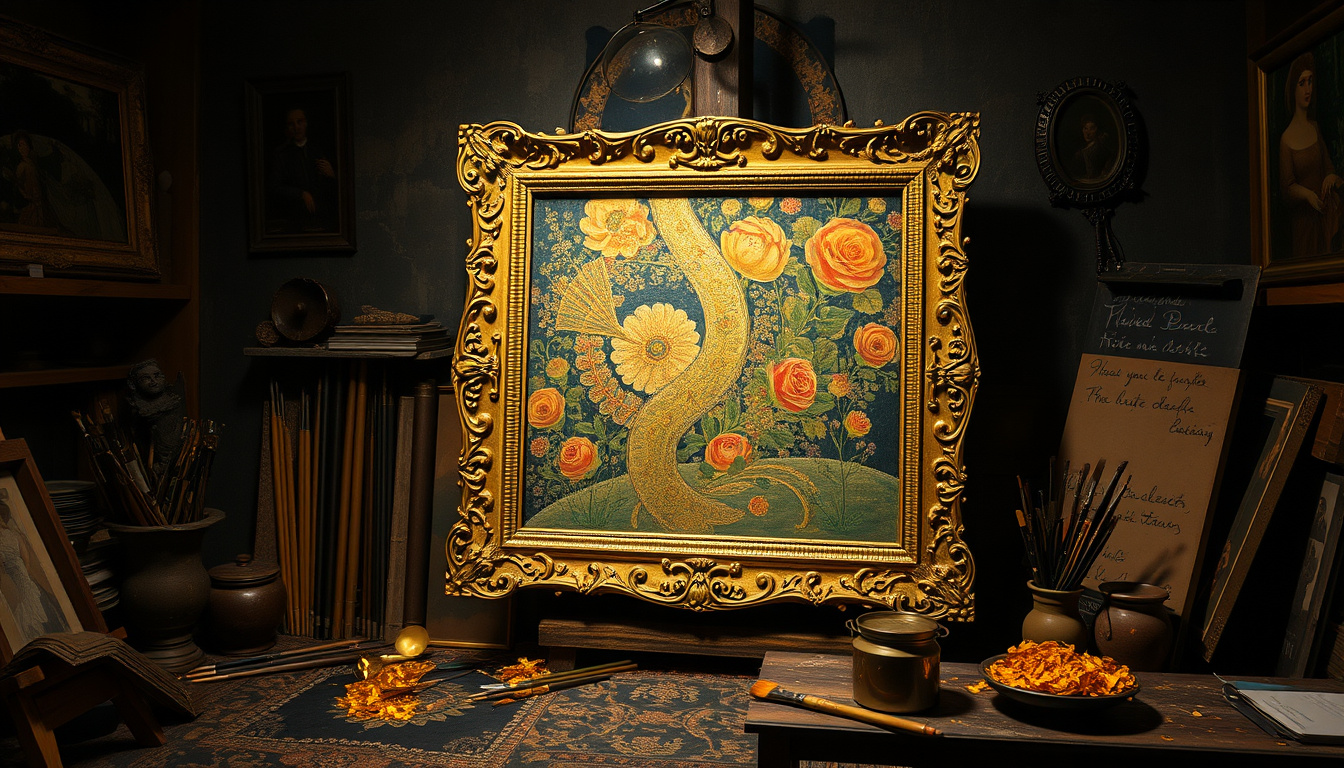
Few artists have wrapped their subjects in gold quite like Gustav Klimt. His shimmering canvases, especially The Kiss, are instantly recognizable — but behind the gilded surface was a man who defied conventions, both in art and in life.
Born: 14 July 1862 · Died: 6 February 1918 · Famous work: The Kiss · Movement: Symbolism, Vienna Secession · Record sale: $150 million (Portrait of Adele Bloch-Bauer I)
Quick snapshot
- Klimt never married (Wikipedia)
- He died of pneumonia after a stroke (Britannica)
- He was a founding figure of the Vienna Secession (The Art Story)
- 1897: Co-founded the Vienna Secession (Britannica)
- 1907–1908: Painted The Kiss (Britannica)
- 1918: Died in Vienna (Britannica)
- Klimt’s auction records continue to climb, with Portrait of Adele Bloch-Bauer I selling for $150 million in 2016 (Wikipedia)
- His works remain central to museum collections like the Belvedere, Vienna (Britannica)
Seven key facts about the artist, drawn from institutional sources:
| Label | Value |
|---|---|
| Born | 14 July 1862, Vienna, Austrian Empire |
| Died | 6 February 1918, Vienna, Austria |
| Nationality | Austrian |
| Movement | Symbolism, Vienna Secession |
| Famous work | The Kiss |
| Children | 14 (illegitimate) |
| Record sale | $150 million (Portrait of Adele Bloch-Bauer I, 2006) |
What is Gustav Klimt most famous for?
The Kiss and the Golden Phase
Klimt’s most iconic painting, The Kiss (1907–1908), is the centerpiece of his so-called “Golden Phase,” a period roughly spanning 1903 to 1909 (The Art Story). The canvas uses oil paint and gold, silver, and platinum leaf to create a shimmering mosaic effect (Britannica). It is held at the Belvedere Museum in Vienna and is often described as one of the finest works of the Vienna Secession (Britannica).
Klimt’s use of precious metals wasn’t just decorative — it signaled a rebellion against the muted tones of academic painting. Collectors willing to pay over $100 million for a single canvas are voting for that defiance.
Vienna Secession and Symbolism
In 1897, Klimt co-founded the Vienna Secession, a group of artists who rejected traditional academic art and favored a highly decorative style linked to Art Nouveau (Britannica). He served as its founding president (The Art Story). The Secession’s goals included exhibiting unconventional young artists, bringing foreign artists to Vienna, and publishing its own magazine (Klimt Gallery). The pattern: Klimt used flat surfaces, ornament, symbolism, and decorative patterning to create a style that was both personal and influential (Artsy).
Did Gustav Klimt have a wife?
His lifelong companion Emilie Flöge
Klimt never married, but he maintained a lifelong relationship with Emilie Flöge, a fashion designer who was his partner and muse (Wikipedia). She was one of many women in his intimate circle, but the exact nature of their arrangement remains a subject of speculation.
His illegitimate children
Klimt fathered at least 14 children with several models and lovers, though the exact number is disputed across biographies — some sources suggest up to 17 (Wikipedia). He had no known legitimate children (Wikipedia).
Klimt painted idealized women in gold, yet kept his real relationships deliberately ambiguous. For biographers, the gap between the public spectacle and the private man remains one of the most intriguing riddles in art history.
The ambiguity of his personal life only adds to the mystique of his art.
How much are Klimt paintings worth?
Record sales: Portrait of Adele Bloch-Bauer I and II
Klimt’s works command extraordinary prices. Portrait of Adele Bloch-Bauer I sold for $135 million in 2006, and Portrait of Adele Bloch-Bauer II fetched $87.9 million in the same year (Wikipedia). These sales placed Klimt among the most valuable artists in auction history.
Oprah’s purchase and sale
Oprah Winfrey bought Portrait of Adele Bloch-Bauer II in 2006 and later sold it privately in 2016 for $150 million, a record for the artist (Wikipedia). The transaction underscored the enduring demand for Klimt’s golden portraits.
What this means: For wealthy collectors, a Klimt is not just a painting — it’s a blue-chip asset that has appreciated faster than many stock portfolios.
How did Gustav Klimt die?
Stroke and pneumonia
Klimt died on 6 February 1918 in Vienna, at age 55, from pneumonia after suffering a stroke (Britannica). The exact cause of his stroke is not documented, and unverified claims persist that he may have had syphilis (Wikipedia).
His final years and legacy
In his last years, Klimt continued to produce major works, including the unfinished Bride. His death marked the end of an era for Viennese modernism. The influenza pandemic of 1918 also claimed other artists like Egon Schiele, but Klimt’s work — especially the golden-phase canvases — has only grown in stature.
Was Gustav Klimt wealthy?
High earnings from portrait commissions
Klimt was among the highest-earning artists of his time. His golden-phase works made him financially successful, and portrait commissions from wealthy Viennese patrons like the Bloch-Bauer family provided a steady income (Wikipedia). He lived comfortably and maintained a large studio.
His financial status at death
At his death, Klimt’s estate was significant, though not as enormous as the auction prices of his paintings today would suggest. The modern value of his work is a testament to the cultural shift that made his once-controversial style a global luxury commodity.
The trade-off: Klimt’s financial success came from painting the very elite he often satirized in his allegorical works. The tension between commercial success and artistic rebellion defined his career.
Timeline
- 14 July 1862 – Gustav Klimt born in Vienna, Austria (Britannica)
- 1897 – Co-founds the Vienna Secession (Britannica)
- 1907–1908 – Paints The Kiss and other works of his Golden Phase (Britannica)
- 6 February 1918 – Dies in Vienna from pneumonia after a stroke (Britannica)
Clarity check
Confirmed facts
- Klimt never married (Wikipedia)
- He died of pneumonia after a stroke (Britannica)
- He was a leading figure of the Vienna Secession (The Art Story)
- The Kiss is his most famous painting (Britannica)
What’s unclear
- Exact number of his illegitimate children (sources vary from 14 to 17) (Wikipedia)
- The specific cause of his stroke (Wikipedia)
- Whether he had syphilis (unverified claims) (Wikipedia)
- Whether he had any legitimate children (low confidence) (Wikipedia)
Quotes on Klimt’s impact
“Austrian artist whose gold-drenched canvases and bold female portraits made him one of the most influential figures of the early 20th century.”
— Christie’s auction house article (Christie’s)
“Klimt’s style is characterized by flat surfaces, ornament, symbolism, and decorative patterning — a visual language that broke with the academic tradition.”
— Artsy editorial (Artsy)
Klimt’s legacy is not just in the gold leaf — it’s in the way he forced the art world to confront the tension between decoration and meaning. For contemporary art collectors, the choice is clear: invest in a Klimt, or invest in the movement he inspired.
britannica.com, restinpieces.co.uk, artalistic.com, de.wikipedia.org, youtube.com, timetravel-vienna.at, mymodernmet.com, financeuk.uk
For a deeper look into his life and creative evolution, see Gustav Klimts biography and art style.
Frequently asked questions
What art movement did Gustav Klimt belong to?
Klimt was a leading figure of Symbolism and the Vienna Secession, a movement that broke from academic art and embraced decorative, Art Nouveau-inspired styles.
What is the meaning of The Kiss?
The painting is often interpreted as a celebration of love and intimacy, rendered in Klimt’s signature golden, mosaic-like style. It remains one of the most romanticized images in Western art.
Who were Gustav Klimt’s muses?
Klimt’s muses included Emilie Flöge, Adele Bloch-Bauer, and many unnamed models. His portraits of women often combined idealized beauty with psychological depth.
How did Klimt influence modern art?
Klimt’s use of ornament, flat perspective, and gold leaf influenced later artists like Egon Schiele and Oskar Kokoschka, and his work is a bridge between 19th-century academic painting and early modernism.
Where can I see Klimt’s paintings?
Major collections include the Belvedere Museum in Vienna (The Kiss), the Neue Galerie in New York (Portrait of Adele Bloch-Bauer I), and the Österreichische Galerie in Vienna.
What is the most expensive Klimt painting?
Portrait of Adele Bloch-Bauer I sold for $135 million in 2006; a private sale of Portrait of Adele Bloch-Bauer II reached $150 million in 2016.
Did Klimt have any famous students?
Klimt taught at the University of Applied Arts Vienna and influenced younger artists, but he did not have a formal school of followers. Egon Schiele, though not a direct student, was deeply influenced by him.
Related stories





Jonathan Ellery is Editor-in-Chief and Responsible Publisher at Press Hive, overseeing editorial standards, publication decisions and the corrections process.