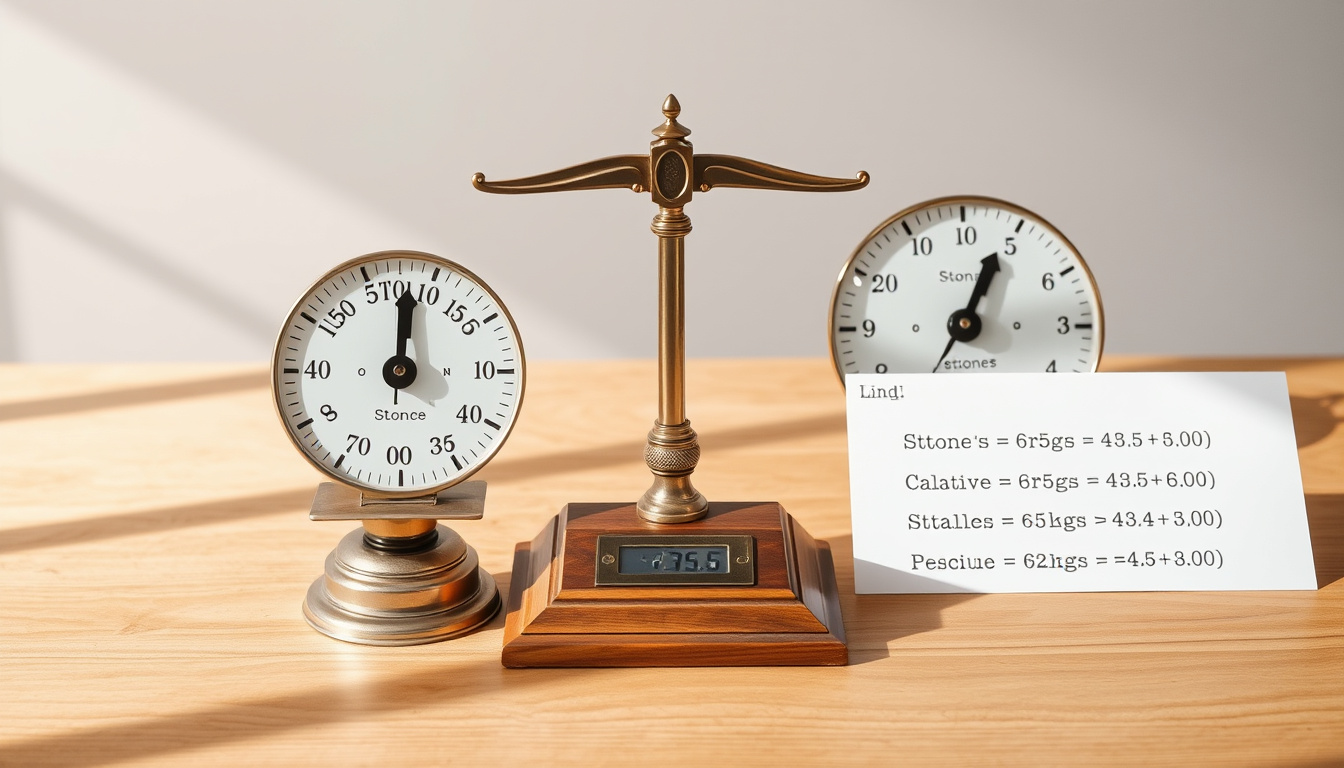

Converting between stone and kilograms is a common need for anyone working with UK and international weight measurements. Understanding the relationship between these units helps ensure accurate communication in healthcare, fitness, and everyday contexts.
The stone remains deeply embedded in British and Irish culture for measuring body weight, even as most of the world has adopted the metric system. This article provides the exact conversion for 10 stones to kilograms, along with the formula, conversion tables, and practical context for using this information.
How Many KG is 10 Stones?
Ten stones equals 63.50293 kilograms when using the precise conversion factor. For everyday purposes, this is commonly rounded to 63.5 kg. The calculation uses the internationally recognized value that one stone equals 6.35029 kilograms.
10 stones = 63.50293 kg (exact) = 63.5 kg (rounded)
Rounded value
Precise value
Pounds equivalent
Primary usage region
- The conversion factor is standardized internationally at 6.35029 kg per stone
- Ten stones equals approximately 140 pounds (since 1 stone = 14 pounds)
- The stone is legally recognized in the UK for body weight measurements
- Healthcare providers in Britain commonly use stone alongside kilograms
- For scientific applications, the precise value (63.50293 kg) is preferred
| Stones | Kilograms | Pounds |
|---|---|---|
| 1 st | 6.35 kg | 14 lb |
| 5 st | 31.75 kg | 70 lb |
| 10 st | 63.5 kg | 140 lb |
| 11 st | 69.85 kg | 154 lb |
| 14 st | 88.9 kg | 196 lb |
| 15 st | 95.25 kg | 210 lb |
How to Convert Stones to KG
Converting stones to kilograms requires multiplying the number of stones by the conversion factor 6.35029. This formula applies universally: kilograms = stones × 6.35029. The calculation is straightforward and can be performed with basic arithmetic or a calculator.
The Conversion Formula
The stone-to-kilogram conversion uses a fixed mathematical relationship. One stone equals exactly 6.350293 kilograms according to the internationally accepted definition. For 10 stones specifically: 10 × 6.35029 = 63.50293 kg.
An alternative approach uses the relationship through pounds: since 1 stone = 14 pounds and 1 pound = 0.45359237 kilograms, the calculation becomes stones × 14 × 0.45359237. This yields the same result when computed precisely.
For quick mental estimates, multiply stones by 6.35 kg. For more precision (such as in medical or scientific contexts), use 6.35029 or the full 6.350293 value.
Step-by-Step Conversion Process
To convert any stone value to kilograms manually, follow these steps. First, identify the number of stones you need to convert. Second, multiply that number by 6.35029. Third, round the result to your desired precision level.
For example, converting 10 stones 5 pounds requires first converting the additional pounds to kilograms (5 lb × 0.45359237 = 2.27 kg) and adding to the base calculation. This yields approximately 65.77 kg for 10 stone 5 pounds.
10 Stones in Pounds and Other Units
Ten stones converts to 140 pounds, since each stone equals exactly 14 pounds. This direct relationship makes conversions between stone and pounds straightforward: simply multiply the stone value by 14. For 10 stones: 10 × 14 = 140 pounds.
Pounds and Ounces Breakdown
When expressed with additional precision, 10 stones 0 pounds equals exactly 140 pounds 0 ounces. For fractional stone measurements, the ounce conversion becomes relevant since 1 pound contains 16 ounces. Healthcare and fitness contexts often use half-stone (7 lb) or quarter-stone (3.5 lb) increments.
The relationship between stone and metric units flows through pounds as an intermediary. One stone equals 14 pounds, which equals 6.35029 kilograms. This chain of conversions allows for precise calculations across all three systems.
Grams and Milligrams
For laboratory or pharmaceutical applications requiring finer granularity, 63.50293 kilograms converts to 63,502.93 grams or 63,502,930 milligrams. These smaller units are rarely needed for body weight but become relevant in scientific and medical measurement contexts.
Most digital scales in the UK display weight in kilograms with one or two decimal places, matching the precision most people require for health monitoring. Specialized medical equipment may provide greater decimal precision.
Context: Where Stone is Used and Weight Insights
The stone measurement remains primarily used in the United Kingdom and Ireland for measuring human body weight. Despite the country’s official adoption of metric measurement, stone persists strongly in everyday conversation, healthcare settings, and personal fitness tracking. This cultural attachment reflects the unit’s deep roots in British society.
Weight Comparison and Average Ranges
Ten stones (63.5 kg) represents a weight that falls within lower-to-average ranges for most adult populations. According to health data, the average adult male in the UK typically weighs between 70-80 kg (approximately 11-12.6 stones), while females generally fall between 60-70 kg (approximately 9.4-11 stones).
At 10 stones, a person would be considered lighter than average for an adult male but within a normal range for smaller-framed individuals or younger adults. Context matters significantly when evaluating whether any specific weight is healthy, as height, build, muscle mass, and other factors influence what constitutes a healthy weight for each individual.
Weight classification depends on multiple factors including height and body composition. Ten stones may represent different health implications for different people. For personalized health guidance, consulting healthcare professionals is recommended.
Regional Usage Patterns
British healthcare providers routinely use stone in patient discussions and medical records, though official documentation increasingly displays kilograms. NHS weight conversion charts provide both values to facilitate understanding across metric and traditional systems. This dual-display approach helps bridge the transition while maintaining familiarity for those accustomed to stone measurements.
Fitness applications and bathroom scales sold in the UK typically offer stone as a primary display option, reflecting consumer preference. Many digital scales allow users to switch between stone, kilograms, and pounds according to their preference.
Those tracking weight for fitness purposes may find our guides on Mounjaro Weight Loss Reviews and Does Creatine Make You Gain Weight helpful for understanding how various factors influence body weight measurements.
Historical Development of the Stone Unit
The stone as a unit of weight has ancient origins in England, dating back to at least the 14th century. Historical records indicate that standardization efforts began in the late 1300s, with the Weavers’ Company of London establishing a 14-pound standard in 1389. This particular value was adopted because it represented a convenient weight for trade—roughly equivalent to what one person could easily carry.
- 14th century: Stone emerges as a trade weight in England
- 1389: Standardization to 14 pounds established by royal decree
- Medieval period: Different regions use varying stone values for specific goods
- 19th century: British weights and measures legislation attempts standardization
- 1985: The Weights and Measures Act effectively phases out stone for official trade purposes
Despite these formal changes, the stone retained cultural significance for body weight measurement. The UK Weights and Measures Act permits the use of stone for personal weight measurements, explaining its continued presence in British daily life.
Measurement Precision and Uncertainty
The relationship between stone and kilograms is precisely defined with no inherent uncertainty. One stone equals exactly 6.35029 kilograms by international agreement. This fixed value means conversions between the two units carry no ambiguity when using the standard factor.
Established Information
- 1 stone = exactly 6.35029 kg
- 10 stones = exactly 63.5029 kg
- 1 stone = exactly 14 pounds
- The unit is legally defined
Less Certain Areas
- Precise historical origins before 1389
- Regional variations in medieval stone values
- Exact etymology of the term “stone”
- Comprehensive usage documentation across all periods
For practical purposes, the rounded value of 6.35 kg per stone serves most everyday needs. Scientific, medical, and commercial applications typically require the full precision value to avoid cumulative rounding errors.
Official Standards and References
The National Institute of Standards and Technology (NIST) provides authoritative reference information on international weight units and their precise definitions. These standards ensure consistency in measurement across international commerce and scientific research.
UK legislation permits the use of stone for personal body weight measurements under the Weights and Measures Act 1985. This legal framework means that healthcare providers, fitness professionals, and individuals can continue using stone measurements without regulatory concerns.
The stone, as a unit of weight for measuring human body weight, remains a permitted supplementary indication in the United Kingdom for personal measurement purposes.
Healthcare organizations including NHS trusts publish official conversion charts to facilitate understanding between measurement systems. These resources, such as weight conversion charts from University Hospitals Sussex NHS Foundation Trust and the Community Pharmacy Scotland, provide verified conversion data for clinical use.
Using This Information
Converting between stone and kilograms becomes straightforward once the conversion factor is understood. For 10 stones specifically, the answer is 63.5 kg when rounded or 63.50293 kg for maximum precision. The calculation formula—multiply stones by 6.35029—applies universally to any stone value.
Whether tracking personal health metrics, following a fitness program, or communicating weight information across regions using different measurement systems, understanding this conversion provides practical utility. Online calculators offer quick results, while knowing the underlying formula enables calculations without digital tools.
For those exploring weight management or fitness journeys, understanding how various factors affect body composition provides valuable context alongside raw weight measurements.
Frequently Asked Questions
What is 1 stone in kg?
One stone equals exactly 6.35029 kilograms. For quick estimates, 1 stone is commonly rounded to 6.35 kg.
Is 10 stone overweight?
Whether 10 stone is overweight depends on individual factors including height, age, gender, and body composition. Ten stones (63.5 kg) falls within normal ranges for smaller-framed individuals or shorter heights.
Where is the stone unit used?
The stone is primarily used in the United Kingdom and Ireland for measuring human body weight. It remains common in healthcare, fitness, and everyday conversation despite metric adoption.
How do I convert stone to kilograms without a calculator?
Multiply the number of stones by 6.35 (or 6.35029 for precision). For 10 stones: 10 × 6.35 = 63.5 kg.
What is 10 stones in pounds?
Ten stones equals 140 pounds, since one stone equals exactly 14 pounds.
Can I use stone measurements officially in the UK?
Yes, UK law permits stone for personal body weight measurements. Official trade uses metric, but healthcare and personal use commonly display stone alongside kilograms.
How accurate is the 6.35 kg approximation?
The rounded value of 6.35 kg is accurate to two decimal places. The precise value is 6.35029 kg. The difference becomes significant only when multiplying across larger values.
Related stories





Amelia Blackwell covers the economy, business and consumer affairs for Press Hive.