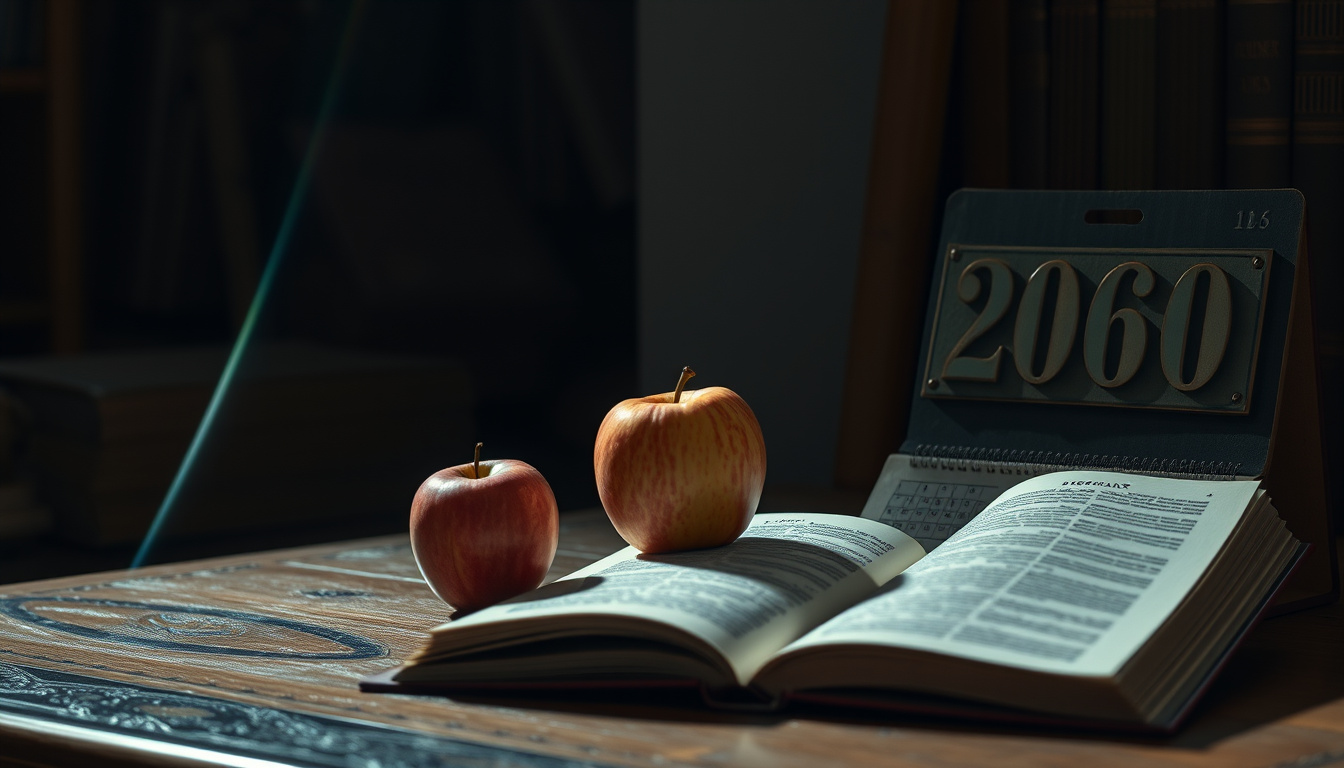
Most people remember Isaac Newton for an apple. But the man behind the story spent far more time on alchemy, biblical prophecy, and sleepless nights than on fruit.
Born: 25 December 1642 · Died: 31 March 1727 · Known for: Laws of motion, universal gravitation · Major Work: Principia Mathematica (1687)
Quick snapshot
- Formulated three laws of motion (Britannica)
- Discovered law of universal gravitation (Britannica)
- Co-invented calculus (New Mexico Museum of Space History)
- 1665–1666: Annus Mirabilis – develops calculus and theories of light (Britannica)
- Ongoing scholarly work on Newton’s theology and alchemical manuscripts (Britannica)
Eight key facts about Newton, one pattern: the man was a relentless polymath whose work spanned physics, mathematics, optics, theology, and even alchemy.
| Label | Value |
|---|---|
| Full Name | Sir Isaac Newton |
| Born | 25 December 1642, Woolsthorpe, Lincolnshire, England (Britannica) |
| Died | 31 March 1727, London, England (Britannica) |
| Known for | Laws of motion, universal gravitation, calculus (Space.com) |
| Education | Trinity College, Cambridge (New Mexico Museum of Space History) |
| Major Works | Philosophiæ Naturalis Principia Mathematica (1687), Opticks (1704) (Britannica) |
| Estimated IQ | 190–200 (modern estimates, not a historical measure) |
| Hours slept per day | 4–5 (often cited, sources diverge) |
What is Isaac Newton best known for?
His laws of motion
- Newton formulated three universal laws that describe how objects move (Britannica).
- These laws underpin classical mechanics and remain foundational in physics education.
Universal gravitation
- Newton discovered that every particle attracts every other particle with a force proportional to their masses and inversely proportional to the square of the distance (Space.com).
- This principle unified celestial and terrestrial motion for the first time.
Invention of calculus
- Newton independently developed infinitesimal calculus during 1665–1666 (New Mexico Museum of Space History).
- He shares credit with Gottfried Wilhelm Leibniz, though Newton’s work predates publication (Wikipedia).
Newton’s three pillars—laws of motion, gravitation, and calculus—effectively invented modern physics. Without them, the discipline would look radically different. For students and teachers, these discoveries form the bedrock of nearly every introductory physics course.
The implication: Newton’s achievements are not just historical footnotes—they are still taught as the starting point for understanding the physical world.
What are 10 facts about Isaac Newton?
Early life and education
- Newton was born prematurely; his mother reportedly said he could fit into a quart pot (Britannica).
- He entered Trinity College, Cambridge in 1661 and earned his Master’s degree in 1668 (New Mexico Museum of Space History).
- During the plague years (1665–1666), he retreated to Woolsthorpe and made his most groundbreaking discoveries.
Scientific achievements
- He published Principia in 1687, described by Biography.com as the single most influential book on physics.
- He invented the reflecting telescope, which eliminated chromatic aberration (Britannica).
- He demonstrated that white light is composed of a spectrum of colors (Britannica).
Personal quirks
- Newton reportedly slept only 4–5 hours per night, a habit that contributed to his enormous output.
- He never married and had few close friendships.
- He was deeply involved in alchemy and theology, writing more on those subjects than on physics (Wikipedia).
The pattern: Newton’s relentless focus on a wide range of topics meant he achieved extraordinary breadth and depth—but also left behind unresolved questions about his esoteric interests.
What are the 3 laws of Newton?
First law: inertia
- An object at rest stays at rest, and an object in motion stays in motion unless acted upon by an external force (Britannica).
Second law: F = ma
- Force equals mass times acceleration. The greater the mass, the more force needed to accelerate it.
Third law: action-reaction
- For every action, there is an equal and opposite reaction (Britannica).
These laws revolutionized engineering, astronomy, and everyday technology. For anyone learning physics, they remain the first step toward understanding motion.
The catch: While these laws are simple to state, they revolutionized engineering, astronomy, and everyday technology.
Who predicted the world will end in 2060?
Newton’s theological writings
- Newton devoted years to studying biblical chronology and prophecy (Wikipedia).
- He believed the Bible contained hidden mathematical codes that could predict major historical events.
The 2060 date interpretation
- In one manuscript, Newton calculated that the “end of the world” could come in 2060, based on the 1,260-day prophecy in the Book of Daniel.
- He never published this date; it was discovered among his papers after his death.
Misconceptions about the prediction
- Newton did not issue a doomsday warning. He wrote that the end would be followed by a new divine kingdom, not destruction.
- His calculation was a scholarly exercise, not a public proclamation. Modern sensationalism often misrepresents it.
The 2060 date is frequently cited in clickbait headlines. For media literacy, understanding Newton’s original context prevents unnecessary alarm. For historians, it reveals the surprisingly intertwined worlds of 17th-century science and religion.
The catch: Newton’s 2060 note is a textbook example of how a narrow, academic remark can be blown out of proportion by a culture that craves apocalyptic predictions.
What is Newton’s estimated IQ?
Historical IQ estimation methods
- IQ scores are modern constructs; they were not applied to individuals until the 20th century.
- Estimates for historical figures like Newton are based on achievements, complexity of work, and contemporary accounts.
Newton’s intellectual achievements
- His ability to synthesize mathematics, physics, and optics into a single framework is considered evidence of extraordinary intelligence.
- An Ohio State University biography calls him “the most original and influential theorist in the history of science” (Ohio State University host PDF).
Comparison with other geniuses
- Popular estimates place Newton’s IQ at 190–200, comparable to Albert Einstein and Leonardo da Vinci.
- These figures are speculative; no standardized test existed during Newton’s lifetime.
The implication: Assigning an IQ number to Newton is more about cultural fascination than science. The real measure is the lasting impact of his ideas.
“If I have seen further it is by standing on the shoulders of Giants.”
Isaac Newton, letter to Robert Hooke, 1675 (Britannica)
“Newton was not the first of the age of reason. He was the last of the magicians, the last of the Babylonians and Sumerians.”
John Maynard Keynes, on Newton’s alchemical pursuits (Wikipedia)
Newton transformed physical science with his three laws and universal gravitation, yet he spent just as many hours studying alchemy and biblical prophecy. The real legacy is not a single discovery but a method—the systematic application of mathematics to nature. For anyone curious about the history of science, the choice is clear: engage with the real Newton, not the myth, or miss the depth of a mind that shaped the modern world.
britannica.com, ancient-origins.net, reddit.com, isaacnewton.org, thecollector.com, southern.libguides.com, spill.casino
For a broader look at his life, discoveries and legacy, readers can explore his life, discoveries and legacy.
Frequently asked questions
Did Newton really invent calculus?
Yes, Newton independently developed calculus during 1665–1666. Gottfried Leibniz published his own version later, leading to a famous priority dispute. Most historians now recognize both as independent inventors. (Britannica)
How did Isaac Newton die?
Newton died in London on 31 March 1727 (Gregorian calendar) at the age of 84. The cause is believed to be natural causes related to old age. (New Mexico Museum of Space History)
Was Isaac Newton knighted?
Yes, Queen Anne knighted Newton in 1705, making him Sir Isaac Newton. (Biography.com)
What was Newton’s role at the Royal Mint?
Newton was appointed Warden (1696) and later Master (1699) of the Royal Mint. He oversaw the Great Recoinage and pursued counterfeiters with zeal.
Why did Newton study alchemy?
Newton believed that alchemy held secrets about the material world’s transformation. He wrote over a million words on alchemistical subjects, viewing it as a legitimate branch of natural philosophy. (Wikipedia)
Did Newton ever marry?
No, Newton never married. He had few close relationships and appears to have been entirely devoted to his intellectual work.
What is the story of the apple and gravity?
The tale that Newton discovered gravity after watching an apple fall is widely repeated. While Newton himself told the story, it may be a simplified anecdote rather than a literal account of his insight. (Space.com)
Related reading: Attila the Hun · King Arthur: The Legend, the History, the Facts
Related stories





Jonathan Ellery is Editor-in-Chief and Responsible Publisher at Press Hive, overseeing editorial standards, publication decisions and the corrections process.