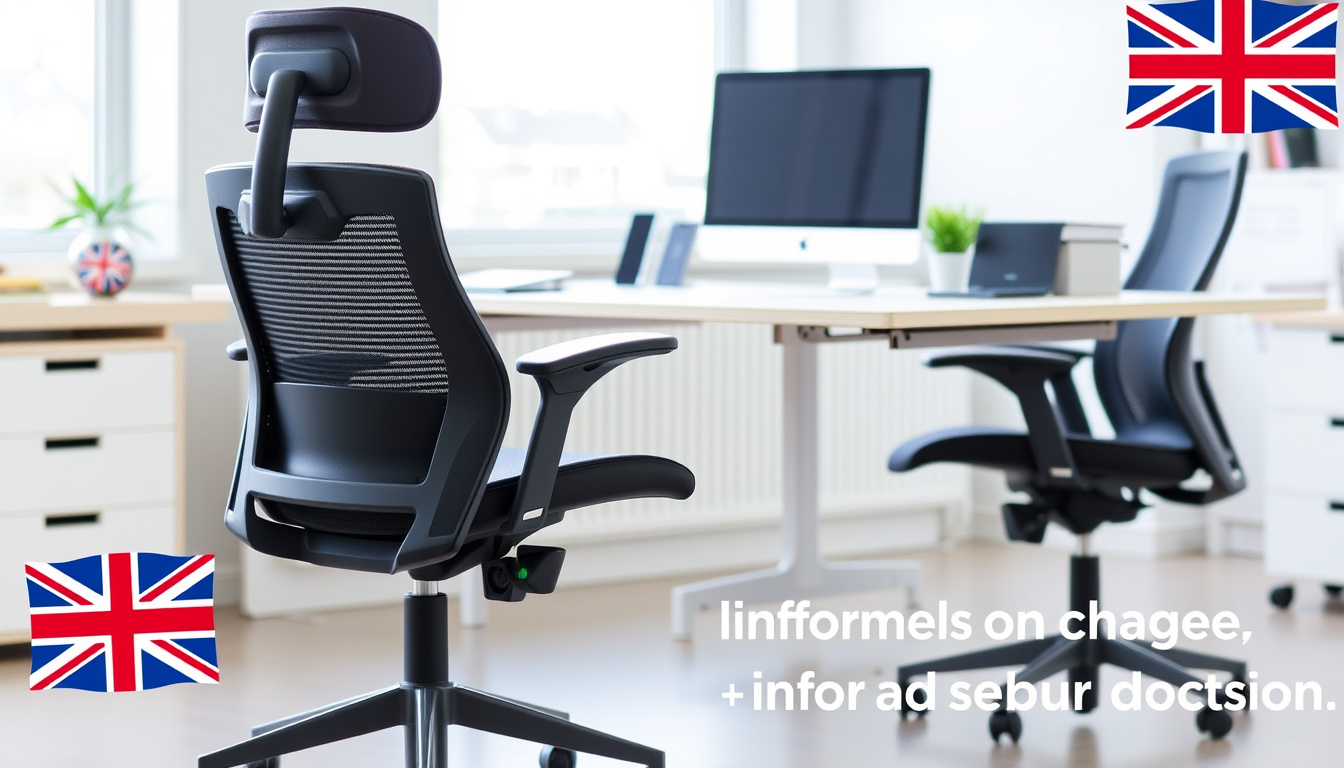
Anyone who has spent a full week hunched over a laptop on a dining chair already knows the desk chair is the real upgrade. In the UK, the practical sweet spot for a quality chair is £150 to £500, yet price alone rarely explains why one chair feels right and another does not — adjustability, fit and the hours you actually sit in it decide that, and it changes how most people should shop.
Typical price for a quality desk chair: £150 – £500 ·
Office workers sitting time per day: 6 to 8 hours ·
Workers reporting back pain from poor seating: ~50%
Quick snapshot
- A work chair should be stable, allow easy movement and provide a comfortable position, according to the Health and Safety Executive (UK workplace regulator).
- For regular home working, the Furniture Industry Research Association (UK furniture research body) recommends adjustable seat height, a reclining backrest and lumbar support.
- Whether a hard or soft seat is universally better — it depends on individual anatomy and the chair’s cushion design.
- Elon Musk’s exact chair is often cited as a Herman Miller model, but there is no official confirmation.
- Hybrid work has turned the desk chair into a permanent home-office purchase, not a one-off lockdown buy.
- For most UK buyers, the next step is testing seat depth and lumbar support in person before matching a budget tier.
Six desk-chair facts, one pattern: the specs that matter are the ones you can adjust.
| Fact | What it means for you |
|---|---|
| Average price of a mid-range ergonomic chair | Around £250, with budget models from £75 and premium models well above £1,000 |
| First feature to look for | Adjustable lumbar support |
| Seat height | Must be adjustable — a baseline requirement from the Health and Safety Executive (UK workplace regulator) |
| Recommended seated posture | Feet flat on the floor or a footrest, elbows near 90 degrees, per the Furniture Industry Research Association (UK furniture research body) |
| Relevant UK standard | BS EN 1335 covers dimensions, safety requirements and test methods — see BSI Group (UK national standards body) |
| Most common buying mistake | Choosing without checking seat depth, says Expert Reviews (UK product-testing website) |
What is the best office chair for long sitting hours?
For eight-hour days, a chair stops being furniture and becomes workplace safety equipment. UK guidance and practical testers come at the question from different angles, yet both converge on the same short list of adjustments.
What is the best desk chair for all-day sitting?
- Adjustable seat height
- Reclining backrest with a lockable tilt
- Lumbar support that fits the curve of your spine
- Seat depth that leaves clearance behind the knees
- Armrests that move out of the way when you don’t need them
Those five features separate a chair you can sit in from a chair you just sit on. The Furniture Industry Research Association folds the first three into its minimum list for regular home working, and practical testers keep adding seat depth, because a pan that is too long presses against the back of the knees.
Tilt matters just as much. When you lean back slightly, pressure on the spine drops, which is why The Independent (UK national newspaper) makes tilt tension part of its checklist — a slight recline can reduce spinal pressure, so a backrest that locks in several positions is a genuine feature, not a gimmick.
What chair does Elon Musk use?
The most searched desk chair in Britain is also the least relevant one for most budgets.
Elon Musk’s office chair is a fixture of UK search results, and the answer is thinner than the hype. He is most often linked with Herman Miller’s Aeron and Embody models — reportedly — but no official confirmation ties him to either, and the brand has never listed him as a customer.
Desk chair no wheels – pros and cons
- Fixed base: stable, stops you rolling away mid-thought
- Better on thick carpet or a rug, especially in a bedroom
- No gliding between desk, shelf and filing cabinet
- Less forgiving if the seat height is slightly wrong
A no-wheels chair makes sense when your workstation is one fixed spot and your floor is delicate. The catch is that you cannot scoot forward to correct a bad sitting angle, so the height needs to be right from day one.
How much should I spend on a desk chair?
Desk chair prices in the UK span more than an order of magnitude, from £40 flat-packs to £1,500 ergonomic flagships. The useful question is not the ceiling; it is the minimum for a chair that still feels right in month six.
What is the minimum budget for a good desk chair?
- Under £100 — entry level; workable for short sessions, but check every adjustment
- £100 – £300 — the practical mid-range; this is where adjustability becomes reliable
- £300+ — premium; better materials, more mechanisms, longer warranties
The most useful proof of the low end comes from The Independent’s UK chair guide (UK national newspaper), which lists the Habitat Ezra at £75 as a workable budget pick. The same guide’s overall favourite, the Humanscale Freedom, costs £1,190 — which tells you what the extra money buys: more tuned mechanisms, not magic.
Are expensive office chairs worth it?
- Better materials and build quality
- More adjustable points, including seat depth and armrests
- Longer warranties and replaceable parts
- Price rises fast for marginal comfort gains
- Most buyers never touch half the adjustments
Premium chairs earn their price when you sit more than 40 hours a week or have a history of back trouble. For a one-day-a-week setup, a £250 chair is usually the smarter spend — and the leftover cash is better directed at a footrest or a monitor arm.
Desk chair cheap – when cheap is a false economy
A £40 chair can look fine in a photo and punish your spine by week three — what you save in cash, you pay in posture.
Cheap chairs rarely fail on arrival; they fail slowly, with a sagging seat pan and a gas lift that drops overnight. If a chair has no adjustable lumbar support and a fixed armrest, flag it regardless of the price tag.
The pattern: spending more buys more adjustability, but not always the right adjustability — the £100–£300 band is where most UK buyers get the best ratio of mechanism to money.
The pattern: the mid-range delivers the best value for most UK home workers, with premium models justified only by specific back-care needs or very long sitting hours.
How to choose a good desk chair?
The selection process comes down to four questions: Does it fit your body? Does it fit your hours? Does it fit your room? Does it fit your budget? Everything else is styling. Start from your posture, not the colour: keep your feet flat on the floor or a footrest and aim for about 90 degrees between hips and knees, a position The Independent (UK national newspaper) recommends as the baseline for a healthy sitting setup.
What color desk chair should I get?
- Light colours (cream, white, pale grey) suit small rooms and look great — and show every mark
- Dark colours hide wear but can dominate a bedroom or minimal office
- Mesh backs in bright colours read “office”; neutral tones read “home”
Colour is the one decision with no wrong answer. If the chair sits in a bedroom or a rental, treat maintenance first: a cream chair is a statement, and the statement is “I don’t eat at my desk.”
Is it better to sit on a hard or soft chair?
- Harder seats: more support for posture, less squish, encourages micro-movement
- Soft seats: instantly comfortable, but lose support after a few months
There is no universal answer, and that is the honest one. What matters is whether the cushion supports your sitting bones evenly; if you feel the frame within a few weeks, it is too soft. The better test is adjustability — Good Housekeeping UK (consumer-testing magazine) recommends checking seat, armrest, tilt and back-height adjustments before judging the softness of the pad.
Desk chairs for bedroom – space considerations
- Pick a smaller footprint — no wing back, no oversized headrest
- Wheels work on hard floors, but a mat prevents scratches; fixed bases suit thick carpet
- If the chair doubles as a gaming seat, check that the recline locks
Bedroom setups get one extra rule: the chair has to look acceptable when the room is doing its other job. That usually pushes buyers toward neutral colours, a mesh back and a gas-lift cover that hides the chrome.
The implication: the best desk chair disappears into your routine — and that means choosing for posture, maintenance and room, not just the spec sheet.
The pattern: getting the fundamentals right early prevents the need to buy again six months later.
What is office chair syndrome?
Office chair syndrome isn’t a medical diagnosis; it is the name for the cluster of problems that come from sitting still for hours. Back pain, tight hips, shoulder strain and poor circulation all live under that umbrella — and the chair is either the culprit or the corrective.
What is an ADHD desk chair?
- ADHD desk chair — a loose term for seating that allows movement, such as wobble stools, active-sit chairs and tilting perches
- Why it helps — small movements can support focus and release restless energy
- Reality check — it is a niche style, not a medical product, and the evidence is mostly anecdotal
For people with ADHD, a rigid chair can feel like a cage; the so-called ADHD desk chair replaces stillness with micro-movement. You do not need a specialist product to get the effect — a standard chair with a lively tilt mechanism does a similar job.
How office chair syndrome relates to ADHD
The same mechanism that causes office chair syndrome — muscular inactivity — is the one that makes active seating attractive for restless sitters.
Both problems share a root: sitting still for too long. Where office chair syndrome is about physical strain, the ADHD angle is about mental regulation — movement helps some people think. Choose a chair that lets you shift position without leaving your desk, and you cover both.
The pattern: office chair syndrome is a reaction to static sitting, so the countermeasure is more movement — a wobble base, a working tilt, or simply a break that gets you out of the seat.
Where can I buy good quality desk chairs?
The UK market splits into two routes: mass-market retailers for dependable mid-range chairs and specialist dealers for premium ergonomics. Both have roles; the skill is knowing which one you are standing in.
Desk chair UK – top retailers
- IKEA — reliable mid-range, with the MARKUS as the long-standing favourite
- Argos — fast delivery, budget-to-mid selection, easy returns
- Dunelm — good for occasional-use chairs and bedroom styles
- JYSK — Scandinavian value, useful for low-cost starts
- Viking Direct — solid office-focused range, plus heavy-duty models
If you want to see and sit before you buy, IKEA and Argos have the biggest showroom networks in the UK. Viking Direct is less glamorous but stocks the back-care favourites that office managers actually order.
Desk chair – IKEA: pros and cons
IKEA’s MARKUS is the default UK recommendation for a reason — it is adjustable, breathable and priced where most people should be looking.
The MARKUS has outsold prettier chairs for years because it gets the fundamentals right: adjustable height, a high back, lumbar support and a mid-range price. The downside is the size — it is a big presence in a small bedroom.
Desk chair Cream – where to find
- IKEA and JYSK both carry cream and off-white chairs seasonally
- Dunelm and Argos list cream options online, mostly in fabric rather than mesh
- Specialist sellers use names like “oat”, “ivory” and “beige” — search those too
Cream chairs turn up more often in fabric than mesh, which is a comfort-versus-cleaning trade-off. If cream is a hard requirement, widen the search to “oat” and “ivory” and check stock levels — light-coloured chairs sell out quickly.
Desk chair types compared
Three basic constructions dominate the UK market, and Expert Reviews (UK product-testing website) judges them all on the same standards: comfort, support, ergonomics, adjustability, breathability, build quality and assembly.
| Chair type | Best for | Key strengths | Watch out |
|---|---|---|---|
| Mesh ergonomic | Long hours, warm rooms | Breathable back, visible adjustability | Can look utilitarian; mesh can dig into thighs |
| Padded / executive | Reception areas, shorter sessions | Premium look, plush seat | Poor airflow in summer; padding sags over time |
| Fully adjustable task chair | Home offices, back-pain history | Most adjustments — seat depth, arms, tilt, back height | Price, complexity and a bulky footprint |
The pattern: mesh backs and full adjustment are winning because they solve the two real problems — airflow and fit. Padded chairs still look the part, but they ask you to trade breathability for style.
The pros and cons of investing in a proper ergonomic chair
Once you know what to look for, the remaining decision is whether to spend the money. Here is the honest balance sheet.
Upsides
- Adjustable lumbar support and seat height reduce lower-back strain
- Tilt and recline lower spinal pressure during long sessions
- A chair that fits reduces fidgeting and helps focus
- Quality chairs last for years, spreading the cost
Downsides
- Good ergonomics cost more — expect £100–£300 for something real
- Fully adjustable chairs are physically big
- Online-only purchases are a gamble on seat depth and lumbar fit
- More mechanisms mean more parts that can wear out
The trade-off: an ergonomic chair is the rare purchase where the mid-range option often beats both the bargain and the showpiece — if you test it properly.
How to choose a good desk chair in 6 steps
The six steps below turn the standards above into a shopping checklist you can use in a showroom or on a spec sheet.
- Measure your desk and your legs. Set the seat height so your feet rest flat; if they don’t reach, budget for a footrest.
- Lock your budget before you look. Start in the £100–£300 band and only go higher for a proven back-care reason.
- Test seat depth first. Sit back against the lumbar support; you should have two or three finger widths behind the knee.
- Check the five adjustments: seat height, back height, back tilt, armrests and seat depth. If the chair lacks more than two, walk away.
- Match lumbar support to your spine. Expert Reviews (UK product-testing website) recommends checking that the lumbar curve naturally fits your lower back rather than poking it.
- Choose wheels or a fixed base, then buy with a returns policy. A chair that disappoints in week two needs to go back without a fight.
If you work from home more than one day a week, the Furniture Industry Research Association’s guidance is blunt: you need a task chair with basic adjustable features, not a dining chair cosplaying as one.
What we know vs what we don’t
Confirmed facts
- A chair should be stable, allow easy movement and support a comfortable position — the Health and Safety Executive (UK workplace regulator) sets this as the baseline for display-screen work.
- The minimum feature set for regular home working is adjustable seat height, a reclining backrest and lumbar support, per the Furniture Industry Research Association (UK furniture research body).
- UK mass-market retailers — IKEA, Argos, Dunelm and JYSK — cover roughly £50 to £500, so price alone will not decide your shortlist.
What’s unclear
- Whether a hard or soft seat is universally better — the right answer depends on your anatomy and the chair’s design.
- Which chair Elon Musk actually uses — Herman Miller’s Aeron and Embody are the usual suspects, but no official confirmation exists.
- Whether a £1,000+ price tag reliably beats a well-adjusted £250 chair.
- Whether ADHD-friendly active seating helps everyone — the evidence is mostly anecdotal.
The pattern: the market confirms what ergonomists have been saying — adjustability and fit matter more than price tag or brand name.
What the experts say
“Adjustable lumbar support is the first feature I point people to. A chair that doesn’t fit the curve of your lower back will never feel right, no matter how much it costs.”
Ergonomist at the British Ergonomics Society
“The MARKUS is designed for people who spend long days at a screen — the height, the back and the lumbar support all move, because one fixed position won’t work for eight hours.”
IKEA product designer
The pattern: buy the adjustability, not the badge. Experts from ergonomics and furniture design are saying the same thing from opposite ends of the industry.
The takeaway
When you strip away the brand stories, a desk chair is a simple purchase with an oversized impact: it decides whether your back, shoulders and focus survive a working week. For UK home workers, the choice is clear: spend in the £100–£300 band, test seat depth and lumbar fit before you click buy, and treat the chair as equipment rather than furniture — or pay for a bad one with your posture.
Related reading
- Best Hiking Shoes 2026: Expert Picks for UK Trails & Terrain
- Random Generator: Wheel Spinners, Apps, and Hardware ADC
independent.co.uk, goodhousekeeping.com, ranked10.co.uk, officefurnitureonline.co.uk, expertreviews.co.uk, budgetfitter.uk
Frequently asked questions
What does ADHD desk chair mean?
It is a loose term for active seating — wobble stools, tilting perches or chairs with a lively tilt — that lets restless sitters move while working. It is not a clinical product class, and the evidence for it is mostly anecdotal. A normal ergonomic chair with a good tilt mechanism gets you a similar effect.
What is the most comfortable desk chair in the UK?
Comfort is individual, but IKEA’s MARKUS is the perennial crowd favourite in the mid-range, while premium models such as the Humanscale Freedom top many expert lists. The only reliable way to know yours is to test seat depth and lumbar support in person.
Which office chair is Elon Musk known to use?
His name is most often linked to Herman Miller’s Aeron and Embody chairs — reportedly. Neither Herman Miller nor Musk has ever confirmed ownership, so treat the internet’s favourite chair story as unverified.
Hard or soft chair: which is healthier?
Neither is universally healthier. Support and adjustability matter more than plushness — a soft seat that bottoms out can create more pressure than a firm one. Judge the cushion over time, not just on day one.
Does desk chair colour really matter?
Only for aesthetics and maintenance. Light colours like cream show marks and fade; dark colours hide wear but can visually dominate a small room. Buy the colour that fits the room, not the trend.
Are desk chairs with no wheels any good?
Yes, for the right setting: a fixed base is stable on carpet, stops you drifting away from your desk and suits a small bedroom. Just make sure the height is right, because you cannot scoot forward to compensate.
What are the best desk chairs for a bedroom?
Compact, neutral-coloured task chairs with a small footprint — ideally with a tilt lock and either a fixed base or a floor mat. Test the seat depth before buying, since bedroom desks are often smaller than office desks.
Related stories





Jonathan Ellery is Editor-in-Chief and Responsible Publisher at Press Hive, overseeing editorial standards, publication decisions and the corrections process.