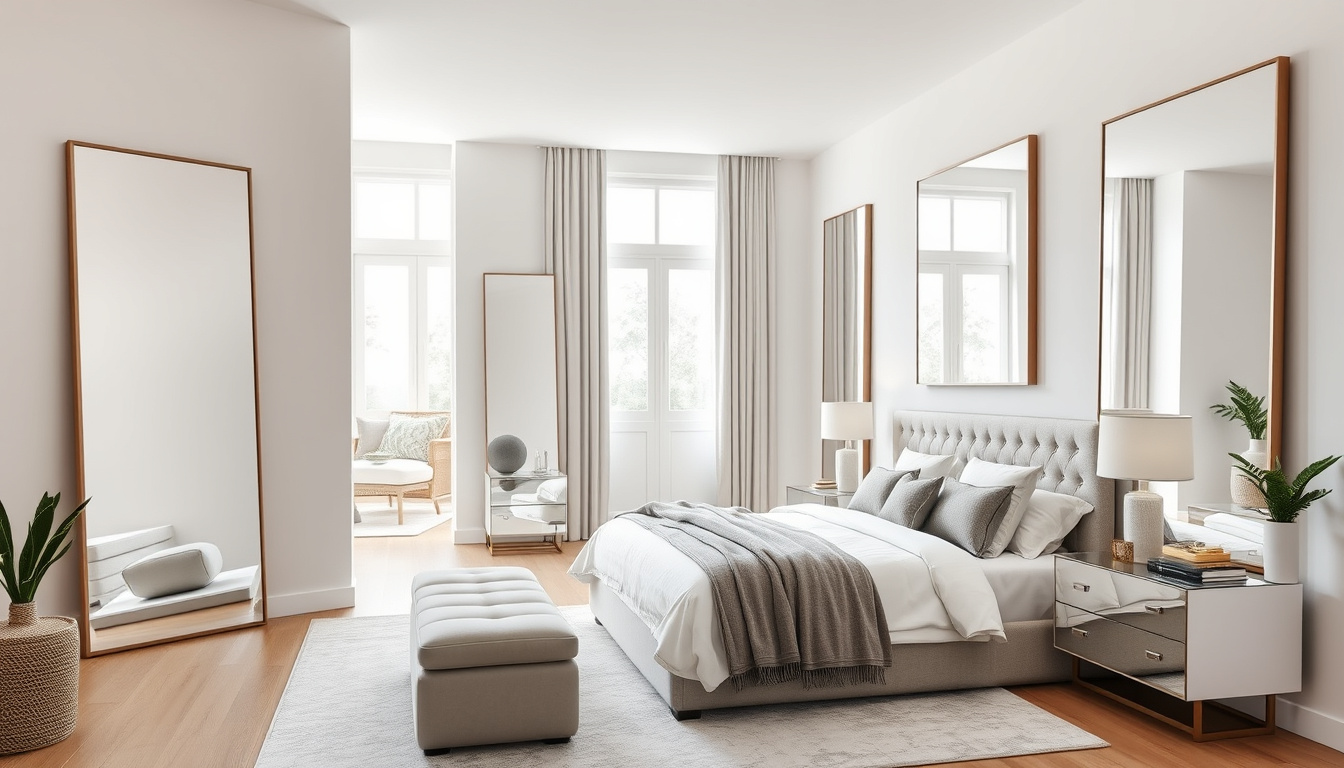

There’s something almost meditative about stepping back to see your whole outfit at once — no craning your neck, no guessing whether those shoes actually match. Full length wall mirrors have quietly become one of the most practical additions you can make to any room, whether you’re getting dressed in the morning or just trying to make a small bedroom feel twice its size. This guide cuts through the options to help you find the right mirror, the right size, and the right spot to hang it.
Starting Price: £9.99 · Popular Retailers: IKEA, JYSK · Common Heights: Full body 48–72 inches · Trending Styles: Arch, Leaning · Mount Types: Wall, Free-standing
Quick snapshot
- Organic sculptural shapes topped 2025 trends (Livingetc)
- Full wall mirrors predicted major 2026 popularity (Livingetc)
- IKEA 2026 collections reportedly include updated mirror designs (YouTube)
- Curved and arched shapes continue to rise through 2026 (Livingetc)
The table below summarises the core specifications referenced throughout this guide.
| Specification | Details |
|---|---|
| Typical Height | 48–72 inches |
| Entry Price | £9.99 |
| Key Retailers | IKEA, JYSK, The Range |
| Mount Types | Wall-mounted, leaning |
| Trending Feature | Arch top |
What are full-length mirrors called?
Beyond the obvious “full-length mirror,” the market uses a handful of specific terms. Cheval mirrors are tall, freestanding versions on a stand — named after the French word for horse, reflecting their original form. Leaning mirrors are exactly what they sound like: designed to prop against a wall at an angle, often with decorative frames. Wall-mounted full-length mirrors get fixed directly to the wall, saving floor space. IKEA’s standing mirrors (official product catalog) are designed for propping against walls or come with built-in stands.
Cheval mirrors
Cheval mirrors originated as ornate bedroom pieces. Modern versions often feature timber craftsmanship and an adjustable angle — useful if you want to tweak your reflection throughout the day. The name has stuck, but the style has modernised.
Leaning mirrors
Leaning mirrors work well in larger rooms where you can afford to leave a few inches between the mirror and the wall. They’re popular in bedrooms and entryways where a full-length check matters more than saving every centimetre of floor space.
What mirrors are trending right now?
The big shift in 2025–2026 has been away from the classic rectangle. According to Livingetc (design publication covering emerging interior trends), organic sculptural shapes dominated bathroom mirrors in 2025 and are evolving into softer curved forms for 2026. Full wall mirrors stretching from basin to ceiling are now a major predicted trend, creating a seamless contemporary look.
Arch full length mirrors
The arch top has gone from niche Instagram find to mainstream staple. The curved silhouette softens hard bathroom surfaces and adds architectural interest without overwhelming a room. Black arched frames in particular add a modern edge — one social media review noted that IKEA’s black arched full-length mirror brings a sharp, contemporary touch to apartments.
Gold leaning mirrors
Gold frames have experienced a quiet resurgence, particularly in the leaning format. They tend to work best in rooms with neutral or warm-toned walls where the frame can catch and reflect light without clashing.
“For so long, mirrors have stuck to the safe classics: rectangles, circles, maybe an oval if someone was feeling daring. Now, designers are playing with softer, irregular, almost fluid forms that feel like pieces of art on their own.”
— Lucie Ayres, founder and principal designer of 22 Interiors
If you’re buying new in 2025–2026, an arch or curved top will feel current. Rectangle lovers needn’t panic — a well-framed rectangle still works in traditional or minimalist spaces, but the design world has moved on to softer shapes.
Do full-length mirrors make rooms look bigger?
Yes — but the effect depends on placement, not just size. Full-length mirrors create an illusion of depth and spaciousness in smaller living areas by reflecting the room back on itself, effectively doubling the visual space. IKEA’s official mirror walls guide confirms that mirror walls reflect light to make rooms brighter, larger, and more dynamic.
Optical illusion effects
The key is what the mirror reflects. A mirror facing a cluttered wall will make a room feel busier, not bigger. Place your mirror where it can reflect something pleasant — a window, a piece of art, or an open doorway — and the illusion of space improves dramatically.
Placement tips
According to Studio McGee (interior design studio with published sizing guidelines), leave a few inches of wall space around the mirror for balance, especially on narrow walls. Mirrors should be a few inches shorter than furniture pieces below to allow layering of decor. Avoid mirrors dominating entire walls — balance with surrounding space.
In small UK flats and apartments where every square metre counts, a well-placed full-length mirror can do the work of moving furniture. A single large mirror on the wall opposite your window can read as effectively doubling your natural light.
What size mirror is best for full-length?
The standard full-length range sits between 48 and 72 inches tall. The specific size that works best for you depends on ceiling height, the person’s height, and whether the mirror needs to be shared between multiple people in a household.
Height recommendations
For a true full-body reflection for an average adult, 60 inches is the practical minimum. Taller individuals may prefer 66–72 inches. In rooms with lower ceilings, a 54-inch mirror can still provide a full reflection without overwhelming the space visually. IKEA’s full-body mirror measures 64×21 inches, which is ideal for apartments providing head-to-toe view without overwhelming space.
Width options
Width matters less than height for a full-length mirror, but a wider mirror gives you more reflective surface to work with. 20–24 inches wide is typical. In bathrooms with two sinks, Studio McGee recommends using two mirrors covering the sink length or one longer mirror. Bathroom mirrors should match sink lengths for proportionality.
This sizing matrix shows how different room types map to mirror heights for optimal coverage.
| Room Type | Recommended Height | Key Consideration |
|---|---|---|
| Small bedroom | 54–60 inches | Ceiling constraint, proportional framing |
| Standard bedroom | 60–66 inches | Average adult coverage |
| Tall person / master bedroom | 66–72 inches | Maximum coverage without crowding |
| Dual-sink bathroom | Match sink length | One long mirror or two standard |
| Entryway / hallway | 60 inches | Quick outfit check, space-saving |
| Living room accent | 48–60 inches | More about style than function |
Where not to place a full-length mirror?
Placement matters as much as the mirror itself. There are practical reasons to avoid certain spots and, depending on your household’s beliefs, some positions carry cultural weight too.
Bedroom facing bed
Most interior design advice cautions against placing a mirror directly opposite your bed. The reasoning is practical first: a mirror in your peripheral vision when you’re trying to sleep can create restlessness. Beyond that, Feng Shui practitioners traditionally view a bed-facing mirror as disrupting sleep energy — though these beliefs vary widely between households.
Superstitions and myths
Old wives’ tales about mirrors include beliefs about trapped souls, doubled luck, and mirrors bringing bad fortune when broken. Cultural perspectives differ enormously: some traditions view mirrors as protective, others as spiritually active. The practical approach is to consider who lives in your household and whether any of these beliefs resonate with your values before dismissing them as superstition.
For UK homes specifically, wall-mounted mirrors above fireplaces or radiators face heat exposure that can damage the reflective backing over time. Bathrooms are fine if the mirror is rated for humidity, but cheaper options can warp in steamy conditions. Check the product specifications before buying for high-moisture rooms.
Clarity on claims
Confirmed
- Full-length = body height mirrors showing head to toe
- Mirror walls make rooms brighter and larger (IKEA official guide)
- Curved and arched shapes replacing square designs through 2026 (Livingetc)
- IKEA offers standing mirrors designed for propping or with stands
- Studio McGee guidelines recommend few inches gap below furniture
Unclear or pending
- Exact 2025-2026 trend trajectories beyond arch styles remain debated
- Pricing for most IKEA full-length models beyond entry level unclear
- Long-term durability data for IKEA mirrors limited
- Regional availability variations between UK and US IKEA stores
“Organic sculptural shapes were the top bathroom mirror trend for 2025, evolving into 2026 curves.”
— Livingetc, 2026 Bathroom Mirror Trends (design publication)
Related reading: Totter and Tumble Mat Review Sizes Guide
For the latest options aligning with arch trends and optimal sizing, 2025 full-length mirror picks highlight top selections ideal for wall placement in any room.
Frequently asked questions
How to clean a full length wall mirror?
Use a soft microfibre cloth dampened with a 50/50 mix of white vinegar and distilled water. Spray onto the cloth rather than directly onto the mirror to avoid liquid seeping behind the frame. Dry with a clean microfibre cloth or lint-free paper towel. Avoid abrasive cleaners or rough materials that can scratch the reflective coating.
Are full length wall mirrors safe for bedrooms?
Yes, when properly mounted. Wall-mounted mirrors should use appropriate fixings for your wall type — plasterboard requires wall anchors or toggle bolts for heavier mirrors. Freestanding and leaning mirrors need to be secured against tipping, especially in households with children or pets. Leaning mirrors should only be used where they can’t accidentally be knocked over.
What rooms suit large full length wall mirrors?
Bedrooms, entryways, and bathrooms are the most common locations. Living rooms work if the mirror serves a dual purpose (light reflection, visual expansion) rather than purely aesthetic. Avoid placing very large mirrors in rooms with limited natural light where the reflective surface shows mostly shadow.
Can I mount a full length mirror on drywall?
Yes, but use appropriate fixings. For mirrors under 10kg, heavy-duty picture hanging strips or hollow-wall anchors work. For heavier mirrors, toggle bolts or molly bolts provide secure anchoring into the studs behind the drywall. Always check the mirror’s weight rating and follow the manufacturer’s mounting requirements.
What is a cheval full length mirror?
A cheval mirror is a tall, freestanding mirror on a stand, named after the French word for horse. The design originated in Victorian-era bedrooms and remains popular for its adjustable angle and portability. Modern cheval mirrors often feature timber frames and work well in bedrooms where you want to reposition the mirror occasionally.
Do lighted full length wall mirrors save space?
Lighted mirrors primarily add function rather than saving space. The integrated lighting eliminates the need for separate vanity lighting in bathrooms, which can reduce fixture clutter. The mirror itself takes up the same wall space as a non-lighted version. Look for LED strips if energy efficiency matters to you.
How much does a full length wall mirror weigh?
Weights vary significantly by size and frame material. A typical 60×24 inch mirror with a timber frame weighs 8–15 kg. Frameless versions tend to be lighter. Always check the weight before purchasing and ensure your wall fixings can handle the load with a safety margin of at least 25%.
For renters in the UK, the practical choice comes down to two things: whether you can drill into the walls, and whether your landlord permits wall fixtures. IKEA’s HUMLESJÖN mirror with suction cups offers a $7.99 no-drill option (new for 2026) for temporary setups. For those who own their homes, investing in a quality arch or gold-framed leaning mirror pays off in both daily use and property aesthetics — and a well-placed mirror opposite a window is the cheapest light-boost trick in the book.
Related stories



Amelia Blackwell covers the economy, business and consumer affairs for Press Hive.