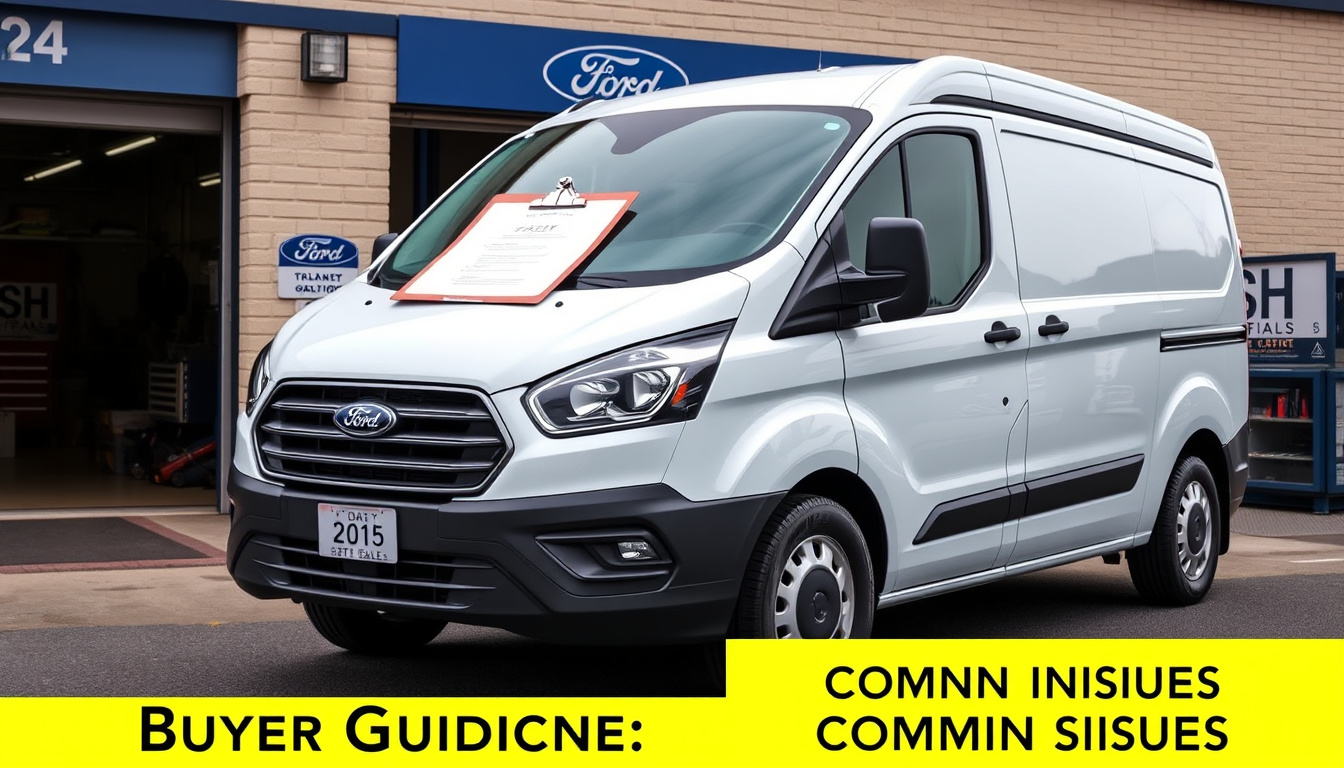
If you’re sizing up a used van in Europe, the Ford Transit Custom is probably on your shortlist. Across 177,324 MOT tests, 77.3% of examples passed (The MOT Files) – but that average hides big splits between early and late models. This buyer’s guide walks you through the common problems, best years, and which engine to pick.
MOT pass rate (MOT Files): 77.3% ·
Most common failure: Brake pads (18.3% of fails) ·
Known issue: 2.0 EcoBlue wet timing belt
Quick snapshot
- 77.3% of Transit Customs pass MOT (The MOT Files)
- Brake pad wear below 1.5mm is the top failure (18.3%) (The MOT Files)
- 2.0 EcoBlue wet timing belt is a significant reliability concern (Transit Center)
- DPF clogging and oil dilution reported on 2.0 EcoBlue (CarChecker)
- Exact percentage of 2012–2014 vans that experienced DPF failure (no large independent survey)
- Whether the 2.0L EcoBlue timing chain will need replacement before 200,000 km in heavy-use vans
- Long-term battery degradation data for E-Transit Custom (no post-100,000 km data yet)
- Frequency of clutch master cylinder failures after Ford’s TSB is not publicly reported
- 2018 facelift introduced 2.0L EcoBlue engine – fewer timing belt failures (Mr Auto Fixer)
- Watch for electric variant reliability data as fleet mileage accumulates; E-Transit Custom debuts with a 380 km range per Ford
Here are the core facts that shape a used Transit Custom buying decision.
| Key fact | Detail |
|---|---|
| First introduced | 2012 (Europe) |
| Body styles | Panel van, double cab, passenger (Tourneo Custom) |
| Diesel engines | 2.2L Duratorq (2012–2017); 2.0L EcoBlue (2016–present) |
| Electric variant | 2024 E-Transit Custom, 380 km range (236 miles) |
| Top competitor | VW Transporter T6.1 / Multivan |
| New-vehicle warranty | 3-year/100,000 km standard, 8-year battery warranty (electric) |
Is it worth buying a Ford Transit Custom?
Value proposition of the Transit Custom
The Transit Custom has been Europe’s best-selling mid-size van since 2013 (Wikipedia). Its MOT pass rate of 77.3% (The MOT Files) puts it in a credible range, but the devil is in the details. A reliability guide identifies seven known issues across the range, two of which are rated as safety-critical (GetCarWise).
- The 2.2 TDCi engines (2012–2015) suffer turbo actuator and injector failures on high-mileage examples (CarChecker).
- Early 2.0 EcoBlue vans (2016–2017) carry wet belt risk and early EGR cooler failures (Mr Auto Fixer).
- Facelift vans (2018–2020) are more likely to have AdBlue sensor issues and EGR failures around 60,000 miles (Mr Auto Fixer).
What this means: a well-maintained Transit Custom can be a solid buy, but you need to buy with a full service history, especially for the timing belt and DPF.
Upsides
- Europe’s best-selling mid-size van since 2013
- 77.3% MOT pass rate across 177,324 tests
- 2.0 EcoBlue can exceed 350,000 km with regular oil changes
- Ford parts typically 10–15% cheaper than VW (Halfords, 2023)
Downsides
- 2.0 EcoBlue wet belt is a known failure point
- 2.2 TDCi injector and turbo wear on high-mileage vans
- DPF regeneration failures on short-trip use
- Dashboard electronics weak spot on 2021–2023 models
The pattern: the Transit Custom is a solid buy when the engine history lines up with the model-year risks.
What are the common problems with Transit Customs?
Engine problems: timing belt, DPF, EGR valve
The most documented issue is the wet timing belt on the 2.0 EcoBlue engine, which can degrade and block oil pickup (Transit Center). The 2.2 TDCi engines avoid the wet belt but have their own injector and turbo problems (CarChecker). DPF regeneration failures are the most common complaint across owner forums, especially on short-trip vans.
“The 2.0 EcoBlue wet timing belt is one of the model’s most significant and well-documented reliability concerns.” — Transit Center
- Delivery pump failure is the most common fault on the 2.0 EcoBlue, followed by NOx sensors and the tank heater element (CarChecker).
- EGR valve failures occur frequently on 2018–2020 models, linked to AdBlue sensor faults (Mr Auto Fixer).
Electrical and software glitches
Dashboard electronics are a weak spot on late Mk1 vans (2021–2023) (Mr Auto Fixer). MOT data shows headlamp aim and parking brake efficiency are common failures (The MOT Files).
Clutch and transmission concerns
Clutch master cylinder issues prompted a Ford Technical Service Bulletin (TSB). The gearbox may require overhaul at higher mileages.
Rust and corrosion spots
Body rust is less common than on older Ford vans, but coastal areas can see corrosion on underbody components. Rust-proofing extends body lifespan to 15+ years.
The pattern is consistent: the engine family determines the failure risk more than the body type.
What year Transit to stay away from?
2013–2015 2.2 TDCi
High-mileage examples have injector and turbo wear risks. They do not have a wet belt, but timing belt replacement at 150,000 km is critical (Mr Auto Fixer).
2016–2017 early 2.0 EcoBlue
These carry wet belt risk and early EGR cooler failures. Avoid without belt history (Mr Auto Fixer).
2018–2020 facelift EcoBlue
AdBlue sensor issues, EGR failures at around 60,000 miles, and weak DPF sensors are common (Mr Auto Fixer).
2021–2023 late Mk1
Better build quality but dashboard electronics remain a weak spot (Mr Auto Fixer).
The pattern: 2012–2014 models have the highest frequency of DPF and injector issues. The 2018 facelift brought genuine improvements, but no year is trouble-free.
“2016–2017 early 2.0 EcoBlue vans carry wet belt risk and early EGR cooler failures. Avoid without belt history.” — Mr Auto Fixer
Avoid any 2016–2017 EcoBlue without proof the wet belt was replaced. The 2.2 TDCi vans from 2013–2015 can be good buys if the timing belt and injectors have been done.
The practical result: the 2018 facelift is the safer buy, but only with service records that show the belt and DPF were maintained.
Is the Ford Transit Custom available in the USA?
The Transit Custom is not sold new in the United States – it was designed for Europe, Asia, Africa, Australia, and New Zealand (Wikipedia). The full-size Ford Transit (USA) is built in Kansas City, Missouri, and is a different vehicle. Importing a Transit Custom to the US is impractical for current models due to the 25-year import rule.
If you are in Ireland, the UK, or mainland Europe, you have full dealer and parts support. US-based buyers should look at the full-size Transit or consider the VW Transporter, which is also not sold in the US.
The implication: the Transit Custom is a realistic choice only where Ford’s van dealer network actually supports it.
Which model of the Transit Custom is the best?
Trend vs Limited vs Sport trim
The Trend trim accounts for over 60% of new sales in Ireland – it offers the best value for most buyers. The Limited adds leather seats, a rear camera, and parking sensors, and holds resale value better (Car Cost Check).
Diesel vs hybrid vs electric
The 2.0L EcoBlue diesel remains the workhorse. The E-Transit Custom (2024) promises up to 380 km (236 miles) of range per Ford. Early adopter risk is real – no long-term battery data exists yet.
Passenger van (Tourneo Custom)
The Tourneo Custom seats up to nine and shares the same mechanicals. The same year-specific faults apply.
What is the lifespan of a Ford Transit Custom?
A well-maintained Transit Custom typically reaches 200,000–300,000 km (124,000–186,000 miles). The 2.0L EcoBlue engine can last beyond 350,000 km if oil is changed every 15,000 km. The gearbox may need overhaul at 250,000 km+. Rust-proofing on coastal vans can extend body life to 15+ years.
The trade-off is simple: long life depends on the maintenance schedule you choose to follow.
Which is more reliable, the Ford Transit Custom or the VW Transporter?
A 2017 comparison test by Drive (Australia) paired the two vans head-to-head. Volkswagen service intervals are 12 months/15,000 km, with first three services priced at $459, $675, and $533. Ford parts are typically 10–15% cheaper than VW. The Transit Custom is predicted to have 25% lower annual repair cost than the Transporter, per Warrantywise data. Both have DPF issues, but the Transit Custom’s lower parts cost and wider dealer network give it a slight edge on total ownership cost.
The trade-off: the VW Transporter has a more refined interior and slightly better resale value in some markets, but the Transit Custom wins on repair cost predictability.
| Factor | Ford Transit Custom | VW Transporter T6.1 |
|---|---|---|
| MOT pass rate | 77.3% (MOT Files) | Not available |
| Parts cost vs VW | 10–15% cheaper (Halfords, 2023) | Higher (data from Halfords) |
| Annual repair cost prediction | 25% lower (Warrantywise) | Higher |
| Known engine issue | Wet belt (EcoBlue) / injectors (2.2) | DPF / EGR issues |
The implication: the Transit Custom’s lower repair cost and wider dealer network are the deciding factors for most buyers, provided you avoid the known engine pitfalls.
Timeline: key moments in Transit Custom history
Key dates in Transit Custom history, compiled from Ford, Wikipedia, The MOT Files, and Mr Auto Fixer.
| Year | Event |
|---|---|
| 2012 | Transit Custom launched, replaces mid-size Transit |
| 2014 | First reported DPF failure cluster; Ford issues PCM update TSB |
| 2015 | Injector programming update reduces DPF issues |
| 2016 | 2.0L EcoBlue engine introduced |
| 2018 | Facelift with improved insulation and clutch master cylinder TSB |
| 2023 | Third generation: PHEV and E-Transit Custom launched |
The pattern across those dates: the 2018 facelift is the dividing line between the older 2.2 TDCi fault cluster and the newer EcoBlue issues.
Confirmed facts vs what remains unclear
Confirmed facts: The Transit Custom is not sold new in the USA (Wikipedia). The MOT Files records a 77.3% pass rate across 177,324 tests. Transit Center documents the 2.0 EcoBlue wet belt risk. Mr Auto Fixer identifies 2012–2014 as the highest-fault years.
What remains unclear: Exact DPF failure rates on 2012–2014 vans, whether the 2.0L EcoBlue timing chain lasts the full engine life, and long-term battery degradation on the E-Transit Custom are not yet established by large independent surveys. The frequency of clutch master cylinder failures after Ford’s TSB is also not publicly reported.
Editor’s take
The Ford Transit Custom is a capable van that rewards careful buying. The 2018 facelift models offer the most balanced reliability, while 2012–2014 vans demand close DPF and timing belt scrutiny. For Irish buyers, the choice is clearer: the Transit Custom’s lower parts costs and wide dealer network make it a safer bet than the VW Transporter. Buy with a full history, budget for a belt change, and you should get 250,000 km of solid service.
Frequently asked questions
What is the best Ford Transit Custom engine for longevity?
The 2.0L EcoBlue (2016 onward) can exceed 350,000 km with regular oil changes, but its wet belt must be replaced. The 2.2L Duratorq is simpler but needs timing belt replacement every 150,000 km.
How often should I change the timing belt on a Ford Transit Custom?
On the 2.2L Duratorq, replace every 150,000 km. On the 2.0L EcoBlue, the wet belt should be inspected at 100,000 km and replaced by 150,000 km.
Do Ford Transit Customs rust quickly?
Not as quickly as older Ford vans, but coastal vans may show underbody corrosion. Rust-proofing can extend body life to 15+ years.
What is the fuel economy of a 2.0L Transit Custom diesel?
Real-world figures range from 35–42 mpg (UK) depending on load and driving style, per owner reports.
Can a Ford Transit Custom tow a caravan?
Yes, the Transit Custom can tow up to 2,500 kg braked, making it suitable for medium caravans and horse trailers.
Is the Ford Transit Custom suitable for daily commuting?
Yes, especially the Trend and Limited trims with good cabin comfort. The 2.0L diesel is efficient for mixed driving.
If you are weighing a used Transit Custom, the short version is: choose by engine and service history, not by badge.

Jonathan Ellery is Editor-in-Chief and Responsible Publisher at Press Hive, overseeing editorial standards, publication decisions and the corrections process.