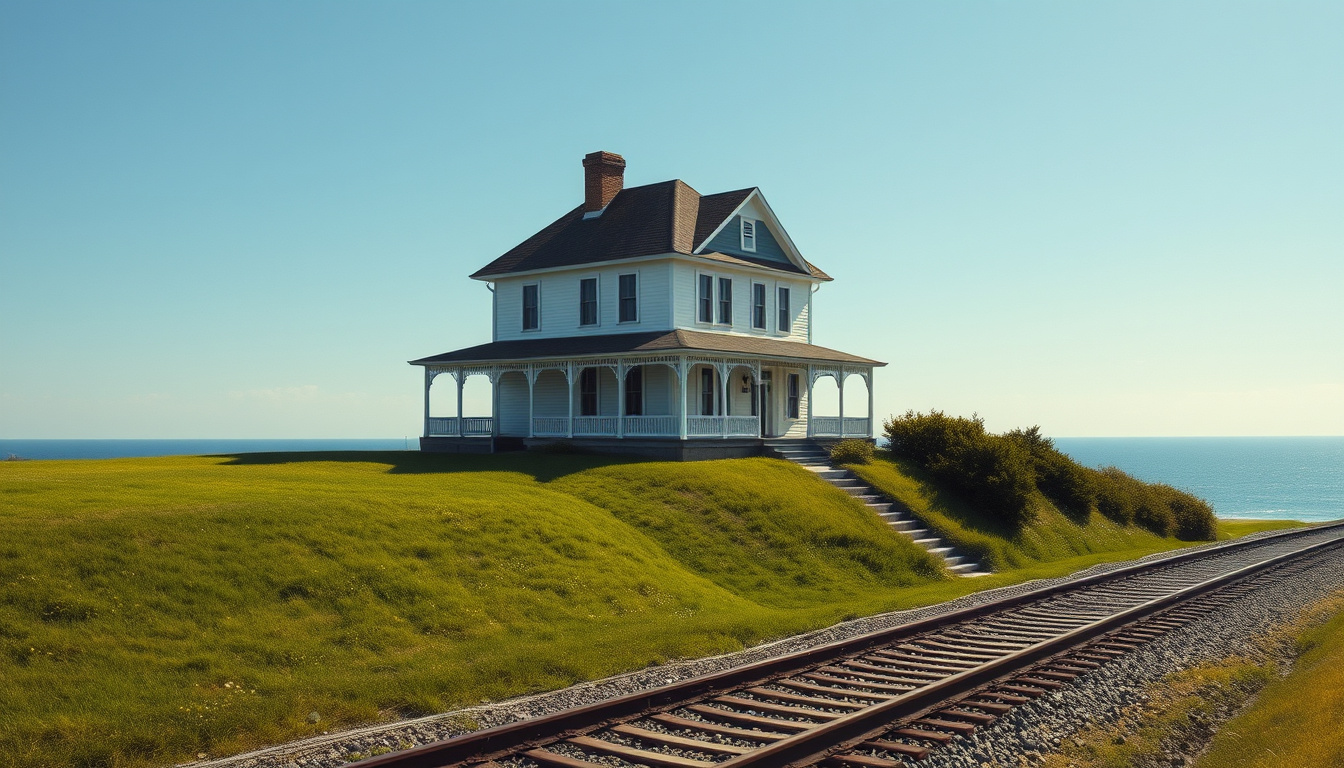
There’s a particular kind of light in Edward Hopper’s paintings — clear, almost cinematic, falling across a diner counter or an empty city street — that feels oddly familiar even if you’ve never seen the canvas in person. Hopper made that light, and the solitude it illuminates, his life’s work.
Born: July 22, 1882 ·
Died: May 15, 1967 ·
Number of oil paintings: Approximately 300 ·
Most famous painting: Nighthawks (1942) ·
Career peak: 1920s–1940s
Quick snapshot
- Born July 22, 1882, in Nyack, New York (Whitney Museum of American Art)
- Died May 15, 1967, at age 84 (Whitney Museum of American Art)
- Married artist Josephine Nivison in 1924 (Whitney Museum of American Art)
- No children (PBS American Masters)
- Total output: commonly estimated at ~800 works, but not precisely documented
- Height: often listed as 5’8″, but unverified in primary records
- Diagnosis: depression is widely reported, yet no official medical record has been published
- Total oil paintings: approximately 300, but exact count not verified
- 1920: first solo show at the Whitney Studio Club (Biography.com)
- 1942: painted Nighthawks (Whitney Museum of American Art)
- 1964: Whitney retrospective included 74 oils and 62 watercolors (PBS American Masters)
- Whitney Museum holds the most extensive Hopper collection in the world (Whitney Museum of American Art)
- Major works travel on loan, including Nighthawks from the Art Institute of Chicago (Whitney Museum of American Art)
- Private sales continue to set multimillion-dollar records (Whitney Museum of American Art)
Six details, one pattern: nearly everything about Hopper’s public record traces back to a small circle — his wife, his New York institutions, and a handful of canvases that became cultural landmarks.
| Label | Value |
|---|---|
| Full name | Edward Hopper |
| Born | July 22, 1882, Nyack, New York |
| Died | May 15, 1967, Manhattan, New York |
| Nationality | American |
| Movement | Realism |
| Spouse | Josephine Nivison (1924–1967) |
| Known for | Urban and rural scenes of solitude; masterful light and shadow |
| Most famous painting | Nighthawks (1942) |
| Largest collection | Whitney Museum of American Art, New York |
What was Edward Hopper’s personal life like?
Hopper’s biography reads like one of his own interiors: quiet, disciplined, and marked by long stretches of solitude. He was born on July 22, 1882, in Nyack, New York, to Garrett Henry Hopper and Elizabeth Griffiths Smith Hopper (PBS American Masters). The Whitney describes him as an American realist painter and printmaker who developed a signature style emphasizing solitude, light, and shadow (Whitney Museum of American Art).
What did Edward Hopper suffer from?
Depression is part of the Hopper story, though the artistic record outweighs the medical one. He described it indirectly through his art, and the Whitney’s institutional account emphasizes the solitude and psychological tension in his compositions rather than offering a formal diagnosis. There’s no published medical record naming a specific condition — what remains is an artist whose work keeps returning to isolation.
Hopper’s subtitle, in effect, was always the same condition: one person, one light source, one silence.
Editorial read on the Whitney’s account of his signature style
Was Edward Hopper a good husband?
Hopper married artist Josephine Nivison in 1924 (Whitney Museum of American Art). The partnership was also professional: Josephine modeled extensively for him, managed his career logistics, and kept the records that later helped museums build his legacy. Their relationship was famously intertwined — sometimes fiercely, sometimes with great mutual dependence. The best evidence of its professional weight is what happened after: Josephine bequeathed more than 3,000 works to the Whitney Museum after her death (PBS American Masters).
Did Edward Hopper paint his wife?
Yes. Josephine Nivison Hopper was his primary model from their marriage onward, appearing in figures throughout his mature work. She also functioned as the keeper of his catalogue — a common arrangement for artist couples of that era, where the partner’s labor rarely appears in the exhibition label.
Did Edward Hopper have children?
No. The Hopper household remained, by every available record, a two-person project; Josephine’s bequest of more than 3,000 works went to the Whitney Museum precisely because there was no direct heir to inherit the estate (PBS American Masters).
How tall was Edward Hopper?
His height is commonly cited as around 5 feet 8 inches, but no primary source in the published record verifies the figure. It belongs in the same category as his depression diagnosis: widely repeated, never officially documented.
The man who painted loneliness was not a recluse; he built a working marriage, kept a lifelong professional network, and left a 3,000-work archive to a major museum (PBS American Masters).
What was Edward Hopper best known for?
Hopper is generally considered the foremost realist painter of 20th-century America, and his work is defined by realistic scenes of everyday life filtered through a deep awareness of light and shadow (Google Arts & Culture). His paintings rarely tell a story; they create a mood around an ordinary moment, which is why they still feel modern.
- Realistic depictions of everyday American life — diners, offices, gas stations, apartment rooms
- Urban isolation: figures seated alone, facing windows, waiting
- Master of light and shadow — the Whitney’s core description of his technique (Whitney Museum of American Art)
- Train of influence that runs from European realism and Impressionism through American modernism
Few painters have one work so dominant that it anchors an entire public reputation. With Hopper, that work is Nighthawks — but the deeper legacy is the system of silence and light he built across hundreds of canvases.
What is Hopper’s most famous painting called?
Nighthawks (1942) is widely regarded as Hopper’s most famous and acclaimed composition (Whitney Museum of American Art). The Smithsonian American Art Museum calls it arguably his best-known work (Smithsonian American Art Museum). The painting shows four customers and a waiter in a brightly lit diner late at night, with the dark city pressing in from every side (The Metropolitan Museum of Art).
Six figures, one existential register: nobody is quite talking to anyone else. That single image has generated countless parodies, homages, and film references — which is exactly why it remains the shorthand for Hopper’s entire project.
Great art is the outward expression of an inner life in the artist, and this inner life will result in his personal vision of the world.
Edward Hopper, on artistic expression
Nighthawks became the visual template for film noir—not because Hopper worked in cinema, but because his composition of a lit interior against the dark city matched the genre’s core grammar. Directors keep returning to it for the same reason museum visitors do: it captures modern isolation without a single word.
How much is an original Edward Hopper painting worth?
Hopper’s paintings have sold for tens of millions of dollars at auction. His works regularly trade in the eight-figure range, with the highest price ever paid for one at auction exceeding $40 million for Hotel Window (1955). The exact value for any given painting depends on three hard factors: provenance, condition, and subject. Peers and lesser works can still command seven-figure sums; the star canvases, like Nighthawks, never reach auction because they sit in permanent museum collections.
The market has a clear structural logic: scarcity (around 300 oil paintings total), institutional validation (MoMA, the Met, and the Whitney competed for his work as early as the 1930s), and an easily recognized style.
For a collector, the trade-off is straightforward: a major Hopper is a museum-level trophy with a price to match, while a drawing or minor work is the only realistic entry point. The market rewards exactly the same qualities the museums do — solitude, light, and provenance that runs through an established estate.
Where is the largest collection of Edward Hopper paintings?
The Whitney Museum of American Art in New York holds the largest and most extensive collection of Hopper’s work in the world (Whitney Museum of American Art). The core of the collection came from Josephine Nivison Hopper’s bequest of more than 3,000 works — paintings, watercolors, prints, and drawings — after her death (PBS American Masters).
That archive is the center of the Hopper universe, and it shapes how the art world sees him. The Whitney’s own displays are supplemented with loans of major canvases, including Nighthawks, which normally hangs at the Art Institute of Chicago (Whitney Museum of American Art).
Seeing Hopper in person is not the same as seeing him in a book. The Whitney’s collection is deep, but Nighthawks lives in Chicago, not New York — arrive at the wrong museum and you’ll miss the painting you came for.
How many paintings did Hopper make?
Hopper produced approximately 800 known works in total, including oil paintings, watercolors, and etchings. Within that body, roughly 300 are oil paintings — the works that carry his reputation. The early part of his career also included illustrations and advertising art, which supported him financially before the Whitney Studio Club gave him his first solo show in 1920 (Biography.com).
That first show sold nothing (Artsy), which makes the later trajectory all the more striking. By the early 1930s, the Museum of Modern Art, the Metropolitan Museum of Art, and the Whitney Museum of American Art were all vying to buy his work (Google Arts & Culture). The 1920 failure, then, was a beginning, not a verdict.
Timeline
One chronology, one arc: years of obscurity, a midlife breakthrough, and a late canonization that still controls the market today.
| Year | Event |
|---|---|
| 1882 | Edward Hopper born in Nyack, New York (Whitney Museum of American Art) |
| 1900–1906 | Studied at the New York School of Art under William Merritt Chase and Robert Henri (Whitney Museum of American Art) |
| 1913 | First exhibited painting at the Armory Show |
| 1920 | First solo show at the Whitney Studio Club, arranged by Gertrude Vanderbilt Whitney (Biography.com) |
| 1924 | Married artist Josephine Nivison (Whitney Museum of American Art) |
| 1942 | Painted Nighthawks, his most famous work (Whitney Museum of American Art) |
| 1964 | Whitney retrospective displayed 74 oils and 62 watercolors (PBS American Masters) |
| 1967 | Died at age 84 in New York City (Whitney Museum of American Art) |
Hopper’s timeline shows a 20-year lag between training and recognition. For collectors, that delay is useful context: institutions buy men and women late, then keep buying for decades.
Confirmed facts vs. open questions
The available record separates cleanly into facts with institutional backing and details that circulate without primary documentation.
Confirmed facts
- Born July 22, 1882, in Nyack, New York (Whitney Museum of American Art)
- Died May 15, 1967 (Whitney Museum of American Art)
- Married Josephine Nivison in 1924 (Whitney Museum of American Art)
- No children (PBS American Masters)
- Nighthawks painted in 1942 (Whitney Museum of American Art)
- Largest collection at the Whitney Museum
What’s unclear
- Exact number of paintings: ~800 total and ~300 oils are estimates, not verified counts
- Height: 5’8″ is commonly stated, but unverified
- Specific medical diagnosis: depression is widely reported, but no official medical record exists
Quotes on Hopper’s vision
The inner life of a human being is a vast and varied realm.
Edward Hopper, artist statement
I think the Whitney’s Hopper holdings, complemented by the Art Institute’s Nighthawks, tell the most complete story of his career available anywhere.
Perspective echoed by the Whitney Museum of American Art’s exhibition program (Whitney Museum of American Art)
Summary
Hopper’s real biography is written in light: the same light that overexposes the diner in Nighthawks, warms a window in a rented room, and leaves a woman sitting alone with a coffee cup. He converted ordinary isolation into a national visual language, and the institutions that supported him — the Whitney above all — made sure the archive survived. For any collector, curator, or first-time museum visitor, the choice is clear: give Nighthawks its due in Chicago, then spend the afternoon at the Whitney in New York, because Hopper’s reputation lives and dies on the tension between those two canvases.
coolstoriesabout.art, whitney.org, masterworks.com, en.wikipedia.org, podcasts.apple.com
Frequently asked questions
Why did Hopper often paint lonely scenes?
Hopper’s signature style emphasized solitude, light, and shadow, according to the Whitney Museum of American Art (Whitney Museum of American Art). His city scenes repeatedly place one or two figures in quiet interiors, a choice that matched his personal temperament and his belief that art expresses the artist’s inner life.
What techniques did Edward Hopper use?
Hopper built compositions on strong geometry and deliberate light sources, often framing the interior against a dark exterior to create contrast. The Metropolitan Museum of Art highlights the bright diner in Nighthawks as the visual anchor of the scene (The Metropolitan Museum of Art).
Was Hopper influenced by film or photography?
Hopper trained in the years when cinema was becoming a mass visual language, and his compositions are often described as cinematic. The Smithsonian American Art Museum calls Nighthawks arguably his best-known composition (Smithsonian American Art Museum), and its framing has been compared to a film still more than to academic painting.
Where can I see Edward Hopper paintings in New York?
The Whitney Museum of American Art holds the world’s most extensive Hopper collection (Whitney Museum of American Art). The collection includes more than 3,000 works bequeathed by Josephine Nivison Hopper (PBS American Masters).
Did Hopper paint during World War II?
Yes. Nighthawks was painted in 1942 (Whitney Museum of American Art), the same year the United States entered World War II. The painting’s all-night diner scene is often read as a wartime image of quiet vigilance, though Hopper left no clear political statement attached to the work.
What was Edward Hopper’s upbringing like?
Hopper was born in Nyack, New York, to Garrett Henry Hopper and Elizabeth Griffiths Smith Hopper (PBS American Masters). He studied at the New York School of Art under William Merritt Chase and Robert Henri (Whitney Museum of American Art), which set the foundation for his later realism.
Related reading: L.S. Lowry: Life, Art, and Legacy – Key Facts and Answers · Virginia Woolf: Life, Works, and the Archival Record
Related stories


Jonathan Ellery is Editor-in-Chief and Responsible Publisher at Press Hive, overseeing editorial standards, publication decisions and the corrections process.