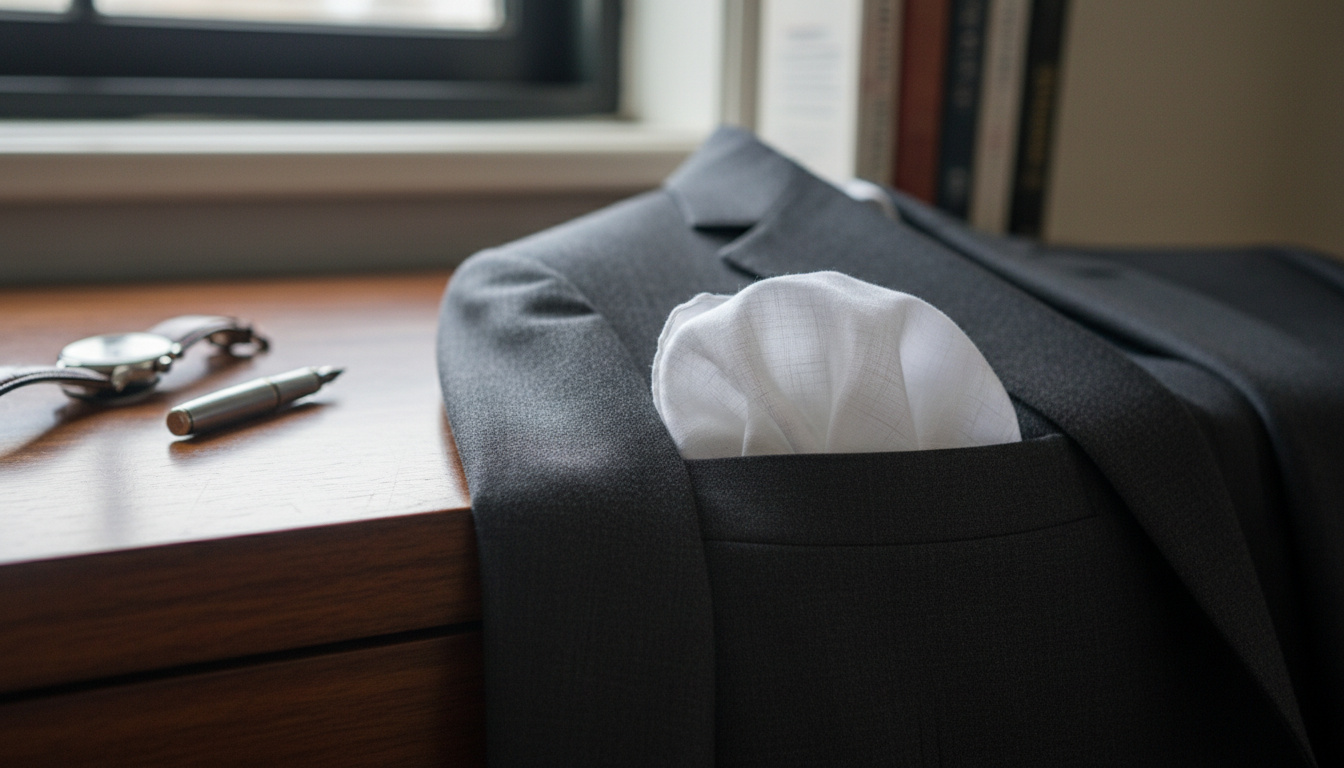

The Geometry of Elegance: Mastering Pocket Square Folds
The pocket square represents one of menswear’s most efficient style upgrades. This silk or cotton accessory, typically measuring thirty to forty centimetres square, occupies minimal real estate yet delivers maximal visual impact when properly folded and displayed in a jacket’s breast pocket. Unlike the tie, which serves both decorative and functional purposes, the pocket square operates as pure ornamentation—a final flourish that signals attention to detail and sartorial confidence.
Contemporary dressing permits significant latitude in pocket square presentation, though certain occasions still demand specific approaches. Understanding the hierarchy of folds separates the novice from the knowledgeable, transforming a simple piece of fabric into a deliberate stylistic statement.
The Essential Fold Vocabulary
Six fundamental approaches dominate the tradition, each conveying distinct levels of formality and nonchalance. The Presidential fold offers a crisp, horizontal line suitable for conservative business environments and black-tie events. The One-Point introduces angular geometry through a single peak, while the Two-Point creates symmetrical peaks resembling mountain silhouettes. The Three-Point or Cagney fold adds dramatic vertical height through triangular layering. The Puff fold emphasizes texture and studied nonchalance, gathering the fabric organically rather than creasing it. Finally, the Winged Puff merges structural precision with volumetric presence, creating wing-like projections flanking a central peak.
Fabric weight and weave dictate fold selection more than most practitioners initially assume. Cotton and linen benefit from structured, geometric folds that maintain creases through starch or natural fibre memory, while silk’s fluidity and sheen suit the relaxed Puff or Reverse Puff configurations. Modern style guides emphasize that linen demonstrates superior structural integrity for sharp edges, making it ideal for multi-point configurations that require rigid precision.
Technical Considerations and Fabric Behavior
The interaction between textile properties and folding mechanics determines longevity of appearance throughout an event. Silk charmeuse, despite its lustrous appeal, possesses low friction coefficients that cause slippage in complex folds unless secured with pocket stitching or careful arrangement. Wool pocket squares, increasingly popular for autumnal tweed ensembles, provide natural body that maintains Puff folds without collapsing.
Colour coordination requires similar nuance. Complementary tones generally outperform exact matching; a navy tie paired with a burgundy or forest green square creates visual interest without the costume-like uniformity of identical hues. Classic menswear resources consistently advise treating the pocket square as a conversational counterpoint to the neckwear rather than its twin.
Comparative Analysis of Folding Techniques
| Fold Style | Difficulty | Formality | Ideal Fabric | Optimal Occasion |
|---|---|---|---|---|
| Presidential | Beginner | High | Silk, Linen | Business, Evening |
| One-Point | Beginner | Medium | Cotton, Silk | Office, Cocktails |
| Two-Point | Intermediate | Medium | Linen, Cotton | Racing, Garden Party |
| Three-Point | Advanced | High | Linen | Weddings, Galas |
| Puff | Beginner | Low-Medium | Silk, Wool | Creative Industries |
| Winged Puff | Intermediate | Medium | Silk | Dinner Parties |
Detailed Methodology for Primary Folds
The Presidential Fold requires laying the square flat and folding it vertically in half, then horizontally to match pocket width. Insert the folded edge upward, allowing a quarter-inch to half-inch of fabric to show above the pocket line. This minimalist approach remains the standard for white-tie occasions and conservative corporate environments where deviation from convention appears distracting rather than distinguished.
The Puff Fold involves pinching the fabric’s centre and lifting, allowing the corners to drape naturally. Gather the material at the base and fold the pointed end upward to create a bundle that fits the pocket depth. The resulting exposed edge should appear slightly irregular, suggesting effortless placement rather than calculated arrangement. Cotton iterations of this fold require more deliberate fluffing to achieve the casual volume that silk achieves naturally.
The Three-Point Fold demands precision. Begin with the square rotated forty-five degrees to form a diamond. Fold the bottom point upward to meet the top, then fold the left point diagonally across, followed by the right. The result resembles an envelope with three visible peaks. Insert with the points facing outward. Specialist haberdashers note that this configuration requires occasional adjustment throughout wear but rewards the effort with architectural distinction.
Historical Evolution and Cultural Context
The pocket square’s lineage traces to sixteenth-century Europe, when scented handkerchiefs served practical hygiene purposes while signaling social status. By the nineteenth century, the accessory bifurcated: the utilitarian handkerchief migrated to trouser pockets, while the decorative square occupied the breast pocket as pure ornamentation.
Hollywood’s Golden Age cemented specific folding conventions. Fred Astaire’s consistent Presidential folds conveyed Continental sophistication, while Gary Cooper’s relaxed Puff suggested American ease. The post-war period saw decline as mid-century business casual emerged, but the 1980s power dressing era and subsequent menswear renaissance restored the accessory to prominence. Contemporary fashion journalism traces the current resurgence to approximately 2005, coinciding with renewed interest in bespoke tailoring.
Dispelling Common Misconceptions
Several persistent myths compromise execution quality. The prohibition against visible manufacturer tags is absolute; these should be removed or concealed completely, never left visible as a status marker. Additionally, the pocket squarepocket square should not match the tie’s pattern exactly—this appears coordinated rather than sophisticated. Instead, extract a secondary colour from the tie or shirt for the square.
Pocket depth varies significantly between ready-to-wear and bespoke garments. Tailoring experts recommend testing fold stability while moving; a properly folded square should survive sitting, standing, and moderate locomotion without requiring readjustment. Overstuffing creates visible tension lines on the jacket’s breast, while insufficient fabric disappears entirely into the pocket.
Contemporary Applications and Styling
Current trends favor “sprezzatura”—the art of studied carelessness—particularly in creative industries where rigid formality suggests insecurity. However, traditional finance and legal sectors maintain stricter conventions, rendering the Presidential fold virtually mandatory. Seasonal variations include raw-edged linen for summer weddings, providing textural contrast against tropical wool suits, and deep burgundy silks for autumnal evening events. For those looking to elevate their style further, discover the ${best coffee table books} to inspire your next look. best coffee table books
The maintenance of silk accessories directly impacts folding performance; crushed or creased squares resist precise geometric arrangements and benefit from steam pressing before execution. Storage in an unfolded state preserves fibre memory and prevents set creases that complicate spontaneous fold changes.
Perspectives from the Trade
“The pocket square occupies the focal point of the torso, directly beneath the face. It frames the conversation. A man who masters this small detail demonstrates that he understands proportion, colour, and context—the three pillars of personal style.”
— Savile Row tailoring tradition
“Novices over-think the fold. The square should look as though it was placed without anxiety. If your fold requires thirty seconds of adjustment every time you stand, you’ve chosen the wrong technique for your fabric.”
— Contemporary menswear consultant
Essential Principles
Mastery of the pocket square requires understanding that this accessory functions as punctuation rather than prose. It completes the suit without dominating it. The Presidential fold serves universal business applications, while the Puff accommodates social scenarios demanding relaxed elegance. Fabric selection dictates fold architecture: structured textiles for geometric precision, fluid textiles for organic gathering. Precision in execution signals respect for the craft; casualness in the Puff fold should appear intentional rather than sloppy. Ultimately, the pocket square offers one of fashion’s most favorable effort-to-impact ratios, delivering significant visual return for minimal material investment.
Frequently Asked Questions
Should the pocket square match the tie exactly?
No. Exact matching creates a contrived appearance. Instead, select a square that complements the tie through colour family harmony or contrasting accents. If wearing a navy tie with burgundy motifs, consider a burgundy solid square or a patterned square containing both navy and complementary gold or green tones.
Can I wear a pocket square without a tie?
Absolutely. The pocket square provides an excellent focal point when wearing an open-collared shirt with tailoring. In such configurations, the square prevents the jacket from appearing incomplete and adds intentional polish to an otherwise relaxed ensemble.
Which fold works best for beginners?
The Presidential fold offers the most forgiving introduction, requiring only straight creases and minimal manipulation. For those seeking something more distinctive with comparable ease, the basic Puff fold accommodates irregularities better than geometric alternatives.
Is silk or cotton better for pocket squares?
Neither is objectively superior; they serve different purposes. Cotton and linen hold crisp creases for structured folds and provide matte texture for daytime business. Silk offers sheen and fluidity ideal for evening wear and relaxed Puff folds. A comprehensive wardrobe includes both.
Related stories





Thomas Hayes covers Westminster, councils and public policy across the United Kingdom.