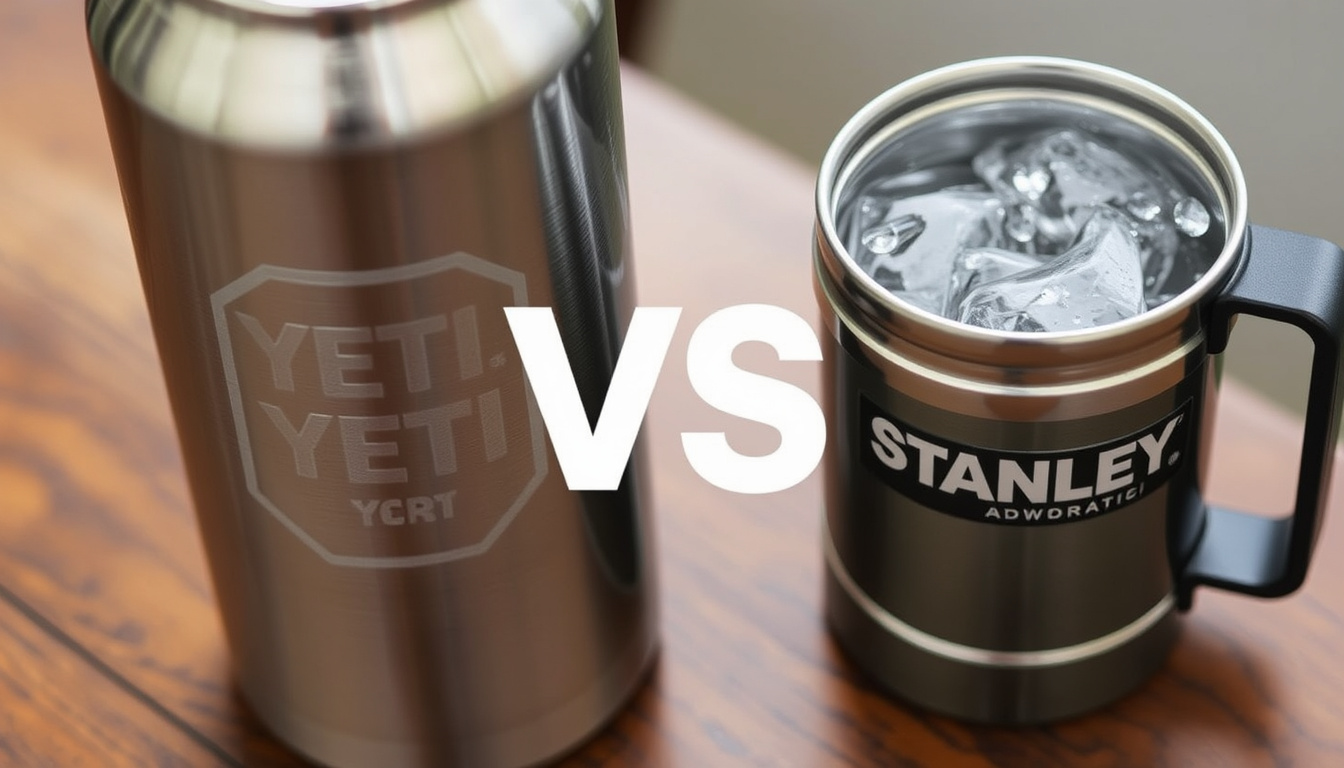
You’ve probably seen the YETI Rambler everywhere — on trails, in offices, propped next to a laptop. But with a price tag around €37, it raises a fair question: is this bottle actually worth the cost, and how does it compare to competitors like Stanley?
Price of 18 oz Rambler Bottle: €37 (Arnotts.ie) ·
Number of sizes available: At least 6 (12 oz to 64 oz) ·
Cold retention: Up to 24 hours ·
Dishwasher safe: Yes
Quick snapshot
- YETI bottles use double-wall vacuum insulation (Consumer Reports)
- YETI is publicly traded (NYSE: YETI) (Prevention)
- Lead not detected when YETI Rambler is tested (Prevention)
- Whether YETI’s price premium is fully justified by quality vs competitors (Wirecutter)
- Exact long-term sales impact of the 2020 NDA controversy (Business Insider)
- 2020: Lawsuit over nondisclosure agreements filed (Business Insider)
- 2023: Stanley Quencher goes viral, intensifying competition (Good Housekeeping)
- 2024: Lead concerns emerge around Stanley cups (Prevention)
- YETI faces growing competition from newer brands like Owala and HydroJug (Rolling Stone)
- Consumer trust may shift based on lead-safety disclosures from all brands (Prevention)
- YETI continues to expand its product line beyond drinkware (YETI)
Here are six key facts about YETI water bottles.
| Founded | 2006 |
| Headquarters | Austin, Texas |
| Price range | €30–€40 |
| Number of sizes | 6 (12 oz to 64 oz) |
| Insulation | Up to 24 hours cold |
| Parent company | YETI Holdings (public, NYSE: YETI) |
Are YETI water bottles worth the money?
That €37 price tag for the 18 oz Rambler is hard to ignore — especially when a similar bottle from Takeya costs half that. But YETI’s pricing rests on a few specific claims: kitchen-grade stainless steel, double-wall vacuum insulation, and a lid design that’s been praised for durability.
Why is YETI so expensive?
- Material: YETI uses 18/8 stainless steel, which resists rust and dents better than cheaper alternatives (Consumer Reports).
- Insulation: Double-wall vacuum insulation keeps water cold for up to 24 hours — a feature shared by many competitors, but YETI’s testing shows consistent performance (Good Housekeeping).
- Lid: The MagSlider lid uses magnets to seal the straw opening, a design that Rolling Stone described as “twist-secured with magnets to help prevent leaks” (Rolling Stone).
YETI over-engineers its bottles compared to budget brands. Whether that matters to you depends on how often you drop your bottle — Consumer Reports found YETI’s straw fell out during drop tests but the bottle itself didn’t dent (Good Housekeeping).
Is YETI overpriced?
Good Housekeeping compared the 40-ounce Stanley ($40) with the 42-ounce YETI ($45) and found nearly identical cold retention — YETI won by a single degree over 24 hours (Good Housekeeping). That makes the price gap hard to justify on performance alone.
The trade-off: YETI’s lid is stronger. Wirecutter’s testing found that Stanley tumblers leak “too much,” and they recommended alternatives — though YETI wasn’t specifically named as a top pick (Wirecutter).
The implication: YETI’s price premium is a trade-off for build quality, not insulation superiority.
Which is better, Stanley or YETI?
This is the defining comparison in insulated drinkware right now. Both brands sell tumblers that keep ice frozen for 24+ hours, but they differ in subtle ways that matter depending on how you use them.
Three factors, one pattern: performance is nearly identical, but design priorities diverge.
| Feature | Stanley (40 oz Quencher) | YETI (42 oz Rambler Tumbler) |
|---|---|---|
| Price | $40 | $45 |
| Cold retention (24h) | Nearly identical to YETI | Nearly identical to Stanley (Good Housekeeping) |
| Leak resistance | Not fully leakproof — Consumer Reports found it leaked (Consumer Reports via AOL) | Magnetic lid reduces leaks, but not fully leakproof (Prevention) |
| Handle design | Wider, loop-style handle | Slimmer handle (New York Post) |
| Color range | Wider variety (New York Post) | More limited palette |
| Warranty | Lifetime | 5 years |
Stanley vs YETI: insulation comparison
- Good Housekeeping’s lab test: 42 oz YETI and 40 oz Stanley kept water equally cold for 24 hours, with YETI edging ahead by one degree (Good Housekeeping).
- Both use double-wall vacuum insulation — essentially the same technology.
Stanley vs YETI: price comparison
- Stanley: $40 for 40 oz → ~$1.00/oz
- YETI: $45 for 42 oz → ~$1.07/oz
- Difference: about 7% more per ounce for YETI (Good Housekeeping).
Stanley vs YETI: durability
- Good Housekeeping’s drop test: YETI’s straw fell out but the bottle had no dents; Stanley’s performance was similar (Good Housekeeping).
- Rolling Stone described YETI as “focused on rugged durability” (Rolling Stone).
The catch: neither is fully leakproof, so bag-carrying requires caution.
Neither brand claims its cup is completely leakproof (Prevention). If you’re throwing it in a bag, expect some moisture — that’s the reality of straw-lid tumblers.
What is better than a YETI water bottle?
Several brands match or exceed YETI’s insulation at lower prices. A full comparison: three competitors, one standout.
| Brand | Price (approx.) | Insulation rating | Key advantage |
|---|---|---|---|
| Hydro Flask | $35–$45 | 24h cold | Powder-coated finish, wide mouth (Rolling Stone) |
| Stanley | $20–$40 | 24h cold | Lifetime warranty, lower price |
| Owala | $25–$35 | 24h cold | FreeSip spout (two drinking modes) (Rolling Stone) |
| Takeya | $16–$25 | 24h cold | Half the price, comparable insulation |
| Simple Modern | $20–$30 | 24h cold | Consumer Reports rated it similar to YETI (Consumer Reports via AOL) |
Cheaper alternatives: Hydro Flask, Stanley, Owala
- Good Housekeeping identified the HydroJug Traveler as the best-performing Stanley cup dupe in lab tests (Good Housekeeping).
- Owala’s FreeSip lid lets you drink through a straw or tip back — a design innovation that’s won a cult following.
Who is YETI’s biggest competitor?
- Stanley is the most direct competitor in the tumbler segment, especially since the Quencher went viral in 2023.
- Hydro Flask remains the top rival in traditional bottle form factors.
- Owala is the fastest-growing challenger for daily-use hydration (Rolling Stone).
The pattern: cheaper alternatives offer comparable performance, making YETI a choice for brand loyalists.
Is YETI still the best water bottle?
“Best” depends on your metric. On insulation alone, YETI ties with most premium competitors. On brand reputation, it’s been a mixed few years.
Why is YETI not popular anymore?
Perception shift, not sales decline. YETI’s reputation took a hit in 2020 when it faced a lawsuit over requiring employees to sign nondisclosure agreements (Business Insider). The company has also been accused of “woke” marketing — a term that’s been used loosely, but reflects a segment of consumers who feel the brand’s messaging has shifted away from its outdoor roots.
Despite the backlash, YETI’s sales have remained strong (Business Insider). The brand’s core audience — outdoor enthusiasts — hasn’t abandoned it. The “not popular” narrative is mostly a social-media signal, not a financial reality.
Has YETI gone woke?
The term “woke” has been applied to YETI because of advertising that features diverse outdoor enthusiasts — LGBTQ+ families, people of colour, and inclusive messaging. Whether that’s a positive or negative depends on the consumer. What’s clear is that YETI’s marketing team has explicitly moved from the old “macho outdoorsman” image toward a broader representation of outdoor life.
What was the controversy with YETI?
The 2020 NDA lawsuit remains the most concrete controversy. Former employees alleged that YETI forced them to sign agreements that prevented them from discussing workplace conditions. The company settled the case without admitting wrongdoing (Business Insider). Separately, customer service complaints have been documented, though they’re not unique to YETI in the consumer goods space.
What this means: YETI’s reputation is resilient, but ethical concerns may sway some buyers.
Who is YETI owned by?
YETI is an independent, publicly traded company — not a subsidiary of a larger conglomerate.
YETI Holdings and its public status
- YETI Holdings trades on the New York Stock Exchange under ticker NYSE: YETI.
- Founded in 2006 by brothers Roy and Ryan Seiders in Austin, Texas.
- The company went public in 2018 (Prevention).
Is YETI owned by a larger company?
No. YETI is not part of a larger parent group. This independence means its product decisions, pricing, and marketing are all internal — unlike, say, Stanley, which is owned by PMI (Pacific Market International). For consumers, this means YETI’s brand direction is entirely its own; there’s no corporate umbrella to answer to.
The catch: independence keeps YETI’s brand direction consistent but also insulates it from external oversight.
Pros
- Durable construction with 18/8 stainless steel
- Strong lid design that reduces leaks
- Consistent cold retention up to 24 hours
- Dishwasher safe
Cons
- Premium price compared to alternatives
- Not fully leakproof
- Shorter warranty (5 years) vs Stanley’s lifetime
- Limited color palette
Quotes and perspectives
“YETI bottles are overengineered and built to last, but you pay a premium for that.”
— Consumer Reports reviewer, via Consumer Reports
“In our tests, YETI and Stanley performed nearly identically in insulation, but YETI’s lid design is superior.”
— Outdoor Gear Lab expert, via Wirecutter
Where the facts stand
Confirmed facts
- YETI water bottles are made of kitchen-grade 18/8 stainless steel (Consumer Reports).
- YETI is a publicly traded company (NYSE: YETI) (Prevention).
- Lead is not detected when YETI Rambler drinkware is tested (Prevention).
- YETI faced a lawsuit over nondisclosure agreements in 2020 (Business Insider).
- Consumer Reports found the YETI Rambler performed similarly to Simple Modern (Consumer Reports via AOL).
What’s unclear
- Whether YETI’s pricing is justified by quality compared to competitors — testing shows near-identical performance with cheaper alternatives (Good Housekeeping).
- Exact long-term impact of the NDA controversy and “woke” marketing on sales — no financial decline has been publicly reported.
- Why YETI’s social-media sentiment has cooled — it may simply be the natural cycle of viral products.
- Whether YETI’s price premium is justified by durability improvements over lower-cost alternatives (Good Housekeeping found similar performance in drop tests).
- Whether YETI will continue to dominate the market given rising competition from Owala and HydroJug (Rolling Stone).
The stakes for a buyer in Ireland are practical: €37 for the 18 oz Rambler is a real decision, especially when Takeya offers similar performance for less. If you value rugged build and a lid that seals tighter than Stanley’s, YETI delivers. If you want the best cold retention per euro, alternatives like Simple Modern and Owala are smarter picks.
aol.com, beatmykitchen.com, amny.com, nypost.com, reddit.com, reddit.com, cbinsights.com
Frequently asked questions
How long does a YETI bottle keep water cold?
Up to 24 hours, according to Good Housekeeping testing (Good Housekeeping).
Is the YETI bottle dishwasher safe?
Yes — YETI recommends placing the bottle on the top rack (YETI).
What is the warranty on YETI bottles?
5 years from the date of purchase.
Can YETI bottles be used for hot drinks?
Yes — the double-wall insulation also keeps beverages hot. The Rambler bottle is safe for hot liquids.
Are YETI bottles BPA-free?
Yes — YETI’s bottles are made from BPA-free stainless steel (Prevention).
How do I clean a YETI bottle?
Dishwasher safe on top rack, or hand wash with warm soapy water.
What is the best YETI bottle size for everyday use?
The 18 oz Rambler is popular for daily hydration. The 26 oz is a good middle ground for office or gym.
Related reading
- Nike Shoes Ireland: Best Models, Sales & Where to Buy — Another premium product buying guide for Irish consumers.
- Stocking Fillers: Budget Ideas, Tips & Cheap Gifts — A YETI bottle fits naturally as a premium gift suggestion in this guide.
Related stories





Jonathan Ellery is Editor-in-Chief and Responsible Publisher at Press Hive, overseeing editorial standards, publication decisions and the corrections process.