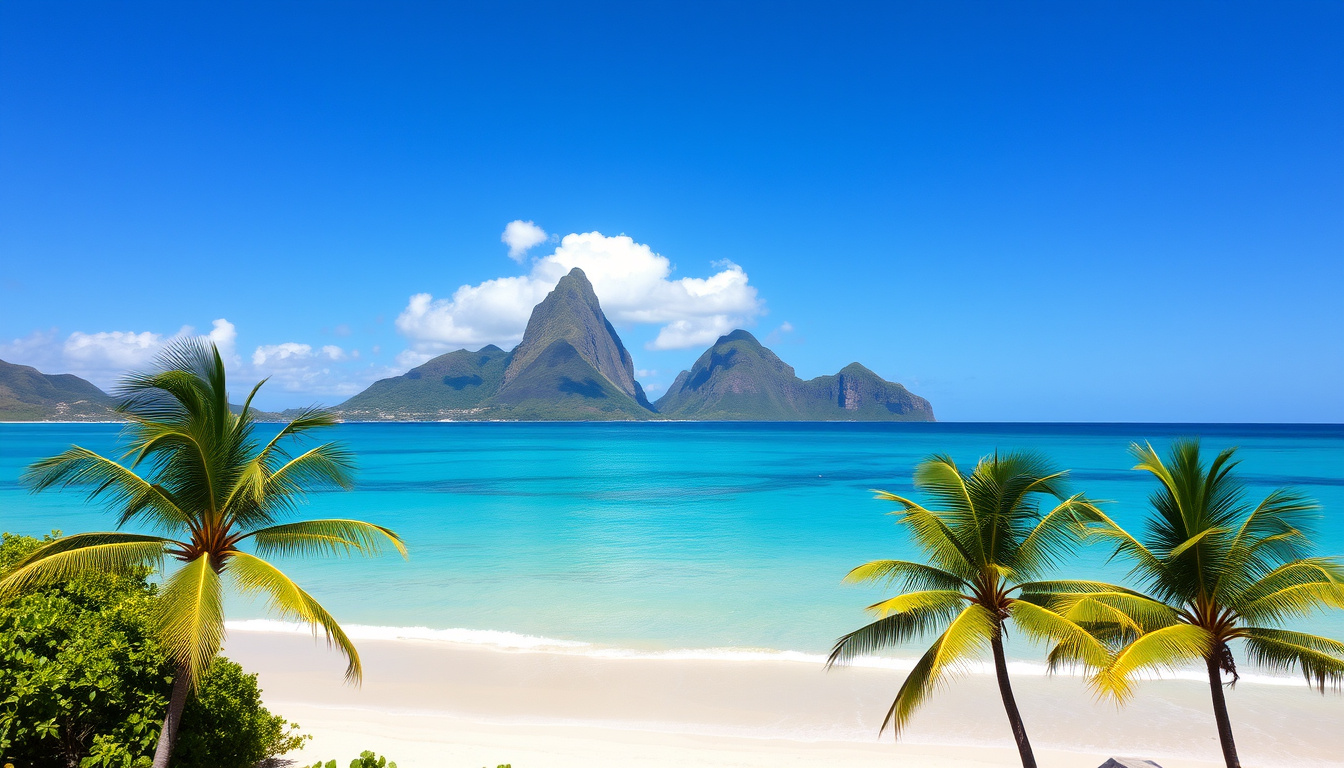
Few Caribbean islands make a first impression like St. Lucia: rainforest peaks, black-sand beaches, and the Pitons rising straight out of the sea. The island also comes with genuine planning questions — cost, safety, and a French-British past that still shapes its culture — and the U.S. State Department’s Level 1 rating is useful context, but not the whole picture (U.S. Department of State (official travel advisory)).
Island area: 617 km² · Capital: Castries · Official language: English · Currency: Eastern Caribbean dollar · Population: ~180,000 (2023 estimate) · Peak tourism season: December to April
Quick snapshot
- English is the official language, and U.S., UK, and Canadian citizens can enter visa-free with a valid passport and proof of onward travel (Saint Lucia Tourism Authority (official tourism board)).
- The U.S. embassy issued a July 10, 2026 advisory for Saint Lucia asking citizens to exercise increased caution due to crime (U.S. Embassy Barbados (official advisory)).
- Major roads are in average to poor condition, and drivers may encounter wandering animals and slow-moving heavy equipment (U.S. Department of State (country information)).
- Year-by-year crime statistics are not published in a traveler-friendly format, which is why the embassy’s “increased caution” language and the State Department’s broader Level 1 wording can look inconsistent.
- The real budget spread between all-inclusive resorts, guesthouses, and self-catering rentals — the tourism authority lists taxes, not typical nightly rates.
- Advisory levels can change with little notice, so the exact guidance in effect on your travel date may differ from what is summarized here.
- Hurricane season runs June through November, and tropical systems can affect ferries, hiking, and flights (Saint Lucia Tourism Authority (health & safety)).
- Before booking, check your passport’s validity and prepare proof of onward travel — both are required for visa-free entry (UK Foreign, Commonwealth & Development Office (entry requirements)).
- If you want lower rates, aim for the off-season between May and November — the same window as hurricane season. (UK Foreign, Commonwealth & Development Office (entry requirements))
Six facts that frame the whole island — currency, language, size, and time zone — in one glance.
| Category | Detail |
|---|---|
| Capital | Castries |
| Official language | English |
| Currency | Eastern Caribbean dollar (XCD) |
| Population | 183,000 (2023 estimate) |
| Area | 617 km² |
| Time zone | Atlantic Standard Time (UTC-4) |
Is St. Lucia good for tourists?
The short answer is a confident yes — with one caveat. St. Lucia is a destination for travelers who want scenery, warmth, and an easy resort rhythm, not for people looking for a cheap beach hop or nonstop nightlife.
What makes St. Lucia unique?
- Volcanic peaks, rainforest, waterfalls, and beaches that alternate between golden sand and black volcanic grains.
- A compact island, so you can switch regions without losing a day to transport.
- Honeymoon-focused resorts that handle the details, which is why the island is such a default answer for couples.
The island’s volcanic core is visible everywhere — in the Pitons, the black sand, and the sulfur springs near Soufrière. That geology is also why a week here rarely feels repetitive: every cove has a different texture.
First-timers who want the postcard version of St. Lucia should base themselves in the north; hikers and repeat visitors usually gravitate to the west, where the Pitons and Soufrière change the pace entirely.
Pros and cons of visiting St. Lucia
Upsides
- Scenery that delivers: the Pitons, rainforest, waterfalls, and two colors of beach.
- Resort infrastructure built around couples, so a honeymoon or anniversary trip needs minimal planning.
- Day trips move fast — hiking, sailing, zip-lining, and snorkeling are all reachable from one base.
Downsides
- Costs run high — the island markets itself as a premium destination, and prices follow.
- Safety needs attention after dark, especially on beaches and in urban areas.
- The cheapest travel window overlaps with hurricane season, so low-season savings come with weather risk.
What this means: choose St. Lucia for the setting and the ease of a resort base, and treat the price as the trade-off you accept for the scenery.
Is it safe to visit St. Lucia now?
The honest answer is that the official safety picture has more layers than a single advisory can capture. Plan smart, and St. Lucia operates like a normal Caribbean destination; plan carelessly, and the evening hours are where visitors get into trouble.
Crime rates and tourist safety
- Petty larceny, burglary, automobile break-ins, and violent crime can occur — and the U.S. State Department advises travelers to avoid walking alone at night, especially on beaches and in isolated or poorly lit locations (U.S. Department of State country information).
- The U.K. Foreign Office warns that there is a continuing serious risk of homicides in Saint Lucia, primarily gang-related and involving guns, and advises tourists to use only licensed taxis and avoid carrying large amounts of cash or jewelry (UK Foreign, Commonwealth & Development Office (safety and security guidance)).
- Around the Saint Lucia Jazz and Arts Festival in May and Carnival in July, the same U.K. guidance says robberies and opportunistic crime become more likely.
Notice the pattern: the homicide warning is about gangs and guns — a very different threat from the opportunistic theft a tourist is likely to meet. For visitors, the risk concentrates in transitions: walking home late, taking an unlicensed taxi, or flashing cash in a crowded bar.
The travelers who get into trouble are rarely on resort property. They are usually on a beach after dark or in a car they shouldn’t have rented, doing the kind of thing that feels routine back home.
Which areas to avoid
- Official advisories do not publish a list of banned neighborhoods; they consistently point to urban areas and isolated beaches as the places where risk concentrates.
- The U.S. guidance highlights poorly lit locations and late-night beach walks; the U.K. guidance adds large event crowds to the watch list.
The practical version of “avoid” is mostly a time-of-day rule: plan to be back at your resort or villa before late night, and ask your accommodation to arrange transport if you don’t feel comfortable driving. That simple habit eliminates most of the scenarios officials describe.
Barbados vs. St. Lucia: safety comparison
The homicide statistics that scare people are, by official description, gang-related and gun-involved — a reality for local communities, not a forecast for resort visitors acting sensibly.
The Barbados-versus-St. Lucia safety question comes up constantly in forums, but the official advisories for both islands follow a similar shape: resort areas are the comfort zone, and urban nightlife deserves the same caution you’d apply anywhere in the Caribbean. The deciding factor is usually where you stay and how late you’re out, not the island name.
Why is St. Lucia so expensive?
St. Lucia is a small island with a small economy, a heavy import bill, and a tourism industry built around luxury resorts. Those three forces push prices up before you even open a menu.
Cost of food and accommodation
VAT on hotels and restaurants: 10% · Service charge: 10% · Customary tip: 10–12% (Saint Lucia Tourism Authority official cost guidance)
- Food and goods are largely imported, which is why grocery and restaurant prices can look closer to New York than to other Caribbean islands.
- Resort stock skews upscale, anchoring the whole island’s price level at the top end.
- Off-season discounts, roughly May through November, are real but overlap with hurricane season.
Add the tax structure to the import costs and you get the island’s real reputation: a place where a modest dinner for two can easily match a city price, and where the “cheap Caribbean” idea never quite arrives.
Is St. Lucia worth the price?
The same window that brings off-season discounts — roughly May through November — is also hurricane season, so the savings come with a genuine weather gamble.
For resort guests, the value story usually works: you’re paying for the setting, the service, and the lack of logistics. For independent travelers, the math is harder, which is why the island’s most loyal repeat visitors tend to be couples who have already looked at the numbers.
Why this matters: if you show up without room in the budget for the mandatory extras, the island will feel twice as expensive as the flight that brought you.
Is St. Lucia French or British?
The honest answer is both — and neither. St. Lucia carried the flags of both empires, but what emerged is a culture that belongs to the island itself.
History of colonial rule
- France and Britain traded control of the island repeatedly during the 18th century, and the two powers’ rivalry left a lasting imprint.
- British rule eventually won the day in the early 19th century, which is why English became the language of government and education.
- The French influence survived in place names like Soufrière and Gros Islet, and in the island’s Creole identity.
You can still feel the tug-of-war in the street names and in the blended accent of local English — a living reminder that the island’s identity was negotiated, not inherited.
Language spoken in St. Lucia
Official: English · Widely spoken: Saint Lucian Creole French (Kwéyòl)
One glance at the language mix explains the island’s double heritage.
| Language | Role in daily life |
|---|---|
| English | Official language — used in government, schools, business, and tourism. |
| Saint Lucian Creole French (Kwéyòl) | Everyday language for many locals; a French-based Creole shaped by African and Caribbean influences. |
The practical result for travelers: English opens every door, and a Creole greeting or two will earn genuine goodwill beyond the resort gates.
The implication: don’t come looking for “French” or “British” St. Lucia — come for the Creole culture that took pieces of both and made its own rules.
Which is the nicest part of St. Lucia?
The honest answer depends on what you want to do after breakfast. St. Lucia’s regions are different enough that a “best area” for one traveler is the wrong base for another.
Rodney Bay and the north
- The island’s hub for nightlife, marinas, long beaches, and the widest selection of restaurants.
- Close to the airport and to Castries, making it the practical base for first-timers who want convenience over seclusion.
- The best fit for travelers who want an active evening scene after a day by the water.
Soufrière and the west
- Sits at the foot of the Pitons, which makes it the natural base for hikers and nature-focused travelers.
- Home to the island’s volcano and sulfur springs, plus the most photographed stretch of coastline in St. Lucia.
- The best fit for visitors who want scenery first and nightlife second.
Marigot Bay and the south
- A yachting pocket that is quieter and smaller, renowned for its beauty and slow pace.
- The best fit for a relaxed stay, a marina-side meal, or a break between two more active regions.
Three very different bases, one pattern: the north is the convenient hub, the west is the scenery, and Marigot Bay is the quiet that most people only see in photographs.
| Area | Best for | The catch |
|---|---|---|
| Rodney Bay & the north | Nightlife, marinas, long beaches, airport convenience | Most developed and resort-heavy stretch of the island |
| Soufrière & the west | The Pitons, hiking, nature tours, volcano and sulfur springs | Winding mountain roads and fewer big beaches |
| Marigot Bay & the south | Yachting views, quiet waterfront stays, slower pace | Smaller restaurant scene and less after-dark activity |
If it’s your first visit and you want a mix, split the trip: a few nights in the north for logistics and beaches, then two nights in the west for the Pitons. Drivers should be comfortable with narrow, winding mountain roads, and daytime driving beats night driving.
What’s confirmed — and what’s still unclear
Confirmed facts
- English is the official language, and U.S., UK, and Canadian citizens can visit visa-free with proof of onward travel (UK Foreign, Commonwealth & Development Office (travel advice)).
- The island is volcanic in origin — visible in the Pitons, the black-sand beaches, and the sulfur springs near Soufrière (UNESCO World Heritage Centre (Pitons Management Area)).
- Hurricane season runs June through November, and official guidance says tropical systems can disrupt travel plans (U.S. National Hurricane Center (season definition)).
What’s unclear
- Year-by-year crime trends: official advisories describe risk in general categories, not in visit-by-visit odds.
- How far a fixed budget will stretch: the tourism authority publishes taxes, not typical nightly rates for guesthouses and rentals.
- How quickly official travel advisories might change before departure; both the State Department and the U.S. Embassy advisories were current when this guide was published.
The distinction matters: confirmed facts tell you what to plan for, while the open questions tell you where to leave flexibility in your itinerary.
Official voices on safety
The U.S. Embassy’s July 10, 2026 advisory asks citizens to exercise increased caution in Saint Lucia due to crime — the most direct official caution currently on the books.
U.S. Embassy Barbados
Use only licensed taxis and avoid carrying large amounts of cash or jewelry — the U.K. Foreign Office makes both points in its safety guidance for Saint Lucia.
UK Foreign, Commonwealth & Development Office
The shared thread in both advisories: crime is real, but the precautions are specific and routine.
The practical takeaway
St. Lucia’s real selling point isn’t that it’s a bargain or a risk-free beach — it’s that the volcanic scenery and cultural mix are hard to overstate. What separates a great trip from a stressful one is a plan that matches the island’s character: choose your base by your itinerary, respect the official safety advice after dark, and budget for the mandatory extras before you arrive. For a first-time visitor from the U.S. or U.K., the choice is clear: book the north for convenience or the west for scenery — and if you want both, split the island instead of trying to pick one coast.
travel.state.gov, thebrokebackpacker.com, osac.gov, travelocity.com, osac.gov, santorinidave.com
Frequently asked questions
Are there snakes in St Lucia?
Snakes rarely come up in official travel advice. The Saint Lucia Tourism Authority’s health-and-safety guidance focuses on mosquito-borne illness, hurricane season, and emergency contacts rather than reptiles.
Do I need a visa to visit St Lucia?
U.S., UK, and Canadian citizens can visit visa-free for tourism, but the entry rules are not loose: you need a valid passport and proof of a confirmed onward journey.
What is the best time to visit St Lucia?
December through April is the peak window and the classic choice for weather; May through November brings lower rates but overlaps with hurricane season, which can affect ferries, flights, and hiking.
Is St Lucia a good honeymoon destination?
Yes — it is one of the default honeymoon answers in the Caribbean, and the resort infrastructure in the north and west is built around couples who want scenery and minimal planning.
What currency do I need in St Lucia?
The Eastern Caribbean dollar (XCD) is the local currency, as shown in the key facts above; it’s the same EC dollar family used across several islands in the region.
Is English widely spoken in St Lucia?
Yes — English is the official language, so conversations with hotel staff, taxi drivers, and tour guides are straightforward; in daily life you’ll also hear a French-based Creole.
Related stories




Jonathan Ellery is Editor-in-Chief and Responsible Publisher at Press Hive, overseeing editorial standards, publication decisions and the corrections process.