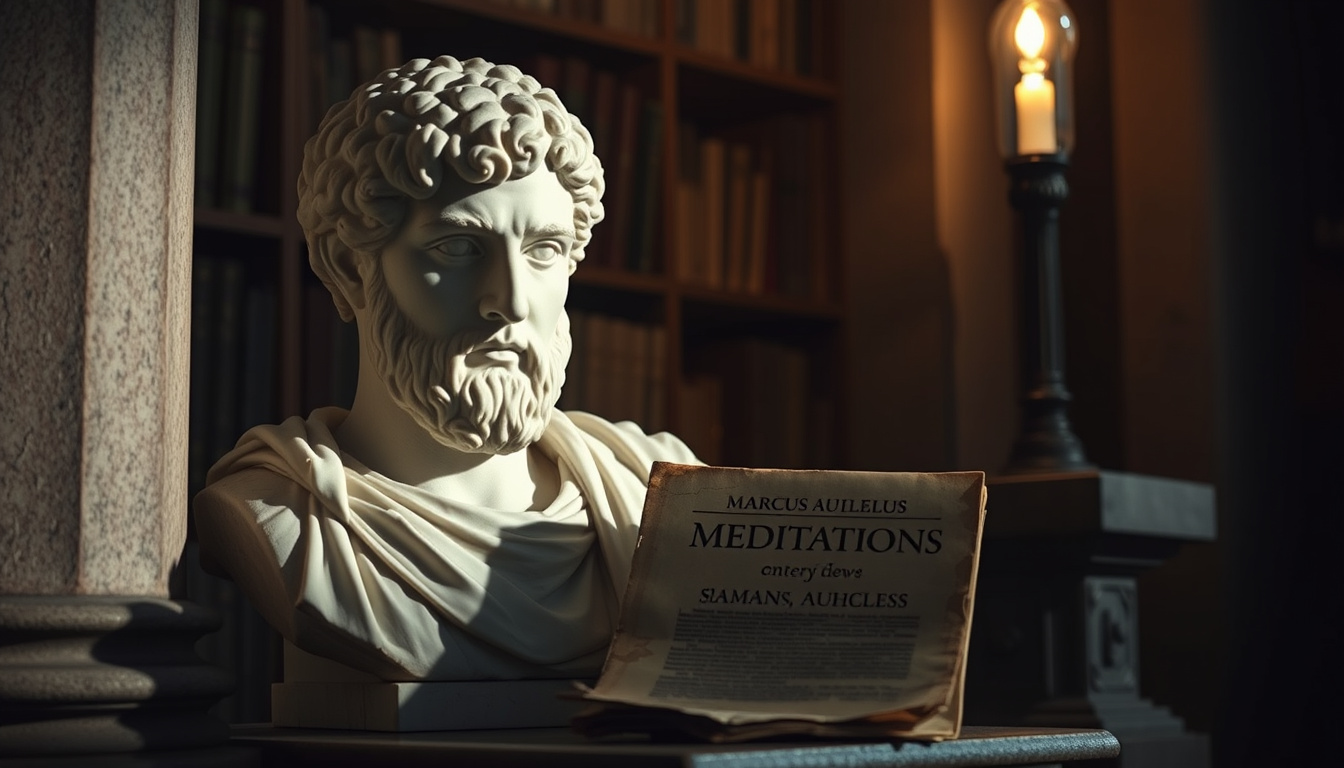
Scroll through any Stoic quote account and Marcus Aurelius appears as a serene philosopher-king dispensing calm. The actual record shows a working emperor who wrote private notes in Greek, ruled from 161 to 180 CE as the last of the Five Good Emperors, and governed an empire under pressure from plague and frontier war.
Reign: 161–180 CE · Dynasty: Nerva–Antonine · Major Work: Meditations · Known As: Last of the Five Good Emperors
Quick snapshot
- Reigned 161–180 CE as the last of the Five Good Emperors (Britannica (historical reference))
- Wrote Meditations in Greek as a private notebook (Stanford Encyclopedia of Philosophy (university reference))
- Cause of death: Antonine Plague or natural causes, with no final verdict (EBSCO Research Starters (academic database))
- The surviving texts never explicitly call Marcus a Stoic (Encyclopedia.com (reference collection))
- Born 121 CE, adopted 138 CE, emperor from 161 CE (Roman Emperors — DIR (digital history resource))
- Meditations was composed during the campaign years, around 171–175 CE (Stanford Encyclopedia of Philosophy (university archive))
- Nietzsche’s critique of Stoic self-sufficiency still shapes the debate (Inquiry — Taylor & Francis (philosophy journal))
Six rows, one pattern: the moment you move past dates and titles, the sources start leaving room for interpretation.
| Attribute | Detail | Source |
|---|---|---|
| Full name | Marcus Aurelius Antoninus | Internet Encyclopedia of Philosophy (scholarly reference) |
| Died | 17 March 180 CE, Vindobona (modern Vienna) | EBSCO Research Starters (academic database) |
| Cause of death | Antonine Plague (likely smallpox or typhus) or natural causes | Roman Emperors — DIR (digital history resource) |
| Major work | Meditations (Tōn eis heauton, “writings to oneself”) | EBSCO Research Starters (academic database) |
| Philosophical school | Stoicism | Encyclopedia.com (reference collection) |
| Reign | 161–180 CE | Stanford Encyclopedia of Philosophy (university reference) |
What Is Marcus Aurelius Most Famous For?
His role as Roman Emperor and Stoic philosopher
- He is remembered as Rome’s philosopher-emperor, a ruler whose Stoic practice shaped how he governed (Encyclopedia.com (reference collection))
- His reign ran through the Antonine Plague and long wars on the Danube frontier, not a quiet golden age
That image of a philosopher-king is half of the story. Marcus was trained in rhetoric and philosophy and spent his life surrounded by teachers, but he was also a working administrator who held the line during the Parthian conflict, the Marcomannic Wars, and the devastating pandemic historians now call the Antonine Plague. The man who wrote about keeping calm was the same man who had to stay calm while the empire burned around him.
The serene portrait is load-bearing for modern Stoicism, but it hides what made the philosophy useful in the first place: Marcus was practicing it under real strain, not in a courtyard.
The implication: Marcus became famous not because he was a perfect Stoic, but because he was the rare emperor who treated philosophy as a working tool for an impossible job.
The writing of Meditations
- Meditations is a private notebook, not a polished treatise — which explains its raw, repetitive, deeply personal tone
- The title translates as “writings to oneself,” and the content reads exactly that way
No one in the ancient world planned to publish this book. Marcus addressed the notes to himself, probably stacking them while military campaigns dragged on. What survives is a record of a mind talking itself through difficulty.
The catch: the book’s popularity today rests on lines that look like modern affirmations. It is easier to make Marcus Instagram-ready when you remove the war deaths, the plague, and the fact that his son turned out to be Commodus.
The implication: the emperor’s private struggle is what makes his philosophy credible.
What Are the 7 Stoic Principles of Marcus Aurelius?
The core tenets of Stoicism as practiced by Marcus Aurelius
- Live according to nature
- Control what you can, accept what you cannot
- The obstacle is the way
- Focus on the present moment
- Practice negative visualization
- Voluntary discomfort
- Cosmopolitanism
Here is the catch: that list is a modern shorthand. The historical Stoics — Marcus included — never published a numbered “7 principles” set. What the sources confirm is a harder, less comforting core: only virtue is good, only vice is bad, and things like wealth, health, and reputation are indifferent (Philomag (philosophy magazine)).
Marcus absorbed this framework through the tradition that runs from the Athenian Stoa to Roman thinkers like Seneca and Epictetus (PhilArchive (open philosophy repository)). His own writings never claim originality; they recycle the same exercises — judgment, duty, endurance — like an athlete working the same drills.
How these principles guided his actions as emperor
- He practiced self-examination in writing, which we now know as Meditations
- He treated politics as an arena for virtue rather than a path to comfort
- He applied “control what you can” to wars and plagues: prepare, act, and do not rage at what is not in your power
None of this made Marcus a passive ruler. He spent the last decade of his reign on the Danube frontier with his armies, wrote his notes between battles, and died on campaign — the opposite of the “retreat from the world” caricature.
The “7 principles” industry makes Stoicism feel like a productivity system. Marcus’s actual method was blunter: keep your judgment clean, do your duty, and stop complaining about what fortune hands you.
The pattern: the more marketable the list, the further it drifts from the ancient material. That does not make the principles useless — it makes them adaptations.
The pattern: the modern list is a simplification, not a scholarly finding.
How Did Marcus Aurelius Treat Jews?
Evidence from historical records
- The Bar Kokhba revolt (132–136 CE) had ended under Hadrian roughly two decades before Marcus took power in 161 CE (Britannica (historical reference))
- No surviving decree from Marcus’s reign records a systematic policy aimed at Jewish communities
- His personal involvement in Jewish affairs is barely documented at all
The honest answer is that the evidence base is thin. There is no moment in the surviving sources where Marcus directly addresses Jews as a group — no judicial ruling, no letter, no policy statement that historians can point to with confidence.
What people usually reach for is background context: Roman imperial practice toward Jews had combined legal toleration with periodic restrictions, and that broad description is often assumed to describe Marcus’s reign too. But assumption is not evidence.
Reading a full policy toward Jews into the silence of the sources says more about the reader’s question than about the historical record. The defensible position is: the evidence does not settle Marcus’s personal attitude.
Interpretations of his policies
- Some historians treat the absence of persecution as evidence of tolerance
- Others argue that absence proves nothing, since Roman provincial administration rarely left personal opinions on record
The scholarly debate is therefore a debate about the meaning of silence. That makes this topic a useful test case: it shows how an emperor’s character is often reconstructed from the gaps in the archive, not just from its contents.
What this means: if you see a definitive sentence about Marcus and the Jews online, treat it as an interpretation, not a verified fact.
What Did Nietzsche Say About Marcus Aurelius?
Nietzsche’s admiration and criticism
Nietzsche called Marcus “the most noble and humane emperor Rome ever had” — then spent years attacking the Stoic system Marcus practiced as a philosophy of self-deception.
- Nietzsche argued that Stoicism overstates rational self-sufficiency and undervalues pain, passion, and the messier energy of life (Inquiry — Taylor & Francis (philosophy journal))
- He also objected to the Stoic call for unconditional acceptance of fate, which in his reading dulled the will to fight and create (PhilArchive (open philosophy repository))
The distinction matters: Nietzsche separated the man from the philosophy. He could admire a ruler who carried enormous weight while rejecting the philosophical armor that ruler used to survive it. That is a more interesting critique than “Marcus is overrated.”
Contrast between Stoic and Nietzschean ethics
- Nietzsche preferred a life-affirming ethics of struggle, danger, and great passion to Stoic detachment
- For him, a philosophy that told people to master their reactions and accept fate was a philosophy that had given up on the world
Marcus, in Nietzsche’s own terms, was the exception — the Stoic who did his duty anyway. The modern Stoic habit of quoting Nietzsche’s admiration while ignoring his attack on the system is cherry-picking on both sides.
The trade-off: Nietzsche gives you permission to respect the emperor without joining his school. The honest reading is that Marcus practiced a philosophy Nietzsche could not stomach — and still earned his respect.
The catch: Nietzsche’s respect for the man complicates the critique of the philosophy.
Why Is Stoicism Considered Toxic?
Modern critiques of Stoicism
- Critics say Stoicism encourages emotional suppression, passivity in the face of injustice, and a habit of blaming people for their own distress (PhilArchive (open philosophy repository))
- The “toxic Stoicism” charge is usually aimed at internet-era self-help, not at the ancient texts themselves
There is a real kernel here. When “control what you can” becomes “stop complaining and get to work,” it shades into a philosophy that asks people to accept bad conditions instead of changing them. Nietzsche saw this hazard a century ago; modern critics just gave it a sharper label.
Potential misinterpretations of Marcus Aurelius’s teachings
The emperor’s notebook is full of empathy, social duty, and warnings against contempt for others. The “toxic” label fits the modern packaging better than the original material.
Read in full, Meditations is not a guide to performing masculinity or suppressing emotion. It is a ruler reminding himself that other people are fellow humans, that anger is a weakness, and that his job is to serve something larger than his own comfort. A philosophy that tells an emperor to remember his duty to the governed is not the same as a toughen-up productivity hack.
What this means: the dark side of Stoicism is largely a dark side of its marketing. The remedy is to stop mistaking a curated feed for the primary source.
The takeaway: the source material undermines the toxic label.
Marcus Aurelius in Timeline
- — Born in Rome (Internet Encyclopedia of Philosophy (scholarly reference))
- — Adopted by Antoninus Pius (Roman Emperors — DIR (digital history resource))
- — Becomes emperor alongside Lucius Verus (Internet Encyclopedia of Philosophy (scholarly reference))
- — Marcomannic Wars on the Danube frontier (Internet Encyclopedia of Philosophy (scholarly reference))
- — Writes Meditations while on campaign (Inquiry — Taylor & Francis (philosophy journal))
- — Dies in Vindobona; succeeded by son Commodus (Philomag (philosophy magazine))
The shape of the life is clear: a long apprenticeship, a heavy reign, and a death out in the field rather than in a palace.
Confirmed Facts vs. Open Questions
Confirmed facts
- Marcus Aurelius belongs on the Roman peak of the Stoic school, alongside Seneca and Epictetus (Philomag (philosophy magazine))
What’s unclear
- Exact cause of death: the Antonine Plague is the leading suspect, but natural causes are not excluded
- Personal attitude toward Jewish communities: barely documented, heavily inferred
- The popular “7 principles” list: a modern construct, not an ancient syllabus
The balance is telling: one rock-solid confirmation, three open questions. That is normal for an ancient life — and a warning against anyone selling a perfectly packaged Marcus.
Marcus Aurelius in His Own Words — and Nietzsche’s
“When you arise in the morning, think of what a precious privilege it is to be alive — to breathe, to think, to enjoy, to love.”
Marcus Aurelius, Meditations, Book 2
That line comes from a private notebook written in Greek, never meant for publication. It survives because someone saved the notes — and because the sentiment travels remarkably well across eighteen centuries.
“the most noble and humane emperor Rome ever had”
Friedrich Nietzsche, The Antichrist (1895)
Nietzsche’s admiration for the man makes his attack on the philosophy more interesting — and more uncomfortable for modern Stoics who want to quote both.
The Takeaway
Marcus Aurelius is one of the few historical figures whose personal notebook became a public monument. The real value of reading him today is not a seven-step routine; it is watching a powerful man argue himself into decency every single day. For anyone picking up Meditations expecting an ancient life coach, the choice is clear: engage the full historical record — wars, plagues, and unanswered questions included — or keep assembling fragments until they fit a mirror.
Related reading
- Henry Eighth: Six Wives, Children & Why He’s Famous — a biography of another ruler whose public image hides a complicated record
- Laurence Olivier: Life, Wives, Net Worth, and Death — an evergreen biography with the same “public persona vs. private reality” tension
Frequently asked questions
Do Stoics drink alcohol?
Stoicism taught moderation, not abstinence. The school ranked virtue as the only good and treated external things, including wine, as indifferent — so self-control, not prohibition, was the goal.
Did Jesus believe in Stoicism?
No. Stoicism was a Hellenistic school that emerged in Athens centuries before Jesus; his teachings are rooted in Judean prophecy, not Greek natural philosophy. Overlapping moral themes are cultural atmosphere, not direct influence.
What is the wisest quote ever said?
That is subjective. The most widely shared line from Meditations is the morning reflection: “When you arise in the morning, think of what a precious privilege it is to be alive.”
What was Marcus Aurelius’ cause of death?
The leading hypothesis is the Antonine Plague, likely smallpox or a typhus-like fever, though natural causes are not excluded. The ancient sources are not unanimous.
Is Marcus Aurelius mentioned in the movie Gladiator?
The 2000 film Gladiator opens with Marcus Aurelius, played by Richard Harris, dying and designating Maximus as his heir — an invention of the screenplay rather than a documented historical plan.
Who was Marcus Aurelius’ son?
Commodus, who succeeded him in 180 CE — a succession that ended the run of the Five Good Emperors.
Where can I get a free PDF of Meditations?
Meditations is in the public domain. Free digital editions are available through library catalogs and open-book services such as Project Gutenberg.
Related stories




Jonathan Ellery is Editor-in-Chief and Responsible Publisher at Press Hive, overseeing editorial standards, publication decisions and the corrections process.