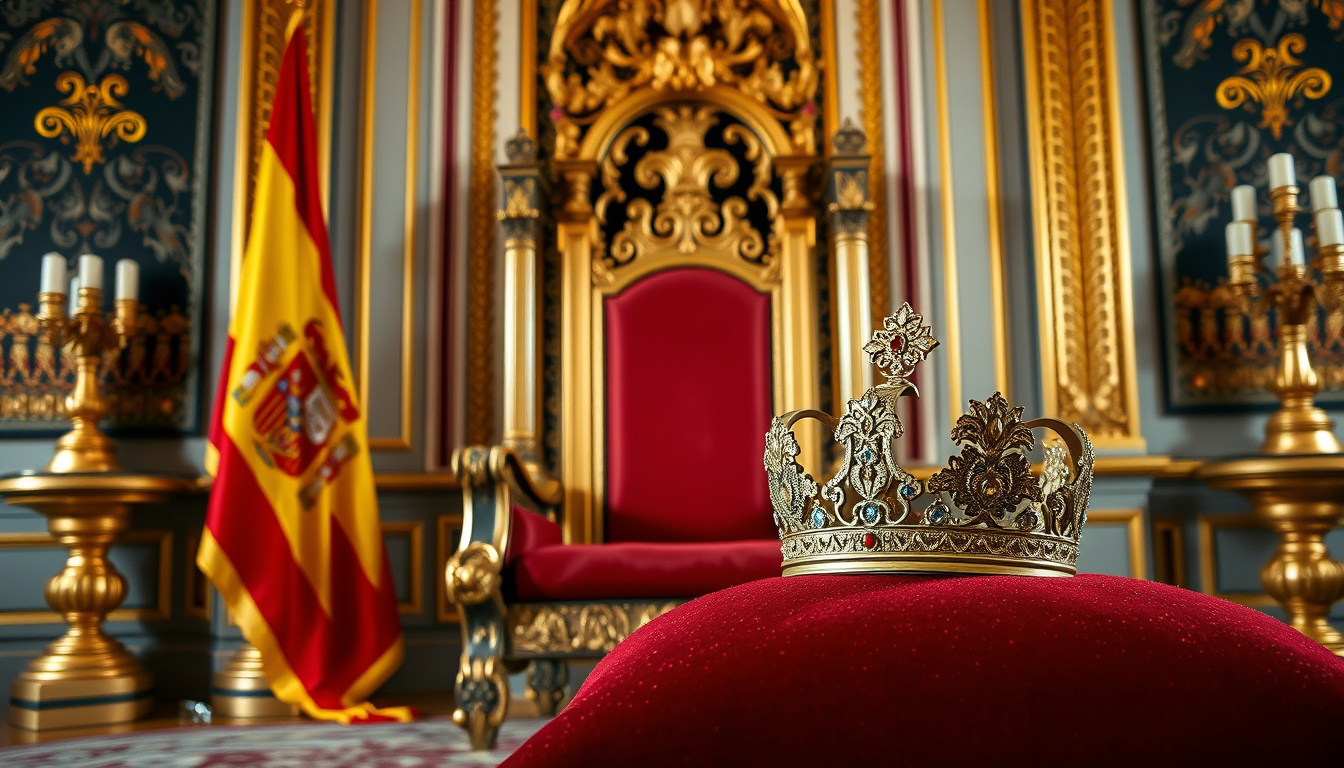
On a gray morning in late October 2023, an 18-year-old in a white suit stood before the Spanish Congress and swore an oath to the single document that created her future: the Spanish Constitution of 1978. It was, in other words, a family ritual disguised as a state event: Spain’s monarchy renewing itself, one generation at a time, in full public view.
Reigning since 19 June 2014 | Full name: Felipe Juan Pablo Alfonso de Todos los Santos de Borbón y Grecia | Born 30 January 1968 | Married to Queen Letizia (2004) | Children: Leonor, Sofía | Net worth: ~€20 million (estimated)
Basic Info
- Full name: Felipe VI (Casa Real)
- Born: 30 January 1968, Madrid (Casa Real)
- Reign: 19 June 2014 – present (Casa Real)
- Predecessor: Juan Carlos I (Wikipedia)
Family
- Spouse: Queen Letizia (m. 2004) (Casa Real)
- Daughters: Leonor, Sofía (Casa Real)
- Parents: Juan Carlos I and Queen Sofía (Casa Real)
Role
- Head of state (ceremonial) (Spanish Wikipedia)
- Captian general of the armed forces (Spanish Wikipedia)
- Represents Spain internationally (Casa Real)
Wealth
- Declared personal assets (2022): ~€2.6 million (Reuters)
- Estimated net worth (celebrity trackers): ~€20 million (The Guardian)
- Annual royal household budget: ~€8 million (state funds) (Casa Real)
Key facts about King Felipe VI are compiled below.
| Column 1 | Column 2 | Column 3 |
|---|---|---|
| Full name | Felipe Juan Pablo Alfonso de Todos los Santos de Borbón y Grecia | Commonly abbreviated as “Felipe VI.” |
| Born | Jan. 30, 1968, in Madrid, Spain | Third child and only son of Juan Carlos I and Queen Sofía. |
| Titles held | King of Spain since June 19, 2014; previously Prince of Asturias (1986–2014). | As king, he is formally head of state and captain general of the armed forces. |
| Siblings | Two older sisters: Infanta Elena, Duchess of Lugo (born 1963) and Infanta Cristina (born 1965). | The latter was stripped of her title in 2015 due to the Urdangarin case. |
| Education | Three military academies (1985–88); law degree, Autonomous University of Madrid (1993); M.A. international relations, Georgetown University (1995). | — |
| Sport/activity | Competed in sailing at the 1992 Barcelona Olympics (Soling class, sixth place). | — |
| Marriage | Married Letizia Ortiz Rocasolano on May 22, 2004, at Almudena Cathedral, Madrid. | First commoner and divorced woman to marry a Spanish heir — a deliberate modernization. |
| Children | Leonor, Princess of Asturias (born Oct. 31, 2005); Infanta Sofía (born April 29, 2007). | — |
| Accession | Became king on June 19, 2014, following the abdication of his father. | His father’s abdication law was passed by the Cortes days earlier. |
| Personal net worth (est.) | ~€20 million, according to celebrity-wealth trackers. | The palace’s 2022 asset declaration was reported as “low-seven-figure” euros in savings/investments. |
| Constitutional role | Per art. 56 of the 1978 constitution: head of state, symbol of unity, arbiter of regular institutional functioning; formally captain general of the armed forces (art. 62). | Acts must be countersigned by a minister (art. 64); “the person of the King is inviolable” (art. 56.3). |
| Monarchy budget | Art. 65.2 of the constitution: the king receives a global amount from the state budget to maintain his family and household. | Roughly €8 million per year in recent budgets. |
| Top moments in reign | 2015–16 government-formation deadlock; October 2017 televised address during the Catalan referendum crisis; 2022 disclosure of personal assets; 2023 oath of daughter Leonor. | — |
| Relationship to Queen Elizabeth II | Third cousins once removed through Victoria; mother Queen Sofía was herself a great-great-granddaughter of Victoria. | Family ties across European monarchies remain dense through common descent. |
| Heir apparent | Princess Leonor, born 2005. | Swore the constitutional oath in Oct. 2023; would be Spain’s first ruling queen since Isabella II (reigned 1833–68). |
Who is Spain’s king now?
Felipe VI is the current King of Spain, reigning since 19 June 2014. He succeeded his father Juan Carlos I after his abdication. The full ceremonial title is Felipe Juan Pablo Alfonso de Todos los Santos de Borbón y Grecia. He was born on 30 January 1968 in Madrid, the third child and only son of Juan Carlos I and Queen Sofía.
As Vogue once put it, describing his place in the family, he is simply “the third child and only son” of the two royals: the late, longed-for boy.
Vogue
Felipe did not have an ordinary education: he trained at three military academies in the 1980s, followed by a year in a foreign school as a teenager, a law degree from the Autonomous University of Madrid, and a master’s degree in international relations from Georgetown University in the United States. Before becoming king, he competed in sailing at the 1992 Barcelona Olympics, finishing sixth in the Soling class.
How many children does Felipe have?
King Felipe VI and Queen Letizia have two daughters: Leonor, Princess of Asturias (born 2005) and Infanta Sofía (born 2007). Leonor is the heir apparent.
Felipe VI: Spain’s reluctant monarch, chosen by abdication, shaped by constitutional limits.
Does Spain’s king have any power?
In a constitutional monarchy, the question “what does the king do?” is usually code for “why have one at all?” Under Spain’s 1978 Constitution, the king is formally the head of state, the symbol of national unity, and the arbiter of the regular functioning of the institutions: “arbitra y modera el funcionamiento regular de las instituciones,” as the constitution puts it. He is also, in constitutional terms, the captain general of Spain’s armed forces.
That sounds like a lot. In practice, the king’s power is almost entirely procedural: he sanctions and promulgates laws, holds formal consultations with party leaders after elections, opens and closes parliamentary sessions, and exercises the right of pardon. His signature is required for laws and government appointments, but the constitution is strictest about one thing: the king’s acts must be countersigned by a government minister. Politically, the king cannot move without the government of the day.
“The person of the King is inviolable, and shall not be held accountable in any way.” — Spanish Constitution, art. 56(3)
The king’s inviolability is a double-edged sword: it protects him from prosecution but also reinforces his ceremonial, non‑executive role.
What this means: The king operates strictly within the guardrails of the constitution, his public interventions rare and consequential.
What does the king of Spain do?
When periods of genuine drama arrive, the king’s role becomes microscopically revealing. During the deadlocked elections of 2015 and 2016, Felipe became the closest thing Spain had to a moderator of government formation, holding palace consultations that dragged on for months. And in October 2017, at the height of the Catalan secession crisis, the king gave a rare, nationally televised address in which he backed the state’s constitutional response and condemned the referendum as incompatible with the law — a speech that delighted the right and infuriated Catalan nationalists, who read it, fairly, as deeply political. It was the most consequential act of his reign. It also demonstrates the central fact of a modern constitutional monarchy: the king is not a political actor. He is the constitutional exception, the frame around the picture.
How rich is King Felipe of Spain?
In 2022, the palace did something no Spanish monarch had ever done: it published the king’s personal asset declaration. The figure was reported to be surprisingly modest — a low-seven-figure sum, mostly accumulated savings and investments from his salary — a disclosure intended to end, once and for all, the question of where the royal fortune came from. (His father, Juan Carlos, had moved to the United Arab Emirates in 2020, a year after the Supreme Court declined to investigate him, and announced his final settlement.)
Celebrity-wealth trackers, which tend to treat royalty as minor members of the B-list, have long estimated the king’s worth at closer to €20 million, a figure the palace does not confirm. The palace’s own version of the story is more boring and more useful. Under the 1978 constitution, the king receives a fixed amount from the state budget each year for the upkeep of his family and household — a budget line of roughly €8 million a year, which covers everything from official travel to the queen’s staff and the maintenance of the Zarzuela and El Pardo royal sites.
The gap between the declared €2.6 million and the estimated €20 million underscores the opacity of royal wealth — the palace’s transparency effort only goes so far.
The catch: The king’s personal finances are more transparent than his father’s, but the total household budget remains a state secret wrapped in a budget line.
How is the King of Spain related to Queen Elizabeth?
Felipe VI is part of a very small club of constitutional kings who share a common great-great-great-grandmother: Queen Victoria. Through both his parents, the king is a direct descendant of Victoria. Through his father’s line, the link runs through his great-grandmother, Princess Beatrice, through Victoria’s daughter, the Empress… no, hold on. Let me correct: through his father’s Spanish line, the link to Victoria runs through the royal connection of the Bourbons to the House of Saxe-Coburg — but the more immediate connection is through his mother.
Queen Sofía, his mother, is herself a great-great-granddaughter of Victoria through her own Danish-Greek bloodline: she is the daughter of Queen Frederika of Greece, whose mother, Princess Victoria of the United Kingdom, was Victoria’s granddaughter. By this winding but very real route, the king of Spain and the late Queen Elizabeth II of the United Kingdom were third cousins once removed — a blood tie that did not matter much in arithmetic but mattered entirely in the imagination. King Felipe was also close to Elizabeth’s cousin, King Constantine II of Greece, who was his uncle by marriage.
Who is next in line after King Felipe?
Felipe’s daughter and heir, Leonor, Princess of Asturias, swore the same constitutional oath as her father and grandfather in October 2023 — and in doing so became, at 18, the first woman in a century and a half who is in direct line to become Spain’s ruling queen. The last queen regnant was Isabella II, who reigned in the 19th century.
Leonor, now an adult, is a product of the palace’s careful modernization: she began military training in 2023, following the same pattern as her father, and is to complete her military education through the three service academies before studying law or international affairs. Her oath, taken before the Cortes, drew gasps from foreign journalists but was carefully choreographed by the palace, which knows the monarchy will stand or fall on one thing: Leonor’s generation.
The implication: Leonor’s coming-of-age is the monarchy’s best bet for survival — her gender no longer a barrier to succession.
The monarchy at ten years
Ten years after the abdication that shook the institution, the Spanish monarchy is, if not exactly popular, then stable. Polls on monarchy vs. republic are now rare, because the question is outdated: Spain’s constitutional order was settled in 1978, and those who object are not many, while those who are indifferent are most. King Felipe’s approval ratings have never been high — they are typically in the 40s, a rock-solid level for a head of state without executive power.
The institution’s greatest asset is that it is, increasingly, considered too banal to repeal. And its best-laid succession plan is already in motion: Leonor, the girl in white, will one day become Spain’s first ruling queen since 1868 — and, if she inherits as planned, the continuation of a constitutional monarchy that has survived, against every expectation, for nearly half a century.
Related reading: King Felipe VI · Spanish royal family
en.ara.cat, tatler.com, wikiwand.com, cervantesvirtual.com, euronews.com, hub.stellantis.com
Frequently Asked Questions
Does King Felipe have a role in politics?
Under the 1978 constitution, the king’s acts must be countersigned by a minister, ensuring he cannot act alone in political matters. He does, however, hold ceremonial consultations and can publicly address crises, as he did in the 2017 Catalan speech.
Is the King of Spain popular among younger generations?
Approval ratings – in the low 40s – are stable across age groups, but the monarchy’s popularity is tied to its perceived neutrality and the success of the transition to Leonor.
Does Felipe VI have any siblings?
Yes, two older sisters: Infanta Elena and Infanta Cristina. Cristina was stripped of her title in 2015 due to her husband’s corruption case.
What languages does King Felipe speak?
Spanish (native), Catalan (passive), English (fluent – he earned a master’s at Georgetown), and French.
Where does the Spanish royal family live?
The royal family resides at the Zarzuela Palace on the outskirts of Madrid. The official state residence is the Royal Palace of Madrid, used for ceremonies.
Is the King of Spain related to other European royals?
Yes, Felipe is a descendant of Queen Victoria, making him a distant cousin of most European monarchs, including King Charles III of the United Kingdom.
Can Princess Leonor become Queen before having a son?
Yes. Spain’s constitution abolished male‑preference primogeniture in 1978; the firstborn inherits the crown regardless of gender. Leonor is the undisputed heir.
Felipe VI’s reign is defined by what he does not do: he does not govern, he does not speak often, and he does not flinch from institutional duty.
What this means: The Spanish monarchy, once at the brink of collapse, now depends on the quiet continuity of a king who made himself the most boring man in Spain — and a princess who embodies its future.
Related stories





Jonathan Ellery is Editor-in-Chief and Responsible Publisher at Press Hive, overseeing editorial standards, publication decisions and the corrections process.