Anyone who’s shopped for a gold ring in Ireland quickly finds there’s more to consider than just sparkle. Between the hallmarks at Dublin Castle and the choice between 9ct and 18ct, this guide cuts through the options to focus on what actually matters for everyday wear.
Gold purity measured in karats: 24K is 99.9% pure, 18K is 75% gold, 14K is 58.3% gold, 9K is 37.5% gold ·
Most common gold ring purity in Ireland: 9ct (9K) and 14ct (14K) are the most popular ·
Average price range for gold rings in Ireland: €50–€500 for 9ct gold, €200–€2,000+ for 14K and 18K ·
Popular gold ring styles: Claddagh, wishbone, stacking bands, and solitaire engagement rings ·
Where to buy gold rings in Ireland: Brands: Pandora, Fields, Dylan Oaks, Keanes; local artisans also available
Quick snapshot
- Affordable entry point (€50–€250) (Martin Gear Jewellers (Irish jeweller pricing guide))
- Durable for daily wear due to hardness (Lebrusan Studio (jewellery comparison))
- Balance of purity and strength — 58.5% gold (Martin Gear Jewellers (Irish jeweller pricing guide))
- Common for engagement rings; moderate price range (Lu and Mol (Dublin jeweller collection))
- High gold content (75%), softer feel (Martin Gear Jewellers (Irish jeweller pricing guide))
- More expensive — roughly double the price of 9ct (Lebrusan Studio (jewellery comparison))
- Low cost but less durable — layer of gold over base metal (CCPC (Irish consumer protection authority))
- May tarnish over time; thickness of gold layer varies (Lebrusan Studio (jewellery comparison))
Five key facts, one pattern: the trade-off between gold content and durability is the central decision for anyone buying a ring in Ireland.
| Fact | Detail |
|---|---|
| Gold Purity Chart | 24K=99.9%, 18K=75%, 14K=58.3%, 9K=37.5% gold (Martin Gear Jewellers (Irish jeweller pricing guide)) |
| Durability Ranking | 9K most durable, 18K least durable among solid gold (Lebrusan Studio (jewellery comparison)) |
| Average Price for 9ct Gold Ring (Ireland) | €80–€250 (Martin Gear Jewellers (Irish jeweller pricing guide)) |
| Most Popular Style | Claddagh rings, wishbone rings, stacking bands (Lu and Mol (Dublin jeweller collection)) |
| Hallmarking Required | Yes, Irish hallmarks indicate gold purity and origin (Rings from Ireland (Irish hallmarking authority)) |
The pattern: higher karat gold means more expense and less scratch resistance. For an everyday ring in Ireland, 9ct makes more sense than you’d expect — it’s tougher, cheaper, and still real gold.
What Types of Gold Are Used in Rings?
What is the difference between 9K, 14K, 18K, and 24K gold?
Gold purity is measured in karats, with higher karats meaning more gold content. 24K gold is 99.9% pure and too soft for everyday jewellery. 18K is 75% gold, 14K is 58.3%, and 9K is 37.5% gold — the rest is alloyed with copper, silver, or zinc for strength (Martin Gear Jewellers (Irish jeweller pricing guide)).
How does gold purity affect durability and price?
9K gold is technically harder than 18K gold because it contains more alloy metals, making it more scratch-resistant (Lebrusan Studio (jewellery comparison)). That same alloy blend also keeps the price down: a 5-gram 9K ring has roughly €245 in raw gold value, while a 5-gram 18K ring is closer to €490 (Martin Gear Jewellers (Irish jeweller pricing guide)).
What are the common alloys in gold rings?
Alloys like copper, silver, and zinc provide strength and color variations. Copper creates rose gold, silver adds a pale tone, and nickel or palladium produce white gold. Irish jewellery often uses a mix suitable for 9ct and 14ct pieces (Lebrusan Studio (jewellery comparison)).
A buyer who prioritises scratch resistance over prestige gets better value from 9ct. Those who want deeper gold colour and are willing to replace or resize a ring later may prefer 18ct.
What this means: your karat choice directly determines both the ring’s lifespan and its cost. In Ireland, 9ct is the practical default, not a compromise.
How to Choose the Right Gold Ring?
Should I choose solid gold or gold plated?
Solid gold (9K–18K) is durable for daily wear — gold plated may wear off over time. The Irish Consumer Protection Commission (CCPC) (Irish consumer rights authority) notes that faulty goods must be refunded within 30 days, but “wear and tear” on plating often falls outside that protection.
What ring style suits my lifestyle?
Consider activity level: active lifestyles prefer lower karat for scratch resistance. A 9ct wedding band holds up better through years of daily use than an 18ct one (Lebrusan Studio (jewellery comparison)).
How to match gold color with skin tone?
Yellow gold suits warm skin tones; white and rose gold complement cool tones. But personal preference still rules — and in Ireland, yellow gold remains the traditional choice for Claddagh and Celtic designs (Rings from Ireland (Irish hallmarking authority)).
An Irish buyer choosing between solid yellow gold and a plated piece faces a €150–€900 difference in upfront cost. But the plated ring may need replacement in 1–2 years, making solid gold the cheaper long-term option.
The catch: budget buyers lean toward plated rings, but Irish consumer law gives stronger protection for solid gold purchases — and the 14-day online cooling-off period still applies (CCPC (Irish consumer rights authority)).
Where to Buy Gold Rings in Ireland?
What are the top jewellery stores in Ireland for gold rings?
Dylan Oaks offers a lifetime guarantee on its gold rings; Pandora has a wide selection of 9ct and 14ct styles; Fields and Keanes stock traditional Irish designs like Claddagh and Harp motifs. Many of these retailers are located in Dublin, Cork, Limerick, and Galway (Lu and Mol (Dublin jeweller)).
Can I buy gold rings online from Irish retailers?
Online stores like Diamonds Factory, Rings from Ireland, and independent jewelers provide delivery across the island. Under Irish law, online buyers have a 14-day cooling-off period starting from the date the goods are received (CCPC (Irish consumer rights authority)).
Are there local Irish artisans selling gold rings?
Local craftsmen in Dublin, Galway, and Cork produce unique Claddagh and Celtic rings. Dublin’s Assay Office at Dublin Castle hallmarks every piece, ensuring gold content and origin (Rings from Ireland (Irish hallmarking authority)).
Why this matters: buying from an Irish artisan adds provenance and a hallmark from Dublin Castle — a mark that’s recognised internationally and adds resale value.
What Are the Most Popular Gold Ring Styles?
What is a Claddagh ring?
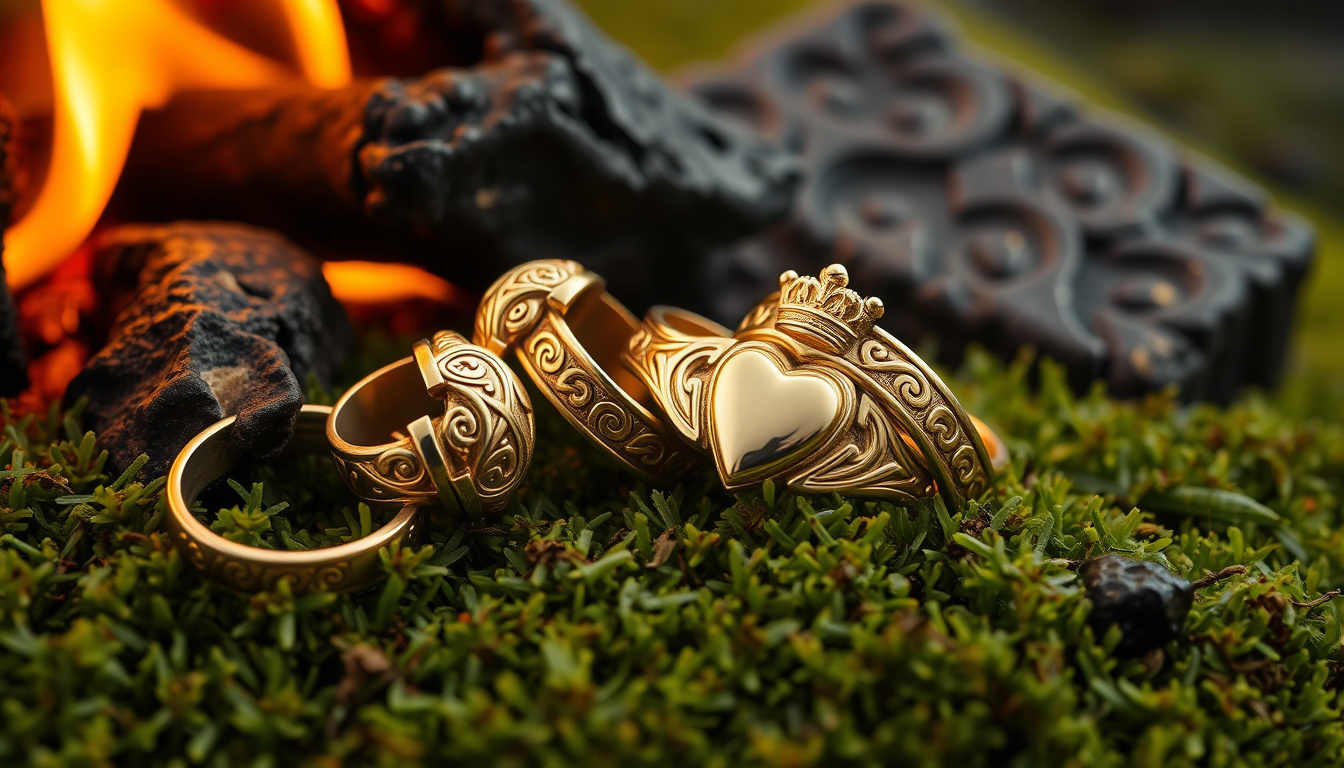
Claddagh rings symbolise love, loyalty, and friendship. They are worn differently based on relationship status: right hand with heart facing outward for single, inward for in a relationship; left hand for engaged or married (Rings from Ireland (Irish hallmarking authority)).
How does a wishbone ring differ from a band?
Wishbone rings have a V-shape symbolising luck and are often set with diamonds. Traditional bands are simpler and more suited for stacking. Both are popular in Ireland for engagement and fashion rings (Lu and Mol (Dublin jeweller collection)).
What are stacking rings and why are they popular?
Stacking rings allow customisation — multiple bands are worn together for a layered look. 9ct gold stacking rings start around €50 to €100, making them an affordable way to build a set over time (Martin Gear Jewellers (Irish jeweller pricing guide)).
The pattern: Irish buyers gravitate toward styles that tell a story — Claddagh, Celtic knots, and wishbone designs dominate because they carry tradition. A plain band is the exception, not the rule.
How Much Do Gold Rings Cost in Ireland?
What is the average price of a 9ct gold ring?
9ct gold rings start around €50 for simple bands and can go up to €500 with gemstones. A 5-gram 9K ring has roughly €245 in raw gold value, so the final price includes labour and retail markup (Martin Gear Jewellers (Irish jeweller pricing guide)).
Are 14K gold rings more expensive than 9K?
14K gold rings are 20–40% more expensive than comparable 9K rings due to higher gold content. A typical 14K band runs €200–€800, while an 18K version can be twice that (Lebrusan Studio (jewellery comparison)).
Does design complexity affect price?
Intricate designs, hallmarks, and branded pieces command higher prices. A 9ct Claddagh ring with intricate detailing may cost €300, while a plain 9ct band might be €80 (Rings from Ireland (Irish hallmarking authority)).
Online “gold plated” rings sold for under €30 often have a 14-day cooling-off period, but if the plating wears off within a year, Irish consumer law does not automatically cover that as a fault — check the guarantee before buying.
The trade-off: a €50 9ct ring is real gold and will last. A €20 plated ring is a gamble — it may wear off in a year, at which point the buyer has no Irish statutory remedy.
Confirmed Facts vs. What’s Unclear
Confirmed facts
- Gold purity is measured in karats; 9K gold is 37.5% pure gold (Martin Gear Jewellers (Irish jeweller pricing guide))
- Irish law requires a 14-day cooling-off period for online purchases (CCPC (Irish consumer rights authority))
What’s unclear
- Exact longevity of gold plated rings depends on thickness and wear — no standardised data for the Irish market (CCPC (Irish consumer rights authority))
- Precise pricing varies significantly by retailer, design complexity, and gold market fluctuations (Martin Gear Jewellers (Irish jeweller pricing guide))
- Gold rings availability from specific retailers changes over time; current stock at Pandora, Fields, Dylan Oaks may shift
- Irish Assay Office hallmark design details may vary by piece and year of production
- 9ct gold scratch resistance relative to 18ct depends on specific alloy composition and may vary
What Irish Experts Say
“9ct gold is technically harder than 18ct gold, which is why it is the most popular choice in Ireland for everyday rings.”
— Martin Gear Jewellers, Irish jeweller pricing guide
“The Claddagh ring is a symbol of love, loyalty, and friendship. How you wear it tells people your relationship status.”
— Rings from Ireland, Irish hallmarking authority
“Solid gold rings that are hallmarked at Dublin Castle carry a guarantee of purity that plated rings simply cannot match.”
— Ivy’s Attic, Dublin-based jeweller
“Consumers in Ireland have 14 days to change their mind on an online purchase, but that cooling-off period does not cover custom-made rings.”
— Competition and Consumer Protection Commission (CCPC), Irish consumer rights authority
Specs Comparison: Gold Purity Levels
Four common purities, one axis: more gold equals more expense and less toughness. Here’s how they stack up for Irish buyers.
| Karat | Gold % | Durability | Typical Irish Use | Price Index (vs 9ct) |
|---|---|---|---|---|
| 9K | 37.5% | High | Fashion rings, wedding bands | 1x (baseline) |
| 14K | 58.3% | Medium | Engagement rings, fine jewellery | 1.3–1.5x |
| 18K | 75% | Low (softer) | Statement pieces, luxury rings | 2x |
| 24K | 99.9% | Very low | Investment bars, not rings | 3x+ |
The pattern: the Irish market clusters around 9ct and 14ct precisely because they offer practical durability at a reasonable price. 18ct is chosen for special occasions, not daily wear.
Pros & Cons of Gold Ring Purity
Upsides
- Solid gold (9K–18K) holds value; hallmarked pieces can be resold.
- 9ct rings are affordable, durable, and widely available across Ireland.
- Irish hallmarking from Dublin Castle provides authenticity and consumer protection.
- Wide variety of styles: Claddagh, wishbone, stacking bands, and custom artisan designs.
Downsides
- Gold-plated rings may tarnish and offer poor long-term value.
- Higher karat rings (18K+) are softer and may bend or scratch.
- Cost increases sharply with karat: 18K costs roughly double 9ct.
- Not all Irish online stores clearly display hallmarking information.
ivysattic.ie, argent-asher.com, ccpc.ie, spunout.ie, facebook.com, blarney.com, edgeonly.com, civicledger.co.uk
For a more focused look at styles and retailers, see our guide to gold rings for women in Ireland.
Frequently asked questions
Can I wear gold rings every day?
Yes, solid gold rings (9K, 14K, 18K) are suitable for daily wear. 9K is the most scratch-resistant option (Lebrusan Studio (jewellery comparison)).
How do I clean a gold ring?
Use mild soap, warm water, and a soft brush. Avoid harsh chemicals. Irish jewellers recommend ultrasonic cleaning for hallmarked pieces (Martin Gear Jewellers (Irish jeweller pricing guide)).
What is the difference between 9ct and 10ct gold?
9ct gold is 37.5% pure gold; 10ct is 41.7% pure. 10ct is more common in the US than in Ireland. Irish retailers typically offer 9ct, 14ct, and 18ct (Rings from Ireland (Irish hallmarking authority)).
Are gold rings hypoallergenic?
Pure gold (24K) is hypoallergenic, but alloys in 9K–18K may contain nickel, which can cause reactions. White gold often contains more nickel than yellow gold (Lebrusan Studio (jewellery comparison)).
How can I tell if a gold ring is real at home?
Look for a hallmark stamp (e.g., 375 for 9K, 585 for 14K). The Irish Assay Office hallmark features a woman holding a harp (Rings from Ireland (Irish hallmarking authority)). A magnet test is not reliable for gold alloys.
Do gold rings tarnish?
Solid gold does not tarnish, but the alloy metals (copper, silver) can oxidise, causing a slight darkening. 9ct may tarnish more than 18ct because it has less gold (Lebrusan Studio (jewellery comparison)).
Should I buy a gold ring with a certificate?
Yes, especially for higher karat or expensive rings. A certificate from the Assay Office of Ireland confirms purity. For 9ct fashion rings under €200, a clear hallmark is sufficient (Rings from Ireland (Irish hallmarking authority)).
Related reading
Choosing a gold ring in Ireland comes down to one clear trade-off: higher karat gold costs more and wears faster. For Irish buyers who want a ring they can wear daily without worry, 9ct solid gold with a Dublin Castle hallmark is the practical winner. Those seeking a deeper colour or an heirloom piece should budget for 14ct or 18ct and accept the need for occasional re-polishing. For the budget-conscious buyer in Ireland, the choice is clear: a 9ct gold ring under €200 beats any plated alternative in longevity and resale value.
Related stories





Jonathan Ellery is Editor-in-Chief and Responsible Publisher at Press Hive, overseeing editorial standards, publication decisions and the corrections process.