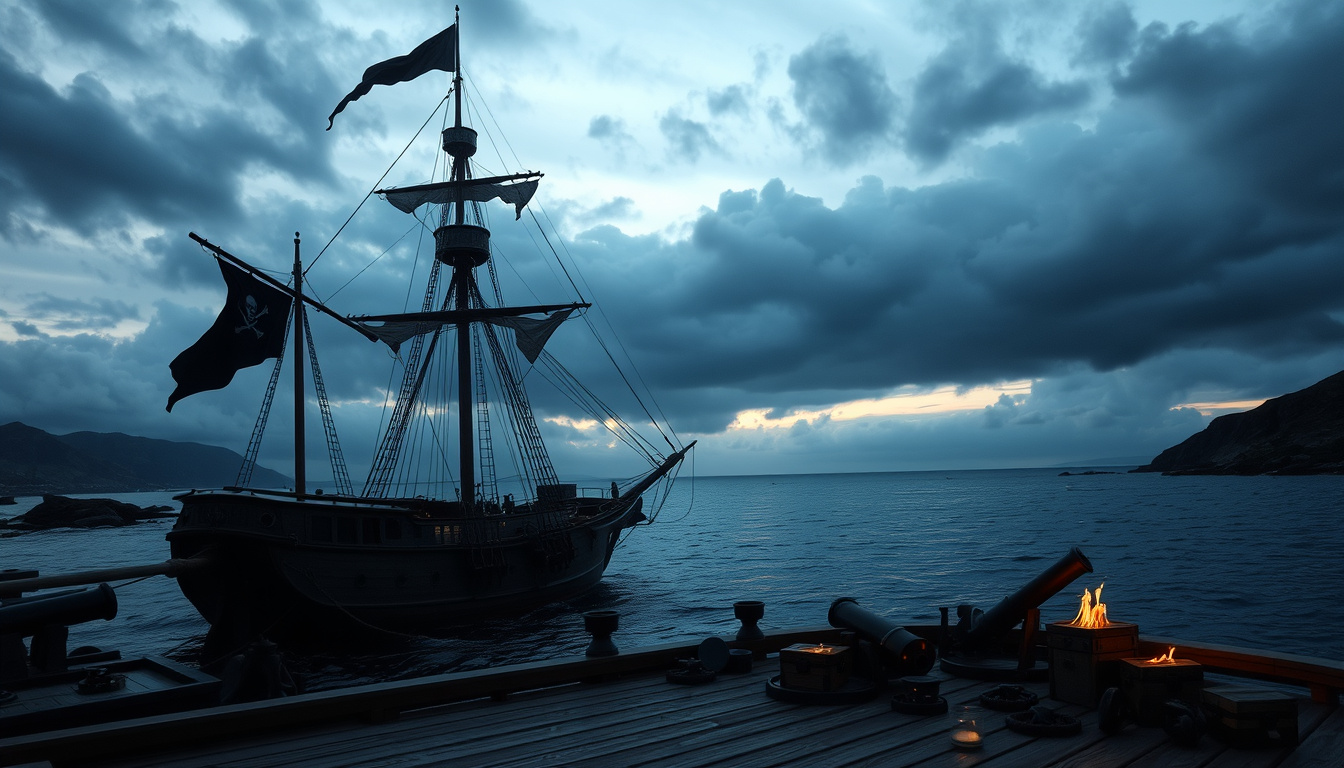
Three centuries after his death off the North Carolina coast, Edward Teach — better known as Blackbeard — remains the most recognizable pirate in history, but separating the man from the myth takes digging. The real Blackbeard was a former privateer who commanded a former slave ship and met a violent end with five gunshot wounds and more than twenty stab wounds.
Born: c. 1680, possibly Bristol, England · Died: November 22, 1718, Ocracoke Island, North Carolina · Wounds sustained in final battle: 5 gunshot wounds and more than 20 stab wounds · Flagship: Queen Anne’s Revenge · Ships captured: Over 40 during his piracy career
Quick snapshot
- Edward Teach was an English pirate who operated in the West Indies and along the North American coast (NCpedia (North Carolina historical encyclopedia)).
- He earned the name Blackbeard by weaving slow-burning fuses into his hair and beard (Smithsonian National Museum of American History).
- His most famous ship was the Queen Anne’s Revenge, a former French slave ship (U.S. National Park Service).
- Exact birth date and birthplace are not documented (Britannica (encyclopedia)).
- The claim that he had syphilis is speculative (Carleton College (academic history site)).
- His last words are not confirmed by contemporaneous sources (Wikipedia).
- Privateer during Queen Anne’s War (1701–1713) (U.S. National Park Service (alternate page)).
- Captured Queen Anne’s Revenge in 1717 (1911 Encyclopaedia Britannica (historical reference)).
- Blockaded Charleston in 1718 (Smithsonian National Museum of American History).
- Killed on November 22, 1718 (North Carolina Department of Natural and Cultural Resources).
- Ongoing archaeological excavation of Queen Anne’s Revenge (QARonline (Queen Anne’s Revenge Project)).
- Historical research continues to separate fact from legend (History.com (history channel)).
Five key dimensions of Blackbeard’s life, one pattern: the legend is louder than the facts, but the primary sources still tell a striking story.
| Attribute | Detail |
|---|---|
| Full name | Edward Teach (also spelled Thatch, Thach, Thatche, Theach) (NCpedia) |
| Birth | c. 1680, possibly Bristol, England (Britannica) |
| Death | November 22, 1718, Ocracoke Island, North Carolina (U.S. National Park Service) |
| Flagship | Queen Anne’s Revenge (former French slave ship) (U.S. National Park Service (alternate page)) |
| Ships captured | Over 40 during his piracy career (Smithsonian) |
| Wounds at death | 5 gunshot wounds and more than 20 stab wounds (North Carolina Department of Natural and Cultural Resources) |
| Marriage | Mary Ormond, North Carolina, c. 1718 (NCpedia) |
| Notable exploit | Blockade of Charleston, South Carolina (1718) (Smithsonian) |
What is Edward Teach famous for?
Edward Teach’s early life and privateer career
- Teach served as a privateer during Queen Anne’s War (1701–1713) before turning to piracy (U.S. National Park Service (alternate page)).
- After the war ended in 1713, he joined the pirate crew of Benjamin Hornigold in the Caribbean (U.S. National Park Service (alternate page)).
- The earliest primary source mentioning Teach is a 1716 deposition by Captain Henry Timberlake, describing a pirate attack on his brigantine Lamb (Carleton College).
What this means: Teach’s move from legal privateer to outlaw pirate was a direct consequence of the end of Queen Anne’s War. Many former privateers had no other livelihood, and the Caribbean became a haven for them.
The adoption of the Blackbeard persona
- Blackbeard cultivated a terrifying image by weaving slow-burning fuses into his hair and beard, creating a smoke-and-fire effect (Smithsonian National Museum of American History).
- The nickname “Blackbeard” comes from his long, dark facial hair, not from a surname change (Smithsonian).
- Captain Charles Johnson’s 1724 General History of the Pyrates says Teach “had distinguished himself for boldness and enterprise” (Wikipedia).
Blackbeard’s fearsome reputation was a deliberate marketing tool. Most of his victims surrendered without a fight — the image alone did the work.
Blockade of Charleston and other notable exploits
- In May 1718, Blackbeard blockaded the port of Charleston, South Carolina, with four ships and seized hostages for ransom (Smithsonian).
- He demanded a chest of medicine from the colonial authorities, which was delivered (NCpedia).
- Over his career, he captured more than 40 ships (Smithsonian).
The implication: The Charleston blockade shows Blackbeard as a strategic planner, not just a brute. He used terror as a bargaining chip and got what he wanted without a full-scale battle.
How many times was Blackbeard shot before he died?
The final battle with Lieutenant Robert Maynard
- On November 22, 1718, Lieutenant Robert Maynard of the Royal Navy attacked Blackbeard near Ocracoke Island (U.S. National Park Service).
- Maynard’s sloops had been sent by Virginia Governor Alexander Spotswood to eliminate the pirate (Smithsonian).
- Blackbeard attempted to run his ship aground but was cornered in a shallow inlet (North Carolina Department of Natural and Cultural Resources).
The pattern: The battle was short and brutal. Maynard’s men charged the pirate vessel after a volley of cannon fire.
Circumstances of Blackbeard’s death on November 22, 1718
- Blackbeard was shot five times before he died (North Carolina Department of Natural and Cultural Resources).
- He also suffered more than twenty stab wounds during the battle (North Carolina Department of Natural and Cultural Resources).
- After his death, Maynard severed Blackbeard’s head and hung it from the bowsprit of his sloop as a trophy (Smithsonian).
The extreme violence of Blackbeard’s death — five gunshots and two dozen stab wounds — suggests he fought ferociously to the last. It also made his head a prize: Maynard claimed a £100 reward from the Virginia government.
The takeaway: Blackbeard fought ferociously to the end; his severed head became a £100 prize.
What were Blackbeard’s last words?
Alleged last words and their historical veracity
- The most commonly reported last words are: Damnation seize my soul if I give you quarters, or take any from you. (Wikipedia).
- These words were reportedly shouted to Lieutenant Maynard before boarding (Britannica).
- No contemporaneous source confirms these exact words; they first appear in Captain Charles Johnson’s 1724 General History of the Pyrates (Wikipedia).
The catch: Johnson’s book is a popular history, not a primary legal document. Historians treat it as a mix of fact and embellishment, so the last words may be a literary invention.
Was Blackbeard’s ship ever found?
The discovery of the Queen Anne’s Revenge wreck
- The wreck of the Queen Anne’s Revenge was discovered in 1996 (QARonline (Queen Anne’s Revenge Project)).
- It lies in about 20 feet of water near Beaufort Inlet, North Carolina (QARonline).
- Thousands of artifacts have been recovered, including cannons, anchors, and medical equipment (QARonline).
What this means: The discovery of the Queen Anne’s Revenge is one of the most important pirate shipwreck finds in American waters. It has provided concrete evidence for many details of Blackbeard’s fleet.
What did Blackbeard do with slaves?
Blackbeard’s involvement in the slave trade
- Blackbeard captured slave ships and often sold the enslaved people (NCpedia).
- He also kept some enslaved individuals as crew members or servants (NCpedia).
- Records show he traded slaves in exchange for supplies and medical treatment (NCpedia).
The implication: Blackbeard treated enslaved people as commodities. He was part of the transatlantic slave trade economy, both as a captor and a trader.
How did Blackbeard get syphilis?
Historical speculation about Blackbeard’s health
- There is no direct historical evidence that Blackbeard had syphilis (Carleton College).
- The claim often arises from the discovery of a syringe and other medical instruments on his ship (QARonline).
- Syphilis was common among sailors in the 18th century, but its connection to Blackbeard is speculative (Smithsonian Magazine).
A syringe does not prove syphilis. It could have been used for any number of medical procedures. This myth shows how a single artifact can fuel a story that runs far ahead of the evidence.
The evidence: a single artifact can fuel a myth that outstrips the facts.
What did Blackbeard do with his wife?
Blackbeard’s marriage to Mary Ormond
- Blackbeard married a local woman named Mary Ormond in North Carolina around 1718 (NCpedia).
- The marriage was a legal ceremony conducted by the governor’s deputy (NCpedia).
- Little is known about the relationship; Mary Ormond survived Blackbeard (NCpedia).
The pattern: Blackbeard’s marriage suggests he was trying to establish a legitimate life on land, possibly as part of a plan to retire from piracy. It didn’t work.
Timeline of Blackbeard’s life
- c. 1680 – Edward Teach born, likely in Bristol, England (Britannica).
- 1701–1713 – Serves as a privateer during Queen Anne’s War (U.S. National Park Service (alternate page)).
- c. 1714 – Joins Benjamin Hornigold’s pirate crew (U.S. National Park Service).
- 1716 – First documented pirate attack (Timberlake deposition) (Carleton College).
- 1717 – Captures the French slave ship La Concorde and renames it Queen Anne’s Revenge (1911 Encyclopaedia Britannica).
- May 1718 – Blockades Charleston, South Carolina (Smithsonian).
- June 1718 – Runs the Queen Anne’s Revenge aground near Beaufort (QARonline).
- November 22, 1718 – Killed in battle with Robert Maynard (U.S. National Park Service).
What this means: The timeline shows a swift transition from privateer to notorious pirate, with his entire piracy career spanning only about five years.
Separating fact from rumor
Confirmed facts
- Edward Teach was an English pirate who operated in the West Indies and along the North American coast (NCpedia).
- He was killed on November 22, 1718, near Ocracoke Island (U.S. National Park Service).
- He suffered 5 gunshot wounds and more than 20 stab wounds (North Carolina Department of Natural and Cultural Resources).
- His ship Queen Anne’s Revenge was a former French slave ship (U.S. National Park Service).
- He married Mary Ormond in North Carolina (NCpedia).
- He captured over 40 ships during his career (Smithsonian).
What’s unclear or unlikely
- His exact birth date and birthplace are unknown (Britannica).
- His last words are not independently verified (Wikipedia).
- The claim that he had syphilis is speculative (Smithsonian Magazine).
- Stories of buried treasure are likely invented (History.com).
- The number of ships he captured is often exaggerated (over 40 is the most reliable count) (Smithsonian).
For other historical figures where fact and fiction diverge, read Arthur Guinness: The Real Story. For a source-graded fact-checking approach applied to a different subject, see Ian Brady: Verified Facts.
Quotes from the sources
“Damnation seize my soul if I give you quarters, or take any from you.” — Attributed to Blackbeard by Captain Charles Johnson, A General History of the Pyrates (1724) (Wikipedia)
“Blackbeard was the most notorious pirate of his time, and his name became synonymous with piracy.” — 1911 Encyclopaedia Britannica (1911 Encyclopaedia Britannica)
“He was a man of great strength and courage, and his appearance was designed to terrify.” — Smithsonian National Museum of American History (Smithsonian)
The evidence shows that Blackbeard was a real historical figure who used a calculated image of terror to dominate the waters. But the myths — the buried treasure, the syphilis, the last words — are mostly later inventions. For the modern reader, the lesson is clear: the documentary record is often more interesting than the legend. For historians and enthusiasts, the ongoing excavation of the Queen Anne’s Revenge offers a rare chance to separate fact from fiction with each new artifact.
smithsonianmag.com, en.wikisource.org, ncanchor.org, ebsco.com, dp.la
Frequently asked questions
What is Edward Teach’s real name?
His name was Edward Teach, also spelled Thatch, Thach, Thatche, and Theach.
How many gunshot wounds did Blackbeard sustain?
He was shot five times and also suffered more than twenty stab wounds.
Did Blackbeard have a family?
He married Mary Ormond in North Carolina around 1718, but little is known about their relationship.
What happened to Blackbeard’s head?
After his death, Lieutenant Maynard severed his head and hung it from the bowsprit of his sloop as a trophy.
Was Blackbeard’s ship a slave ship?
Yes, the Queen Anne’s Revenge was a former French slave ship.

Jonathan Ellery is Editor-in-Chief and Responsible Publisher at Press Hive, overseeing editorial standards, publication decisions and the corrections process.