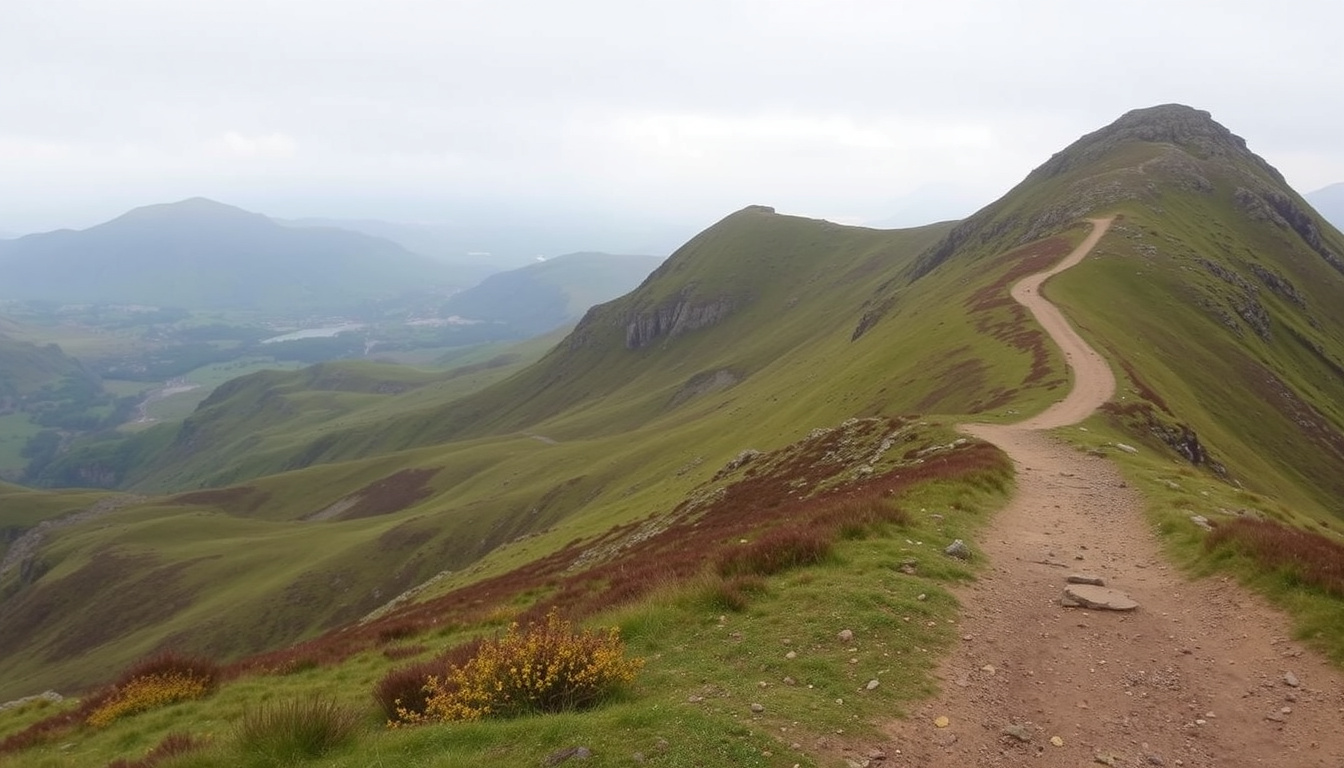
There’s a reason why Cat Bells is one of the most photographed fells in the Lake District. With its 451-metre summit offering sweeping views of Derwentwater, it’s the kind of walk that rewards effort without punishing your legs.
Height: 451 metres (1,480 ft) · Location: Lake District, Cumbria, England · Classification: Wainwright fell · Walking distance (popular route): Approx 3.5 miles (5.7 km) · Typical walking time: 3 hours (including stops) · Difficulty: Moderate
Quick snapshot
- Height 451 m (Keswick.org local tourism board)
- Wainwright fell in Book 6 (Lake District National Park official site)
- Walk distance ~3.5 miles (Keswick.org local tourism board)
- Typical time 3 hours (Countryfile walking magazine)
- Exact etymology of the name – multiple theories exist
- Whether the fell was historically a wild cat shelter
- Exact first ascent date (ancient fell)
- Pre-19th century: name derived from Old English ‘cat bield’ (Live for the Outdoors walking magazine)
- 1950s–1960s: Wainwright includes Cat Bells in his Pictorial Guide (Live for the Outdoors walking magazine)
- 2000s onward: becomes one of the most popular fells (Live for the Outdoors walking magazine)
- Growing popularity may increase pressure on parking and paths (The Wandering Wildflower walking blog)
- Longer circular routes (e.g., extending to Maiden Moor) gaining traction (The Wandering Wildflower walking blog)
- Boat shuttle from Keswick remains a popular start option (Countryfile walking magazine)
| Attribute | Value |
|---|---|
| Height | 451 metres (1,480 ft) |
| Prominence | Approx 83 m |
| Grid reference | NY 244 201 |
| Parent peak | Skiddaw |
| OS Landranger map | 89 |
| First ascended by | Unknown, ancient fell |
Four data points confirm the fell’s dimensions and official status; the table fills in the geological specifics.
Why is it called Cat Bells?
Etymology and possible origins
The name’s origin is not definitively recorded, but the most repeated theory holds that it derives from “cat bield” – an Old English term for a wild cat shelter. Historically, the area may have harboured wildcats, though no concrete evidence survives. Several alternative explanations exist, including a connection to the shape of the fell or a corruption of a personal name. No single theory has been proven.
The lack of a clear origin story doesn’t diminish the fell’s appeal. If anything, the mystery adds to its character – a fell that keeps a secret.
Cat Bells or Catbells: spelling variations
Both spellings are used interchangeably. Official maps and the Lake District National Park (the park authority) favour “Cat Bells” as two words, while some guidebooks and online resources – including Keswick.org (local tourism board) – use “Catbells”. Either form is acceptable.
Bottom line: The mystery forces walkers to accept that some parts of the fell’s history remain unwritten.
What did Wainwright say about Cat Bells?
Wainwright’s description in his Pictorial Guide
In his Pictorial Guide to the Lakeland Fells, Book 6: The North Western Fells, Alfred Wainwright described Cat Bells as “completely encircled” by the B5289 road. He noted that the fell was one of the most popular in the region, calling it “a glorious fell” that offers a short but invigorating climb. His guide has been credited with cementing the fell’s modern popularity.
“Cat Bells is completely encircled by the B5289 road, yet it remains one of the most popular fells in the Lake District.”
— Alfred Wainwright, quoted by Lake District National Park official site
Cat Bells as a ‘glorious’ fell
Wainwright’s choice of words – “glorious” – is telling. In a collection of 214 fells, such praise is reserved for those that deliver exceptional views for modest effort. Live for the Outdoors (walking magazine) describes Cat Bells as “Lakeland’s favourite mini mountain”, a description that echoes Wainwright’s sentiment.
Is Cat Bells a Wainwright fell?
List of Wainwright fells and Cat Bells’ placement
Yes, Cat Bells is one of the 214 Wainwright fells. It appears in Book 6: The North Western Fells, which covers the area around Derwentwater and Skiddaw Forest. The Lake District National Park (official park authority) confirms its inclusion and notes that it is one of the most accessible fells from Keswick.
Why Wainwright included Cat Bells
Wainwright’s criteria for including a fell were not based solely on height – he valued character, views, and distinctiveness. Cat Bells, with its distinctive shape and panoramic views of Derwentwater, clearly met the mark. Keswick.org (local tourism board) notes that the fell is a highlight of the North Western Fells, attracting walkers of all abilities.
Bottom line: The fell’s inclusion in Wainwright’s list guarantees walkers a landscape worth climbing for.
Is Cat Bells easier than Skiddaw?
Comparison of difficulty: Cat Bells vs Skiddaw
In short, yes. Cat Bells (451 m) is less than half the height of Skiddaw (931 m), and the classic route is about 3.5 miles round trip, while Skiddaw’s main route is roughly 9 miles. The table below lays out the key differences.
| Attribute | Cat Bells | Skiddaw |
|---|---|---|
| Height | 451 m (1,480 ft) | 931 m (3,054 ft) |
| Walk distance (popular route) | ~3.5 miles (5.7 km) | ~9 miles (14.5 km) |
| Typical time | ~3 hours | ~6–7 hours |
| Total ascent | ~380 m (Coppermines walking blog) | ~900 m |
| Difficulty | Moderate | Challenging |
| Scrambling sections | Minor scramble near summit | None (steep but clear path) |
The pattern: Cat Bells is a gentle introduction to Lake District fell walking, while Skiddaw is a full-day outing that demands fitness and planning. For most hikers, the choice comes down to time and experience.
If you’re new to the Wainwrights, Cat Bells offers a confidence-building start. Skiddaw is a natural next step once you’ve mastered the 3-hour rhythm.
Is Cat Bells a hill or a mountain?
Definition of hill vs mountain in the UK
In the UK, there is no official height threshold that separates a hill from a mountain. Traditionally, land over 2,000 feet (610 m) was considered a mountain, but this convention has been relaxed. Cat Bells, at 451 m, falls well below that line. Yet in the Lake District, the term “fell” is used for any upland area, regardless of height. The Lake District National Park (park authority) refers to Cat Bells as a “fell” in its official materials.
Cat Bells classification as a fell
Practically, the distinction is less important than the walking experience. Walkers often call Cat Bells a hill, but its inclusion in the Wainwright fells gives it a status that feels almost mountainous. Keswick.org (local tourism board) describes it as “a small but perfectly formed fell”.
Bottom line: Call it a hill, a fell, or a mini mountain – the experience is the same. For first-time visitors: it’s a walk that feels like a mountain adventure without the commitment.
Spec table: Cat Bells walk route
Six key specs for the classic route, one pattern: it’s a short, moderate ascent with a steep final push.
| Spec | Details |
|---|---|
| Distance (classic route) | ~3.5 miles (5.7 km) – Keswick.org local tourism board |
| Total ascent | ~380 m (1,250 ft) – Coppermines walking blog |
| Time | ~3 hours (including stops) – Keswick.org local tourism board |
| Difficulty | Moderate – Keswick.org local tourism board |
| Start points | Hawse End car park, Skelgill, or Keswick (via boat) – Countryfile walking magazine |
| Terrain | Well-defined paths, steep stepped section, minor scramble – Keswick.org local tourism board |
| Best time of day | Morning for quieter paths and better light |
| Parking | Limited at Hawse End; alternatives at Skelgill or Keswick – Walking Britain walking guide |
The implication: early starts and alternative transport solve the parking problem.
How to walk Cat Bells: a step-by-step route
Start at Hawse End car park
- Park at the small car park at Hawse End (grid ref NY 246 211) – WalkLakes walking guide
- Follow the signed footpath towards the fell; a signpost reads “Cat Bells 1 mile” – WalkLakes walking guide
Ascent to the summit
- Climb a steep stepped path; some beginners may find it off-putting – TheLakeDistrict.org walking guide
- Minor scrambling near the top – Keswick.org local tourism board
- Reach the summit cairn for panoramic views of Derwentwater
Descent and return
- Continue south to Hause Gate, then descend a zigzag path towards Derwent Water – Live for the Outdoors walking magazine
- If returning to Keswick, walk back via public footpaths through fields and woodland (~4 km each way) – Lake District National Park official site
- Tea-stop options on the return: Lingholm, Nichol End, or Portinscale – Lake District National Park official site
The Hawse End car park fills quickly by 9am. For a stress-free start, take the Keswick Launch boat to Hawse End – Countryfile walking magazine recommends this as a relaxing alternative.
Timeline of Cat Bells
- Pre-19th century – Cat Bells used as a landmark and common grazing land; name derived from ‘cat bield’ (Old English)
- 1950s–1960s – Alfred Wainwright visits and includes Cat Bells in his Pictorial Guide to the Lakeland Fells, Book 6
- 2000s onward – Cat Bells becomes one of the most popular fells in the Lake District, with dedicated guided walks and tourism – Live for the Outdoors walking magazine
Bottom line: Wainwright’s mid-20th-century guide transformed a quiet grazing hill into a national walking icon. The timeline shows how one person’s enthusiasm can shape a landscape’s identity.
What’s known and what’s uncertain
Confirmed facts
- Cat Bells is a Wainwright fell (214 fells) – Lake District National Park official site
- Height is 451 m (1,480 ft) – Keswick.org local tourism board
- It is included in Book 6: The North Western Fells
- Wainwright described it as ‘completely encircled’ by road – Lake District National Park official site
What’s unclear
- Exact etymology of ‘Cat Bells’ – multiple theories exist
- Whether the fell was historically a cat shelter
- Exact first ascent date (ancient fell)
Quotes from walkers and experts
“Cat Bells is Lakeland’s favourite mini mountain.”
— Live for the Outdoors walking magazine
“The walk from Keswick to Cat Bells is a pleasant stroll mainly on public footpaths through fields and woodland.”
— Lake District National Park official site
The contrast between the two perspectives is revealing: one emphasises the peak’s iconic status, the other the gentle approach. Together, they capture the fell’s dual appeal – a serious enough climb to feel accomplished, but with a soft landing at the start and end.
manvsglobe.com, campingadventures.co.uk, anadventurousworld.com
Frequently asked questions
How long is the Cat Bells walk?
The classic route is about 3.5 miles (5.7 km) and takes roughly 3 hours including stops – Keswick.org local tourism board.
Where do you park for Cat Bells?
Main parking is at Hawse End car park (grid ref NY 246 211). Alternative parking at Skelgill or in Keswick. Hawse End fills early – Walking Britain walking guide.
Is Cat Bells suitable for dogs?
Yes, but the steep stepped section near the top may be challenging for some dogs. Keep dogs on leads near livestock.
Can children do the Cat Bells walk?
Yes, for active children aged 8+ with walking experience. The moderate difficulty and short distance make it a family-friendly option – Keswick.org local tourism board.
What is the best time of day to walk Cat Bells?
Early morning (before 9am) for quieter paths and better light. Weekdays are significantly less crowded than weekends.
Are there toilets at Cat Bells?
No toilets on the fell itself. Nearest facilities are in Keswick or at the Keswick Launch landing stages.
Does the Cat Bells walk have scrambling sections?
Yes, a short minor scramble near the summit. Most walkers find it manageable – Keswick.org local tourism board.
How hard is the Cat Bells climb?
It’s moderate. The steep stepped path may feel tough for beginners, but the overall ascent is only 380 m – Coppermines walking blog.
Cat Bells occupies a sweet spot in the Lake District: accessible enough for a half-day adventure, yet satisfying enough to earn a place on any Wainwright tick list. For the first-time visitor from Keswick, the choice is clear: start with Cat Bells, and let the view from the summit decide whether you’re ready for Skiddaw.

Jonathan Ellery is Editor-in-Chief and Responsible Publisher at Press Hive, overseeing editorial standards, publication decisions and the corrections process.