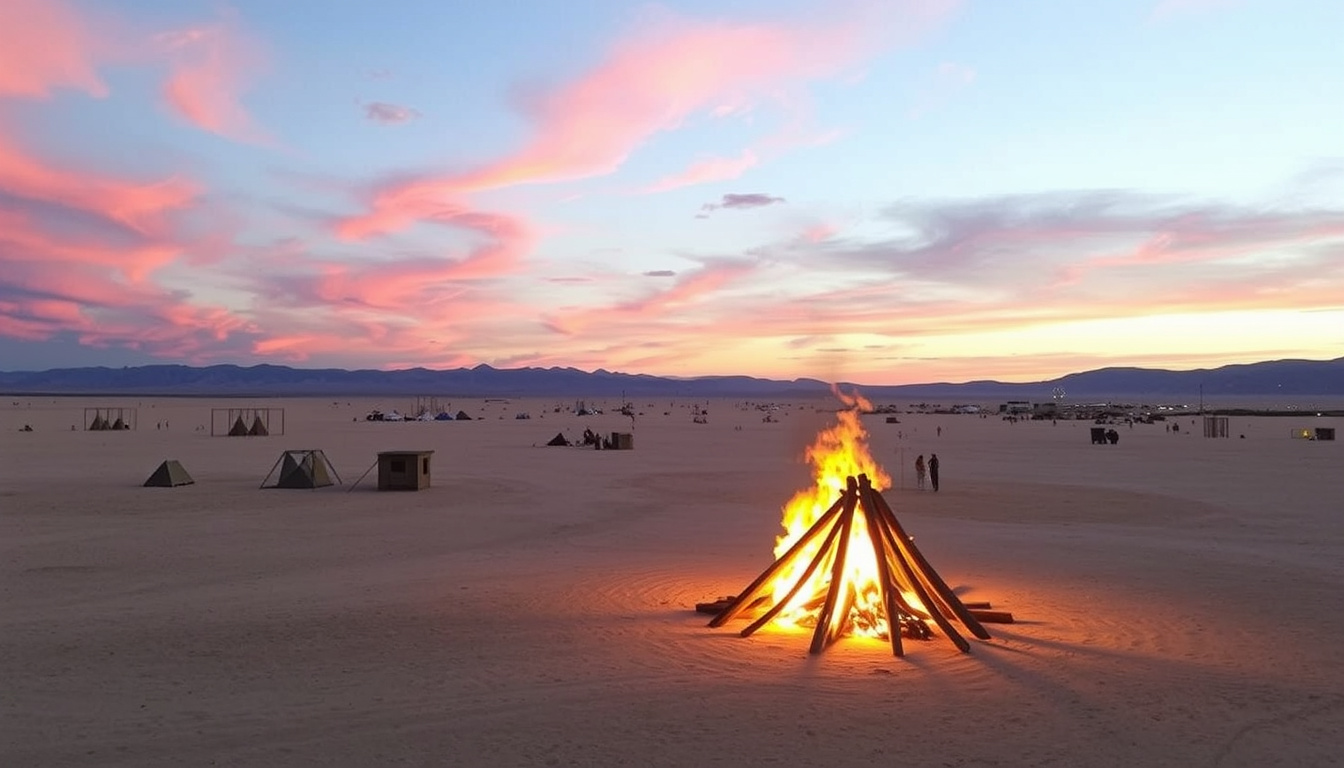
You have heard the stories — a burning man, a city in the dust, radical self-expression. But what actually happens when 73,000 people build a temporary metropolis in the Nevada playa is an experiment in community, art, and self-reliance far more structured than it looks from the outside.
Year Founded: 1986 ·
2023 Attendance: 73,000 ·
Location: Black Rock Desert, Nevada, USA ·
2024 Ticket Price: $575
Quick snapshot
- Black Rock City 2026: August 30 – September 7 (Burning Man Project – Ticketing Information)
- 2026 theme: “Axis Mundi” (Burning Man Project – Black Rock City 2026)
- Kids 12 and under admitted free with a Kids Ticket (Burning Man Project – Ticketing Information)
- Exact ticket price allocation across tiers (2026 pricing listed as $550–$3,000 but availability is unknown) (Burning Man Project – Ticketing Information)
- Official art installations and full event schedule beyond dates (Burning Man Project – Ticketing Information)
- Number of attendees for 2026 (pre-COVID level was ~73,000) (Burning Man Project – Black Rock City 2026)
- Sunrise Sale registration: Jan 26 – Feb 3, 2026 (Burning Man Project – Ticketing Information)
- Stewards Sale purchase period: Mar 4 – Apr 20, 2026 (Burning Man Project – Ticketing Information)
- Main Sale: April 29, 2026 (Burning Man Project – Facebook)
- Ticket Aid and Resilience applications open Feb 25, 2026 (Burning Man Project – Ticketing Information)
- STEP platform opens Mar 18, 2026 (Burning Man Project – Ticketing Information)
- Main Sale registration opens Apr 20, 2026 (Burning Man Project – Ticketing Information)
The following table summarizes key facts about Burning Man.
| Fact | Value |
|---|---|
| Founded | 1986 by Larry Harvey and Jerry James |
| 2023 Attendance | 73,000 |
| Location | Black Rock Desert, Nevada, USA (playa) |
| Duration | 8 days (last Sunday in August to first Monday in September) |
| 2024 General Ticket Price | $575 |
| Official Website | https://burningman.org |
What is the whole purpose of Burning Man?
Burning Man is a temporary city built around a shared set of values. The Ten Principles — written by co-founder Larry Harvey in 2004 — frame the entire experience: Radical Inclusion, Gifting, Decommodification, Radical Self-reliance, Radical Self-expression, Communal Effort, Civic Responsibility, Leave No Trace, Participation, and Immediacy. These are not rules enforced by security; they are cultural expectations that every participant is asked to embody.
A city with no money but a $575 ticket, no laws but a thousand unspoken norms. The purpose lies in living the principles, not just reading them.
The implication: Without adherence to the principles, the temporary city would collapse.
The Ten Principles as a Foundation
The official Burning Man Project states that the event “is not a festival; it is a temporary city.” The 10 principles are the social contract. Participants are expected to bring everything they need (Radical Self-reliance), give gifts without expecting anything in return (Gifting), and leave the desert as clean as they found it (Leave No Trace).
Radical Self-Expression and Self-Reliance
From enormous art cars to solo theme camps, self-expression is the lifeblood of the event. But it comes with a catch: you must be self-reliant. There are no vendors selling food or water — you bring your own supplies. The desert’s harsh conditions demand preparation. As one longtime burner put it on a community forum, “the dust, the creativity, and the feeling of belonging” make it worth the effort.
Community and Decommodification
Decommodification means no brand logos, no cash transactions (except for ice and coffee at Center Camp), and no advertising. The goal is to create a temporary society where relationships, not commerce, define value. This principle has become harder to maintain as the event has grown, but it remains central to the vision.
The implication: Burning Man asks you to trade comfort for community. For those who embrace it, the payoff is a week of radical creativity and connection that money cannot buy.
What are the 10 rules at Burning Man?
The so-called “10 rules” are the Ten Principles listed above — they are not a legal code but a cultural compass. The Burning Man Project does not police them; instead, the community self-regulates through shared values.
The Ten Principles in Detail
- Radical Inclusion: Anyone may be a part of Burning Man. No prerequisites.
- Gifting: Gift giving without expectation of payment.
- Decommodification: No commercial sponsorships or advertising.
- Radical Self-reliance: Participants rely on their own resources.
- Radical Self-expression: Unique gifts from the individual — no spectators.
- Communal Effort: Cooperative creation and civic works.
- Civic Responsibility: Civilize the city; obey the laws of the state.
- Leave No Trace: Leave the environment as you found it.
- Participation: Transform from spectator to participant.
- Immediacy: Embrace the moment, overcome fear.
How Rules Are Enforced at Black Rock City
There is no rulebook handed out at the gate. Enforcement is informal: neighbours remind neighbours, and camps set their own boundaries. The most serious breaches — theft, violence, driving drunk — are handled by law enforcement from Pershing County. The official website notes that tickets to Black Rock City are available through the Ticketing Information page rather than at the gate.
The pattern: The principles work because people choose to follow them. When they don’t, the community holds itself accountable — or calls the sheriff.
Why is Burning Man so controversial?
Critics point to a gap between the utopian ideals and the reality on the playa. The event has grown from a small beach bonfire to a global phenomenon with a multi-million dollar organization and a waiting list of thousands.
Criticisms of Burning Man’s Culture and Cost
Accusations of elitism, environmental damage, lack of diversity, and commercialization have followed the event for years. The 2024 general ticket price was $575, and 2026 prices range from $550 to $3,000 per ticket. Many long-time burners say the event has become too expensive for the very people who built it.
Environmental Impact and the Burn Scar
The “Leave No Trace” policy is taken seriously by the organization, but the temporary city leaves a physical imprint on the desert. The “burn scar” — the area where the Man burns — requires restoration efforts. Critics argue that a week-long city of 73,000 people cannot be truly carbon-neutral.
Wealth Inequality and VIP Camps
High-cost camps with luxury RVs and private chefs have drawn accusations of hypocrisy. The official line is that anyone can camp anywhere, but in practice, wealthy attendees often have access to resources that others do not. This tension between radical inclusion and real-world economics is one of the most persistent controversies.
The catch: Burning Man tries to create a world without money, but the ticket prices and VIP camps remind you that you need money to get in.
When and where is Burning Man 2026?
Black Rock City 2026 is scheduled for Sunday, August 30 through Monday, September 7, 2026 — the traditional Labor Day weekend window. The location remains the Black Rock Desert in Nevada, USA.
Burning Man 2026 Dates and Location
The event page on the official website confirms the dates and reveals the theme: “Axis Mundi”. The 2026 season begins with the Sunrise Sale in February and runs through the Main Sale in late April.
How to Get Tickets
The ticketing system has several phases. Most sales require prior registration. Here is the 2026 schedule based on official sources:
The table below details each sale phase and its registration and purchase windows.
| Sale | Registration / Application | Purchase Period |
|---|---|---|
| Sunrise Sale | Jan 26 – Feb 3, 2026 | Feb 4, 2026 |
| Stewards Sale | Feb 20 – Feb 27, 2026 | Mar 4 – Apr 20, 2026 |
| Main Sale | Apr 20, 2026 | Apr 29, 2026 |
| Ticket Aid | Opens Feb 25, 2026 | – |
| STEP | Opens Mar 18, 2026 | – |
All information from the official Ticketing Information page and a public Facebook post confirming the Main Sale date.
Burning Man 2026 Lineup and Theme (Speculation)
The theme “Axis Mundi” points to a central world axis — likely influencing the design of the Man itself and the layout of the city. No official lineup or art grants have been announced beyond the theme. Historical patterns suggest that theme camps and art installations will be revealed in spring 2026.
What this means: For anyone planning to attend, the key dates are the sales windows — missing a registration could mean missing out. The theme suggests a year focused on cosmic symbolism, but the real draw is the community experience.
What happens at Burning Man: The good and the bad?
Burning Man offers a intense mix of inspiration and discomfort. The good: a week of unfiltered creativity, deep connections, and art that takes your breath away. The bad: 100-degree days, freezing nights, white-out dust storms, and porta-potties that test your willpower.
Upsides
- Radical self-expression — wear or build anything
- Massive interactive art installations
- Strong sense of community and belonging
- Disconnect from screens and consumer culture
Downsides
- Extreme weather: heat, cold, dust storms
- Lack of sleep (24-hour noise from art cars)
- High cost: ticket + supplies + travel
- Reported theft and sexual assault incidents
Positive Experiences: Art, Community, Self-Discovery
Participants describe feeling liberated by the expectation to participate. The absence of commerce removes a layer of social anxiety. Many burners say the experience changes how they approach life back in the default world.
Negative Aspects: Dust, Lack of Sleep, Harsh Conditions
The environment is unforgiving. Wind storms can reduce visibility to near zero. Dehydration and heat exhaustion are real risks. The official website advises bringing “everything you need to survive for a week,” and that includes a dust mask and goggles.
Unusual Events: Births and the ‘No Girl’ Phenomenon
Babies have been born at Burning Man — at least one in 2023, according to a Newsweek report. The term “no girl” refers to someone who has never attended; a “burner” is a veteran. The phrase is used within the community, though its origin is unclear.
The trade-off: You gain a week of magic, but you pay for it in dust and exhaustion. For most burners, the trade is worth it. For some, it is a dealbreaker.
Do people do drugs at Burning Man?
Drug use — especially psychedelics — is common, but it is not officially endorsed. The Burning Man Project reminds attendees that illegal substances are prohibited by state and federal law. Law enforcement patrols the playa and makes arrests each year.
Drug Culture at the Burn
Psychedelics like LSD and psilocybin are used by many participants, often to enhance the immersive art experience. MDMA, cannabis, and other substances are also present. The culture is one of personal responsibility: you are expected to manage your own set and setting.
Legal Consequences and Safety Concerns
Burning Man 2026 takes place in Pershing County, Nevada, where all state laws apply. Undercover officers and drug-sniffing dogs operate on-site. Harm reduction groups like the Zendo Project provide medical support for those having difficult experiences, but they cannot prevent legal consequences.
Why this matters: For a first-time attendee, the open drug culture can be surprising. The official line is clear: drugs are illegal. But the reality on the ground is more complicated. Know the risks before you go.
What is the dark side of Burning Man festival?
Beyond the dust and discomfort, there are deeper concerns that organizers and participants grapple with each year.
Environmental Impact
The construction of a temporary city — with roads, fences, generators, and thousands of vehicles — leaves an undeniable footprint. While the Leave No Trace team works year-round to restore the playa, the burn scar and carbon emissions are real.
Safety Issues: Theft and Sexual Assault
Reports of theft and sexual assault surface every year. The community has a zero-tolerance policy, and the organization provides resources for survivors. However, the size and temporary nature of Black Rock City make policing difficult.
Cost and Accessibility
For a principle rooted in radical inclusion, the price tag creates a barrier. The cheapest 2026 ticket is $550 — plus travel, food, water, and equipment. Many argue that the event has become a playground for the wealthy, contradicting its countercultural roots.
The implication: Burning Man is both a utopian experiment and a reflection of the inequalities it tries to escape. The darker aspects are not reasons to avoid it, but they are reasons to go in with eyes open.
Timeline: From Baker Beach to Black Rock City
- 1986 — First Burning Man on Baker Beach, San Francisco (Burning Man Project – History)
- 1990 — Move to Black Rock Desert, Nevada (Burning Man Project – History)
- 1996 — First large-scale event with 8,000 participants
- 2013 — Attendance reaches 70,000; tickets sell out in hours
- 2020 — Event cancelled due to COVID-19
- 2021 — Return with reduced capacity
- 2024 — Attendance back to pre-COVID levels (~73,000)
The pattern: What started as a small beach gathering has become a global cultural event. Each milestone reflects a tension between growth and authenticity.
Clarity: What we know and what we don’t
Confirmed facts
- Burning Man 2026 will be held at Black Rock Desert, Nevada. (Burning Man Project – Black Rock City 2026)
- The theme is “Axis Mundi”. (Burning Man Project – Black Rock City 2026)
- Ten Principles remain the core philosophy. (Burning Man Project – Ticketing Information)
What’s unclear
- Exact number of attendees for 2026
- Full list of art installations and theme camps
- Whether the 2026 Main Sale price tier distribution will match previous years
Voices from the playa
“We are trying to create a temporary community based on radical self-expression and self-reliance.” — Larry Harvey, co-founder
“Burning Man is not a festival; it is a temporary city dedicated to art, community, and self-expression.” — Burning Man Project (official website)
“The dust, the creativity, and the feeling of belonging — it’s unlike anything else.” — Anonymous participant (Reddit community forum)
Related reading: Mount Everest Bodies · King Arthur: The Legend, the History, the Facts
airhubapp.com, 2news.com, eenews.net, radicalstorage.com, facebook.com, deserthopetreatment.com, en.wikipedia.org, instagram.com, burningman.org, sabinabergstedt.se
Frequently asked questions
Is Burning Man family-friendly?
Yes, families attend. Children 12 and under are admitted free with a Kids Ticket. However, the environment can be intense — consider age-appropriate preparation.
How do I prepare for my first Burning Man?
Start with the official “What to Bring” list on burningman.org. Essentials: water, food, shelter, dust masks, goggles, warm clothes, bike, and a first-aid kit. Arrive early, register for a ticket sale, and join a theme camp for support.
What is the average age of attendees?
Surveys indicate the median age is around 35–45. A significant portion are first-timers each year.
Can I camp alone at Burning Man?
Yes, but it’s challenging. Solo campers need to be fully self-sufficient. Many first-timers join established camps for shared resources and community.
What happens to the Man after the burn?
The wooden figure is burned on Saturday night. The ashes are collected and taken away as part of the Leave No Trace effort.
Are dogs allowed at Burning Man?
No. Pets are not allowed due to the harsh desert environment and health regulations. This policy is strictly enforced.
How do I volunteer at Burning Man?
Volunteer opportunities are listed on the official website. Roles include gate crew, sanitation, art support, and more. Volunteers often get early ticket access.
What is the difference between a burner and a Sparkle Pony?
A “burner” is an experienced participant. A “Sparkle Pony” is a new attendee who comes with a lot of enthusiasm (and sometimes flashy outfits) but may not have fully embraced the principles. The term is affectionate, not derogatory.
Burning Man is a paradox: a gift economy built on a $575 entry fee, a city without a government that runs on civic responsibility, a week of radical freedom that demands immense preparation. For the 73,000 people who will make the pilgrimage in 2026, the choice is clear: embrace the dust, the principles, and the community — or watch from the default world. For Nevada, the economic impact and environmental cost are part of a larger conversation about the future of large-scale gatherings. The burn will happen every year as long as people are willing to build it.
Related stories




Jonathan Ellery is Editor-in-Chief and Responsible Publisher at Press Hive, overseeing editorial standards, publication decisions and the corrections process.