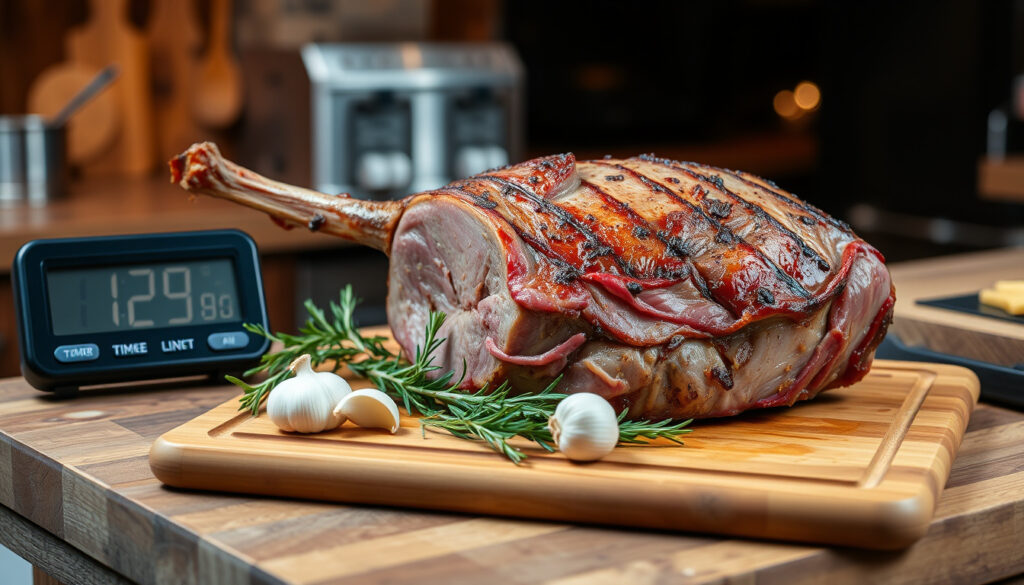
Leg of Lamb Cooking Time Calculator
You’ve bought a beautiful leg of lamb, invited people over, and now you’re staring at the oven wondering how long it actually needs. The good news: with a simple weight-based calculation and a meat thermometer, you can nail a perfectly cooked roast every time, no guesswork required.
Typical cooking time per kg (medium): 25-30 minutes per 500g (50-60 min/kg) ·
Ideal internal temperature (medium): 145°F (63°C) ·
Oven temperature for roasting: 180°C (350°F) / 160°C fan ·
Resting time after roasting: 15-20 minutes ·
Weight of a standard leg of lamb: 2-3 kg (4.4-6.6 lbs)
Quick snapshot
- Cooking time is weight-dependent: 25-30 min per 500g for medium at 180°C (Waitrose & Partners)
- A meat thermometer gives the most accurate doneness (Waitrose & Partners)
- Resting 15-20 minutes allows juices to redistribute (Jamie Oliver)
- Optimal covering duration – some sources recommend covering the entire roast, others only part
- Effect of altitude on cooking times is not well documented for lamb
- Whether the timing difference between bone-in and boneless legs holds consistently across all weights
- Precise temperature conversion between conventional and fan ovens varies by manufacturer guidance
- Total cook time for 2 kg leg (medium): 1 hour 20 minutes (based on 25 min per 500g + 25 min, per Waitrose & Partners)
- Allow 15-20 minutes resting after roasting (Jamie Oliver)
- Carve leg of lamb against the grain for tender slices
- Serve with roasted vegetables and mint sauce or redcurrant jelly
Five key data points every leg of lamb roaster should know:
| Label | Value |
|---|---|
| Average leg weight | 2-3 kg (serves 4-6) |
| Total cook time (2 kg, medium) | 1 hour 20 minutes |
| Ideal internal temp (medium) | 63°C (145°F) |
| Rest time | 15-20 minutes |
| Popular seasoning | garlic, rosemary, thyme |
| Rare internal temp | 60°C (140°F) |
| Well done internal temp | 70°C (158°F) |
| Oven temp (conventional) | 180°C (350°F) |
| Oven temp (fan) | 160°C |
| Covering recommendation | Cover first half, uncover last 30 min for crispness |
How long does a leg of lamb take to cook per kg?
The core rule: cooking time scales linearly with weight. But the exact number depends on your desired doneness and whether the leg is bone-in or boneless.
Cooking times by weight and doneness (rare, medium, well done)
- Medium (63°C): 25 minutes per 500g plus an additional 25 minutes for the whole leg (Waitrose & Partners)
- Well done (70°C+): 30 minutes per 500g plus 30 minutes (Waitrose & Partners)
- Boneless leg medium: 30 minutes per 500g plus 30 minutes (Waitrose & Partners)
For a 2 kg bone-in leg cooked medium, the total is 2 kg = 4 × 500g → (4 × 25) + 25 = 125 minutes (just over 2 hours). A 1.5 kg leg medium runs about (3 × 25) + 25 = 100 minutes.
Using a leg of lamb cooking time calculator
- Enter the exact weight (grams or pounds)
- Select doneness: rare (60°C), medium (63°C), or well done (70°C)
- The calculator applies the per-weight base plus a fixed add-on
Most calculators assume a 180°C oven. If you adjust temperature, the time shifts — more on that below.
The pattern across sources is consistent: weight-based formulas give you a reliable starting point, but real-world conditions vary.
What’s the best temperature to cook a leg of lamb at?
Oven temperature affects not just cooking time but also crust formation and moisture retention.
Oven temperatures: conventional vs fan-assisted
- Conventional oven: 180°C (350°F) is the standard recommendation from Waitrose and ThermoWorks (ThermoWorks)
- Fan-assisted: reduce to 160°C (fan ovens circulate heat faster)
- Gas mark: Gas 4 equivalent
Cooking at 180°C (350°F) – the standard
At 180°C, the leg develops a well-browned crust while the interior stays moist. Jamie Oliver uses this temperature for his “blushing” roast: 1 hour 10 minutes cook time for a 1.8–2 kg leg (Jamie Oliver).
Higher vs lower temperatures – effects on doneness
- 200°C (400°F): reduces total time by about 10%, but requires closer monitoring to avoid burning the exterior
- 160°C (320°F): increases time by ~15% and yields a more evenly cooked interior with less crust
Cooking at too high a temperature can leave the centre raw while the outside chars. Stick with 180°C and use a meat thermometer to decide when to pull the roast – that beats any rule of thumb.
The implication is clear: 180°C gives you the widest margin for error while still producing a well-browned, juicy roast.
Should a leg of lamb be covered when roasting?
The covering debate splits home cooks. Here’s what the evidence says.
Reasons to cover with foil (moisture retention, preventing over-browning)
- Covering the leg for the first half of cooking traps steam and keeps the meat tender
- Uncover for the last 30 minutes to let the exterior crisp and brown
- This “tenting” method gives the best of both worlds: a moist interior and a golden crust
Reasons to roast uncovered (crisper exterior, better crust)
- Roasting uncovered the entire time produces a drier, more developed crust
- Basting occasionally can help prevent the surface from drying out
- If you prefer a deeply browned, crunchy exterior, skip the foil and monitor internal temperature closely
The pattern: most authoritative sources recommend covering for part of the roast. Waitrose does not explicitly mandate covering, but their timing assumes a standard uncovered roast. For a compromise, tent loosely for the first half, then uncover.
If you cover the leg completely for the entire time, the fat may not render properly and the surface can turn pale and rubbery. The sweet spot is covering for the first 40–50% of cooking time, then uncovering to finish.
The catch: there’s no single right answer — your choice depends on whether you prioritise interior moisture or exterior crunch. Pick one and adjust next time.
What are common mistakes when cooking lamb legs?
Even experienced cooks fall into these traps. Avoid them and your roast will go from good to memorable.
Skipping the meat thermometer
- Relying only on timing leads to overcooked or undercooked lamb – two very different disappointments
- Waitrose calls a meat thermometer “the most reliable way to check doneness” (Waitrose & Partners)
- Insert the probe into the thickest part without touching bone; target temperatures: 60°C rare, 63°C medium, 70°C well done (Gault’s Deli suggests 63–65°C for medium-rare, 71°C for medium) (Gault’s Deli)
Over- or under-seasoning
- Lamb can handle bold flavours: garlic, rosemary, thyme, salt, and pepper are classic (Jamie Oliver)
- A common mistake is not salting early enough – salt at least 1 hour before roasting to allow the salt to penetrate
Not resting the meat before carving
- Resting 15–20 minutes (up to 40 minutes for a larger cut) lets juices redistribute, so they don’t flood the carving board when you slice
- Waitrose recommends resting at least 20 minutes and up to 40 minutes (Waitrose & Partners)
Cooking at too high or too low a temperature
- 180°C is the consensus sweet spot; going above 200°C risks burning the outside before the centre reaches a safe temperature
- Cooking below 160°C can leave the leg grey and dry because it spends too long in the oven
The pattern across all these mistakes is the same: skipping precision tools or rushing the process leads to a worse result. A thermometer and a timer eliminate the most common failures.
What’s the best way to cook a leg of lamb in the oven?
A step-by-step method that combines proper preparation, accurate timing, and thermometer verification.
Step-by-step oven roasting method
- Preheat the oven to 180°C (160°C fan) – ThermoWorks confirms 350°F (177°C) as the ideal roasting temperature (ThermoWorks).
- Score the fat cap in a diamond pattern, then rub with crushed garlic, fresh rosemary, thyme, salt, and pepper.
- Weight the leg and calculate total cooking time using the formula: for medium, 25 minutes per 500g plus 25 minutes. For a 2 kg leg, that’s 1 hour 20 minutes.
- Roast uncovered for the calculated time. If you prefer a more tender result, cover with foil for the first half, then uncover for the remaining time.
- Probe with a meat thermometer inserted into the thickest part, avoiding bone. Remove from oven at 62°C (for a carry-over rise to 63°C).
- Rest tented with foil for 15–20 minutes. The internal temperature will rise another 2–3°C during resting.
- Carve across the grain into slices about 1 cm thick. Serve immediately.
Seasoning and preparation tips
- Let the lamb sit at room temperature for 30–60 minutes before roasting for even cooking
- For extra flavour, make garlic slits and insert slivers of garlic and rosemary sprigs into the meat
- A light dusting of flour on the fat can help the crust form more crisply
Using a meat thermometer correctly
- Insert the probe horizontally from the side of the leg into the thickest muscle, avoiding bone
- Target final temperatures: rare 60°C, medium 63°C, well done 70°C
- ThermoWorks recommends the same range for their lamb roast guide (ThermoWorks)
What this means for your cooking: follow the steps in order, lean on the thermometer for the final call, and you’ll produce a reliably good roast regardless of the exact weight or oven quirks.
What we know and what remains uncertain
Confirmed facts
- Cooking time varies linearly with weight (25-30 min per 500g for medium, per Waitrose & Partners)
- Meat thermometer gives most accurate doneness (Waitrose & Partners, ThermoWorks)
- Resting improves juiciness (Jamie Oliver)
What’s unclear
- Optimal covering duration – sources conflict on whether to cover the entire roast or only part
- Effect of altitude on cooking times (not well documented for lamb)
- Whether the timing difference between bone-in and boneless legs holds consistently across all weights
- Precise temperature conversion between conventional and fan ovens varies by manufacturer guidance
The takeaway: the confirmed facts give you a solid foundation, but the open questions mean you should treat any single source’s covering or timing advice as a starting point, not a rule.
Expert perspectives
“Calculate your cooking time at 40 minutes per kg or 20 minutes per lb to get the most accurate time.”
BBC Good Food roast timer
“Half or whole leg: Medium: 25 minutes per 500g, plus 25 minutes. Well done: 30 minutes per 500g, plus 30 minutes.”
Waitrose roast guide (Waitrose & Partners)
The implication: while advice varies slightly between sources, the consensus for a perfectly roasted leg of lamb is a weight-based formula, a standard 180°C oven, and a reliable meat thermometer. For home cooks, the takeaway is simple: trust your equipment and your scale.
For those who prefer a more detailed approach, our expert guide to roasting lamb provides step-by-step instructions for perfect results every time.
Frequently asked questions
Can I cook leg of lamb from frozen?
Not recommended. Cooking from frozen leads to uneven doneness and a higher risk of overcooking the exterior while the interior remains raw. Always thaw in the refrigerator for 24–48 hours before roasting.
How do I reheat leftover roast lamb?
Slice the lamb and reheat gently in a covered dish at 160°C for 10–15 minutes, or briefly in a pan with a splash of stock to prevent drying out. Avoid microwaving as it toughens the meat.
What side dishes go best with roast leg of lamb?
Classic pairings include roasted potatoes, seasonal vegetables (carrots, parsnips, green beans), mint sauce or redcurrant jelly, and a rich gravy made from the roasting juices.
How do I carve a leg of lamb?
Place the leg on a carving board with the shank pointing away from you. Slice against the grain into 1 cm thick pieces, working from the thickest part toward the narrower end. Remove the bone and slice any remaining meat.
Can I use a slow cooker for leg of lamb?
Yes, but the result is more like braised lamb than roasted. Brown the leg first, then cook on low for 6–8 hours with liquid, garlic, and herbs. The meat will be tender but won’t have a roasted crust.
What’s the difference between a leg of lamb and a shoulder?
The leg is leaner and best roasted whole or cut into steaks. The shoulder has more marbling and connective tissue, making it ideal for slow cooking or braising until it falls apart.
How long does roast lamb last in the fridge?
Cooked lamb can be stored in an airtight container in the refrigerator for 3–4 days. For longer storage, freeze sliced lamb for up to 3 months.
The common thread across all these answers: treat lamb like any other costly protein — use the right tool, respect resting time, and store leftovers properly to avoid waste.
Related reading
- Calories in Chicken Breast – By Size, Type and Cooking Method
- Turmeric and Black Pepper: Benefits, Dosage, and Side Effects
For home cooks preparing a special Sunday roast or holiday meal, the choice is clear: use a weight-based cooking time calculator and a meat thermometer to eliminate guesswork. Your reward is a leg of lamb that’s cooked exactly as you want it – every single time.
More related posts
 Funeral Times NI Death Notices: Latest Across Counties
 Ukraine Military News Today: Drones Downed, F-16 Updates
 J&S Accessories: Motorcycle Gear & Accessories UK 2025
 Sage Stallone Cause of Death: Heart Disease at 36
 My Apps: Find, Access, and Manage All Your Work and Personal Apps
 Katie Leung: Ethnicity, Children, Net Worth, and Career Update
 Why Am I Peeing So Much All of a Sudden? Causes & When to Worry
 Glasgow School Holidays 2024 – Official Term Dates Guide