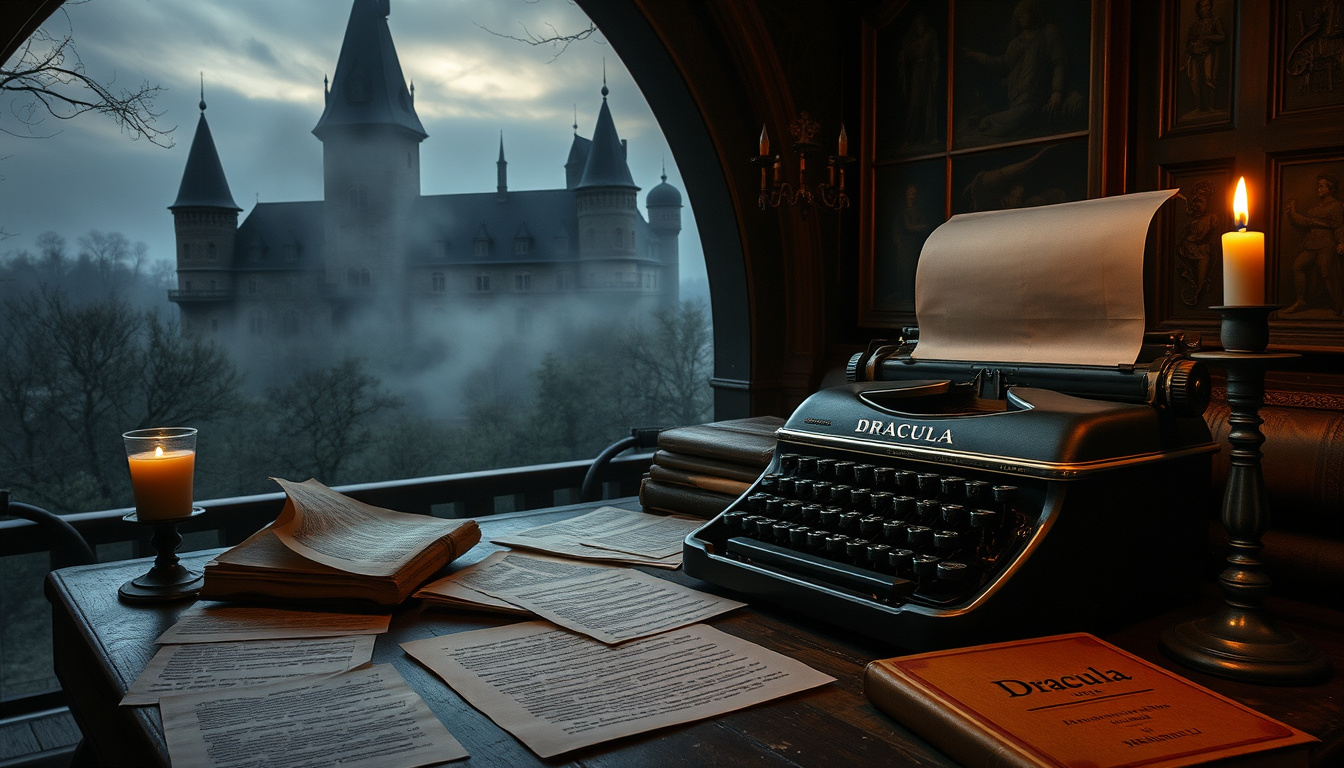
Every Halloween, somebody dresses as Count Dracula, yet the man who invented him still lingers in the shadows. Bram Stoker spent decades as a theatre manager before publishing the 1897 novel that would outlive every performance he ever staged — and the gaps in his own record keep readers guessing. Across his Dublin childhood, his London theatre years, the Whitby holiday, and the controversies that still circle Dracula, one question keeps returning: which parts of the story are true?
Born: 8 November 1847, Dublin ·
Died: 20 April 1912, London ·
Dracula publication: 1897 ·
Age at publication: 50 ·
Dracula in print: Continuously since 1897
Quick snapshot
- Stoker was born on 8 November 1847 in Clontarf, Dublin (Encyclopedia.com (biographical reference)).
- Dracula was published in 1897 (HISTORY (biography archive)).
- Stoker’s Whitby holiday inspired the villain’s name and some of the novel’s most dramatic scenes (English Heritage (UK heritage body)).
- The disease behind Stoker’s death remains unresolved; the cause recorded at the time was exhaustion, but the diagnosis has been debated.
- Whether Dracula encodes same-sex desire or anti-Semitic stereotypes is scholarly interpretation, not Stoker’s stated intention.
- Stoker’s surviving research notes document his sources but do not reveal a single intended allegory for the novel.
- Stoker began assembling Dracula in 1890, the year of his Whitby visit (The Victorian Web (literary history archive)).
- He spent roughly seven years researching folklore and vampire lore before publication (Legacy.com (memorial publisher)).
- The name “Dracula” came from a history of Wallachia and Moldavia he consulted during that research (Portland Center Stage (theatre company)).
- Stoker’s research notes keep complicating the old story that Dracula was simply Vlad III rebranded (IGN (entertainment media)).
- Recent readings look to Irish history for Dracula’s deepest roots — historian Fiona Fitzsimons argues the novel’s main theme came from Stoker’s own family history (The Telegraph (UK national newspaper)).
- Each new biography and new edition of the novel tends to add another layer to the debate. (IGN (entertainment media))
Eight rows of biography, one pattern: the dates and places of Stoker’s life are easy to confirm, while everything about the meaning of the novel he wrote gets murkier the closer you look.
The biography table below lays out the documented record — a straightforward set of facts that frame Stoker’s life before and after Dracula.
| Label | Value |
|---|---|
| Full name | Abraham Stoker |
| Born | 8 November 1847, Clontarf, Dublin, Ireland (Mental Floss (popular culture magazine)) |
| Died | 20 April 1912, London, England |
| Occupation | Novelist, short story writer, theatre manager |
| Education | Trinity College Dublin, 1864–1870, with a later MA (IrishCentral (Irish diaspora media)) |
| Early adulthood | Studied at Trinity College and then entered the Irish Civil Service (The Victorian Web (literary history archive)) |
| Notable work | Dracula (1897) |
| Recorded cause of death | Exhaustion, at age 64 (HISTORY (biography archive)) |
What disease did Bram Stoker have?
The short answer: nobody has settled it. Stoker was sickly early in life, worked a full theatre career as an adult, and the cause of his death remains the most contested item in his file.
What were the documented symptoms and diagnoses?
- His later years included gout and recurring ill health, and surviving records do not explain how much either contributed to his death.
- His death certificate has been read as listing “locomotor ataxia,” a neurological diagnosis that some later historians have linked to syphilis.
- The syphilis connection remains speculative: no surviving document confirms it, and the recorded cause at the time was exhaustion.
The exhaustion diagnosis is the one hard fact in the file. Everything else is a layer of interpretation added after his death, and none of it has ever closed the case.
A famous author with an ambiguous cause of death invites armchair diagnosis. The documented record stops at exhaustion; the rest is projection, not verdict.
The implication: Stoker’s disease matters less than what it reveals about his era — a prominent man’s death could be recorded in vague, respectable terms and never questioned. That cultural silence is part of the Dracula story too.
Why did Bram Stoker go to Whitby?
Whitby was a seaside escape, not a research trip. It turned into one: the Yorkshire town gave Stoker the visual heart of Dracula — the abbey, the harbor, the shipwreck — while his library gave him the vampire.
Why did Bram Stoker write Dracula?
- He spent about seven years researching Eastern European folklore and vampire stories before the novel appeared (Legacy.com (memorial publisher)).
- He cited Emily Gerard’s essay on Transylvanian superstitions and Sabine Baring-Gould’s Book of Werewolves as direct influences (The Irish Times (Irish newspaper of record)).
- Scholars see the actor Henry Irving in Dracula’s theatrical power; according to Wikipedia, the scholarly consensus is that Dracula drew in part on Irving (Wikipedia (crowdsourced encyclopedia)).
- Historian Fiona Fitzsimons argues that Stoker’s main theme came from Irish history and his own family history rather than overt Irish references, and she points to Manus O’Donnell, a 16th-century Irish lord, as a direct ancestor and an influence on the book (The Telegraph (UK national newspaper)).
Whitby enters the story in 1890. English Heritage notes that Stoker’s holiday there inspired the name of his villain and some of the novel’s most dramatic scenes (English Heritage (UK heritage body)).
The town gave him the postcard; the books gave him the monster. His research notes show him working from a history of Wallachia and Moldavia, where he found the name “Dracula” and believed it meant “devil” in Romanian (Portland Center Stage (theatre company)).
Whitby gets the credit in tourism brochures, but the engine of Dracula was research: seven years of folklore, regional history, and superstition gathered one library note at a time (Legacy.com (memorial publisher)).
What age was Bram Stoker when he wrote Dracula?
- Stoker was 50 when Dracula was published in 1897 — a fact that surprises readers who imagine the novel as a young man’s fantasy.
- He began assembling the novel in 1890, in his early 40s; the Victorian Web dates the start of the writing to that year (The Victorian Web (literary history archive)).
- In other words, Dracula was not a young man’s book: it arrived after a full career in the theatre, which is exactly why it works as showmanship.
What this means: the romantic version of the Dracula story begins with a seaside town, but the documentary version begins with a research project. Whitby supplied atmosphere; the source material supplied the vampire.
What is the famous line from Bram Stoker’s Dracula?
Dracula has generated more quotable lines than almost any other Victorian novel, and most of the famous ones belong to the count himself.
- “Welcome to my house! Enter freely and of your own will!” — the count’s invitation to Jonathan Harker, and the line that frames the entire novel as a trap.
- “Blood is life” — sometimes rendered “Blood is the life” — the novel’s central equation: blood is survival, power, and infection in one substance.
- “I am Dracula” — the character’s self-announcement, later echoed in films and adaptations across generations.
The invitation line carries the most weight. It presents Dracula’s castle as a home, the count as a host, and the relationship as a voluntary agreement — an agreement the novel immediately destroys. The same pattern runs through all three lines: Dracula invites, declares, and consumes.
The pattern: the famous lines are permissions and declarations — Dracula lets you in, then announces himself, and by the time the invitation sinks in, the doors are locked.
Why is Dracula controversial?
The controversy is older than the film adaptations. Victorian readers got a horror novel and found a book full of blood, desire, and invasion anxiety; later readers found a mirror for their own obsessions.
Is Dracula a metaphor for homosexuality?
- A persistent academic reading treats the count’s blood-sharing and his hypnotic pull on men as coded same-sex desire.
- Stoker never confirmed or denied the reading; his letters and notes do not settle it.
- The Irving connection keeps the metaphor alive: scholars who see Dracula’s theatrical power as a portrait of Henry Irving — Stoker’s employer at the Lyceum Theatre — have one more reason to read the novel as a work of hidden personal meaning. According to Wikipedia’s summary of the scholarship, Dracula drew in part on Irving (Wikipedia (crowdsourced encyclopedia)).
Is Dracula based off of Jews?
- Some critics read Dracula’s physical features and his foreignness as drawing on anti-Semitic stereotypes common in Victorian England.
- The novel never identifies Dracula as Jewish, and no surviving Stoker comment supports the reading.
- The interpretation persists because Stoker built his villain from a bundle of period fears: the outsider, the invader, the one who hides in a great city and feeds on its people.
Both readings are interpretations, not biography. What makes them hard to dismiss is how easily the novel absorbs them: Dracula is written as an empty stage for Victorian anxieties, and every generation projects a different monster onto it.
When a take starts with “Dracula is really about…”, check whether Stoker’s own writing supports it. The novel invites readings; it confirms none.
Why this matters: the controversy is not a flaw in the novel. It is the mechanism that kept Dracula alive for more than a century of criticism, scholarship, and adaptation.
Why did Dracula allow himself to be killed?
This is a movie question. Readers who know Dracula only from films assume the count dies by a rulebook — stake, sunlight, cross. The novel plays by different rules.
In the book’s final scene, Dracula is not staked and does not burn in sunlight. He is killed by Quincey Morris and Jonathan Harker with a Bowie knife when the hunters finally corner him.
Why did Dracula look so old?
- The novel ties Dracula’s age directly to his feeding: when blood-starved, he looks old; when well fed, he grows younger.
- By the end of the story, the weakened count looks ancient, which is why his final defeat reads as the collapse of something already dying.
- Stoker gave his vampire a body that behaves like a ledger — youth is a balance, not a condition.
Does Dracula ever get a happy ending?
- No. The novel closes with Dracula’s death and the restoration of Mina’s safety; the count gets no redemption, no farewell, no afterlife.
- A happy ending belongs to the humans — Jonathan and Mina survive, and the band of hunters closes the book intact.
- The final note reads relief with a shadow: the danger is over, but the story has cost everyone something.
So does Dracula “allow” the fatal blow? Not in the text. The novel shows a cornered count, starved across a long pursuit and overwhelmed in the final rush. The idea that he chooses death is an adaptation’s invention, not Stoker’s.
The catch: the most famous vampire in fiction dies in a few sentences, without gothic ceremony, in a scuffle. The movie rulebook was written later.
Was the real Dracula evil?
The fictional count and the historical prince share a name, not a biography. The connection between them is one of the most repeated myths in vampire culture.
- Stoker found the name “Dracula” in a history of Wallachia and Moldavia during his research, and he believed it meant “devil” in Romanian (Portland Center Stage (theatre company)).
- That discovery is not the same as modeling the character on Vlad III. Stoker’s research notes complicate the simple claim that the novel’s villain was directly named after Vlad the Impaler (IGN (entertainment media)).
- Recent scholarship has also questioned the direct Vlad identification, along with older suggestions that the count drew on Elizabeth Báthory (Wikipedia (crowdsourced encyclopedia)).
The historical Vlad III was a 15th-century prince of Wallachia known for cruel punishments, including the mass impalement of enemies. His historical reputation varies sharply depending on whose account you read, and modern historians continue to debate it.
Keeping Vlad in the story makes Dracula feel more historical, but it erases Stoker’s real achievement: he invented a modern myth from folklore fragments, not from a Wallachian war record.
Why this matters: linking the fictional count to the historical prince is a great marketing story but poor history. The name is borrowed; the monster is invented; and the real Vlad remains a separate, messier figure.
Timeline: the documented Stoker
Five dates anchor Stoker’s biography; together they show a writer who reached his most famous creation late, after decades of other work.
- — Born in Clontarf, Dublin, on 8 November (Encyclopedia.com (biographical reference)).
- — Moved to London and became associated with Henry Irving and the Lyceum Theatre.
- — Visited Whitby on holiday, the trip that seeded Dracula (English Heritage (UK heritage body)).
- — Published Dracula.
- — Died in London at 64; the recorded cause was exhaustion (HISTORY (biography archive)).
What we know and what we are guessing
The gap between confirmed biography and popular myth is wide, and the literature on Stoker sometimes blurs it. This is the split, in plain terms.
Confirmed facts
- Born 8 November 1847 in Clontarf, Dublin (Encyclopedia.com (biographical reference)).
- Studied at Trinity College Dublin and entered the Irish Civil Service (The Victorian Web (literary history archive)).
- Published Dracula in 1897 (HISTORY (biography archive)).
- The Whitby holiday inspired Dracula’s name and key scenes (English Heritage (UK heritage body)).
What’s unclear
- The disease that killed Stoker — exhaustion is on record, but the diagnosis has been debated ever since.
- Whether Dracula was directly based on Vlad the Impaler or Elizabeth Báthory — both links have been questioned by recent scholarship (Wikipedia (crowdsourced encyclopedia)).
- Whether the novel encodes same-sex desire — a scholarly reading, not Stoker’s stated intention.
- Whether the count was built on anti-Semitic stereotype — a critical interpretation with no confirming Stoker comment.
- Whether Stoker meant any real-world political allegory — no letter or note settles it.
Quotes that frame the Stoker debate
A fictional count and a historian — two voices that keep shaping how readers talk about Stoker.
“Welcome to my house! Enter freely and of your own will!”
— Count Dracula, Dracula (1897)
Historian Fiona Fitzsimons, whose research was covered by The Telegraph (UK national newspaper), frames Stoker’s project this way:
Stoker’s main theme came from Irish history and his own family history rather than overt Irish references.
— Fiona Fitzsimons, historian
“I am Dracula.”
— Count Dracula, Dracula (1897)
None of this makes Stoker easier to classify. He was a Dublin civil servant turned theatre manager who published his masterpiece at 50, after seven years of research, and then spent the next 15 years living in its shadow. The documented record keeps pulling him back to earth — Clontarf, Trinity, the Lyceum, a London death in 1912 — while the rumors keep pulling him toward the coffin. For the reader who wants the biography behind the vampire, the choice is clear: trust the death certificate and the research notes over the gossip, or lose the real Stoker to the shadow of his own creation.
Frequently asked questions
What other works did Bram Stoker write?
Stoker wrote steadily across genres — novels, short stories, and criticism — before and after Dracula. He began as a theatre reviewer for the Dublin Evening Mail, and his long association with the Lyceum Theatre and Henry Irving runs through the whole career. Dracula was neither his first nor his last published work.
Where is Bram Stoker buried?
Stoker died in London in 1912 at the age of 64 and was cremated. His ashes are interred at Golders Green Crematorium, which remains a pilgrimage stop for Dracula readers.
Who influenced Bram Stoker’s writing?
The list is unusually well documented: Emily Gerard’s essay on Transylvanian superstitions and Sabine Baring-Gould’s Book of Werewolves, a history of Wallachia and Moldavia where Stoker found the name Dracula, a Yorkshire seaside holiday, and the theatrical presence of Henry Irving.
How many pages is Dracula?
Page count depends on the edition. The 1897 first edition ran to about 400 pages, while modern paperbacks typically range between 300 and 400 pages depending on type size, notes, and introduction material.
What is the full title of Dracula?
The novel was published in 1897 under the single-word title Dracula, with no subtitle. Stoker found the name while researching a history of Wallachia and Moldavia and believed it meant “devil” in Romanian, which is why the title traveled so easily across languages and adaptations.
Is Dracula based on a true story?
No. Dracula is fiction, but it is built from real materials: Whitby’s abbey and harbor shaped key scenes, folklore research supplied the vampire’s powers, and the name came from a historical book. The popular claim that the count is directly based on Vlad the Impaler is a later gloss that recent scholarship questions.
What happened to Bram Stoker’s manuscripts?
The original working manuscript of Dracula was long thought lost. A manuscript with Stoker’s handwritten notes and outlines resurfaced in the 20th century and is now preserved in an American archive. The document has complicated the old story that Dracula was simply named after Vlad the Impaler, because it shows how Stoker assembled the novel from research notes.
Related stories



Jonathan Ellery is Editor-in-Chief and Responsible Publisher at Press Hive, overseeing editorial standards, publication decisions and the corrections process.