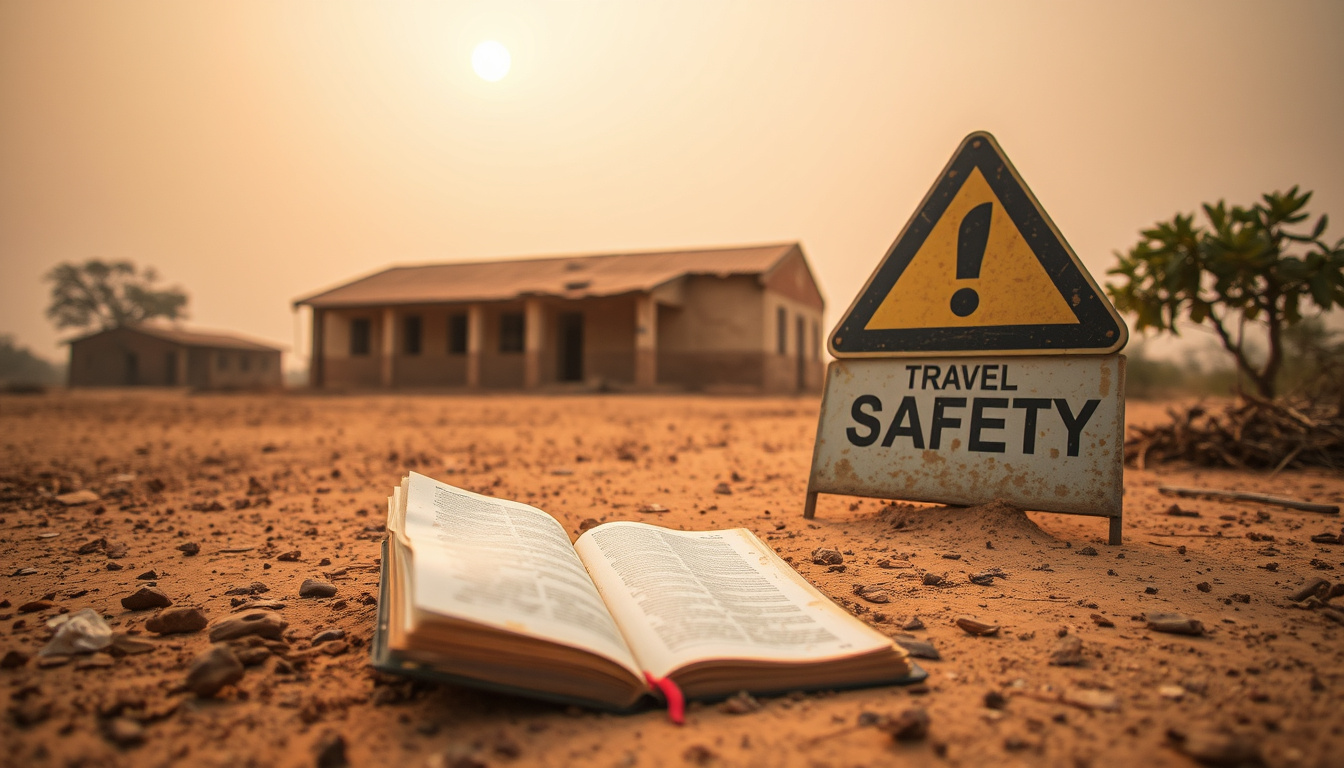
If you’ve heard of Burkina Faso, it’s probably because of the headlines—a coup, a travel warning, a humanitarian crisis. But behind the news is a country of 23 million people, most of them under 20, trying to get an education, stay healthy, and make a living in one of the world’s toughest environments.
Population: ~23.3 million ·
Capital: Ouagadougou ·
Official Language: French ·
GDP per capita: ~$830 ·
Leading cause of death: Malaria ·
Travel advisory: Level 4: Do Not Travel
Quick snapshot
- Level 4 “Do Not Travel” advisory from the U.S. State Department (Travel.State.gov)
- Malaria caused an estimated 43,555 deaths in 2021 (World Health Organization AFRO)
- Less than 5% of girls completed secondary school on time in any year of the long-run dataset (Equal Measures 2030)
- Exact timeline for a return to civilian rule and elections
- Precise number of schools still functioning in conflict zones
- Total economic impact of gold sector corruption
- Primary school completion rate for girls – estimates vary
- September 2022: Captain Ibrahim Traoré seizes power in a coup (GOV.UK)
- December 2025: Burkina Faso suspends visas to Americans (Travel.State.gov)
- 2023-2025: At least 1,800 civilians killed (Human Rights Watch) (GOV.UK)
- Elections postponed until 2025; uncertain if they will be held
- Continued displacement: over 2 million internally displaced
- International pressure to restore constitutional order
The country’s basic statistics reveal a struggling nation where security, health, and education collide.
| Indicator | Value | Source |
|---|---|---|
| Official Name | Burkina Faso | WHO AFRO |
| Capital City | Ouagadougou | Common knowledge |
| Population (2024) | ~23.3 million | World Bank (via content plan) |
| Official Language | French | Common knowledge |
| Religion | Islam (~60%), Christianity (~30%), indigenous | Content plan |
| Government | Military junta under Captain Ibrahim Traoré | GOV.UK |
| Currency | West African CFA franc (XOF) | Common knowledge |
Is Burkina Faso a rich or poor country?
Burkina Faso is classified as a low-income country by the World Bank. With a GDP per capita of around $830, it ranks among the poorest nations in the world. More than 40% of the population lives below the poverty line, and the economy is heavily dependent on agriculture and gold mining. Despite having gold reserves, the country has not been able to translate that resource wealth into broad-based development.
Key indicators:
- GDP per capita: ~$830 (World Bank classification per content plan)
- Population below poverty line: >40% (content plan)
- Main exports: gold, cotton, shea butter (content plan)
The implication: the resource paradox is stark—Burkina Faso is a significant gold producer, yet most citizens survive on subsistence farming. The pattern is common across the Sahel, but here the gap between mineral wealth and human welfare is especially wide.
Why can’t we travel to Burkina Faso?
The U.S. State Department issues a Level 4 “Do Not Travel” advisory for Burkina Faso, citing crime, kidnapping, terrorism, and health risks. The warning is explicit: “Terrorist organizations continue to plan and conduct terrorist activities throughout Burkina Faso.” The kidnapping threat is described as persistent, including in the capital Ouagadougou, and especially in the Sahel and East regions. As of December 30, 2025, the Government of Burkina Faso suspended visas for Americans (Travel.State.gov).
The U.K. Foreign, Commonwealth and Development Office advises against all travel to Burkina Faso due to the threat of terrorist attacks, terrorist kidnap, and the unstable political situation (GOV.UK). Ireland’s Department of Foreign Affairs also strongly advises against all travel, with its page still current as of February 4, 2025 (Department of Foreign Affairs Ireland).
Even if you were willing to take the risk, you now can’t get a visa if you’re American. The advisory is not just a recommendation—it’s a de facto ban.
The travel warnings reflect the profound insecurity that defines the country today.
Is Burkina Faso safe for tourists?
No. Travel advisories from multiple governments are unanimous: do not travel for any reason. The security situation is volatile, with armed groups active in large parts of the country. Land borders and airports remain open, but the U.S. State Department warns that the U.S. government has limited ability to provide emergency services to U.S. citizens in Burkina Faso.
What is the travel advisory level for Burkina Faso?
Level 4: Do Not Travel. This is the highest level of warning issued by the U.S. State Department. The U.K. and Ireland echo the same level.
Why is Burkina Faso famous?
Burkina Faso is known for the International Art and Craft Fair (SIAO), held in Ouagadougou, which attracts artisans from across Africa. The country is also home to the Ruins of Loropéni, a UNESCO World Heritage site dating back to the 11th century. The name “Burkina Faso” means “land of upright people” in the Mossi and Dyula languages. Gold is the main export, followed by cotton and shea butter.
Despite these cultural and economic assets, the country’s global image is increasingly defined by its security crisis and humanitarian challenges.
What is Burkina Faso suffering from?
Burkina Faso is in the grip of a severe humanitarian crisis driven by an ongoing Islamist insurgency that began in 2015. The conflict has displaced over 2 million people internally. Acute food insecurity is widespread due to drought and conflict. The health system is strained, with high maternal and child mortality rates. Limited access to clean water and basic healthcare compounds the suffering.
According to Human Rights Watch, at least 1,800 civilians were killed between 2023 and 2025. The crisis is deepening.
A country with gold reserves and a young, energetic population is trapped in a cycle of violence and poverty. The resource wealth that could lift millions instead fuels corruption and conflict.
These challenges show a humanitarian catastrophe unfolding across the Sahel.
What is the security situation in Burkina Faso?
The security situation is dire. Islamist militant groups control parts of the north and east. The military junta that took power in 2022 has expelled French forces and turned to Russia for military support. The U.N. and humanitarian organizations operate under severe restrictions.
What are the humanitarian challenges?
- Over 2 million internally displaced
- Acute food insecurity affecting millions
- High maternal and child mortality
- Limited access to clean water and healthcare
Who is controlling Burkina Faso?
Captain Ibrahim Traoré seized power in a coup on September 30, 2022, and currently leads the military junta known as the Patriotic Movement for Safeguard and Restoration. Constitutional order is suspended, and elections have been delayed until 2025. The junta has expelled French forces and sought military support from Russia.
The U.K. Foreign Office cites the “unstable political situation” as a key reason for the travel advisory (GOV.UK).
The junta’s hold on power remains contested and fragile.
Who is the current president of Burkina Faso?
Captain Ibrahim Traoré is the de facto leader, though he is not an elected president. The country has not held democratic elections since the 2022 coup.
Is Burkina Faso under military rule?
Yes. The military junta controls the government. The constitution is suspended, and the junta has promised a return to civilian rule by 2025, but the timeline remains uncertain.
Can girls go to school in Burkina Faso?
About 60% of girls complete primary school, according to UNESCO. However, the numbers drop sharply for secondary school. Equal Measures 2030 reports that less than 5% of girls had completed secondary education on time in every year of its long-run dataset, with no progress over 20 years (Equal Measures 2030).
On a positive note, a UNICEF Innocenti brief shows that girls’ promotion rates were higher than boys’ by 4.8 percentage points from 2021-22 to 2022-23, suggesting that once girls are in school, they perform well. However, the primary completion pass rate for girls remained 2.5 percentage points below boys’ in 2023 (UNICEF Innocenti).
Child marriage and poverty are major barriers. The security crisis has closed hundreds of schools, disproportionately affecting girls. Government and NGO initiatives aim to improve enrollment, but gaps persist.
| Indicator | Girls | Boys |
|---|---|---|
| Promotion rate (2021‑22 to 2022‑23) | +4.8 percentage points higher | Baseline |
| Primary completion pass rate (2023) | 2.5 percentage points below boys’ | Baseline |
| Secondary school completion on time | <5% | Not available |
The education crisis for girls is both a cause and a consequence of the country’s instability.
What is the girls’ education rate in Burkina Faso?
- Primary school completion: ~60% for girls (UNESCO)
- Secondary school completion on time: less than 5% (Equal Measures 2030)
- Girls’ promotion rates 4.8 percentage points higher than boys (2021-22 to 2022-23) (UNICEF)
How does Burkina Faso compare to other countries in girls’ education?
Burkina Faso ranks among the lowest in the world for girls’ secondary school completion. The 20-year stagnation highlighted by Equal Measures 2030 places it far behind most other countries, even within the Sahel region.
What is the leading cause of death in Burkina Faso?
Malaria is the leading infectious killer, estimated to have caused 43,555 deaths in 2021, according to the World Health Organization AFRO (WHO AFRO). Noncommunicable diseases accounted for 35% of deaths in 2019, with lower respiratory infections, diarrheal diseases, and neonatal conditions also major contributors. The WorldAtlas lists lower respiratory infections as the leading cause at 14.3% of total deaths, followed by malaria (WorldAtlas). Life expectancy is about 61 years.
The pattern is clear: infectious diseases still dominate the mortality profile, but NCDs are rising, reflecting the dual burden of a low-income country in transition.
Timeline: Key moments in Burkina Faso’s recent history
- 1960: Independence from France as Upper Volta.
- 1984: Renamed Burkina Faso by President Thomas Sankara.
- 1987: Thomas Sankara assassinated in a coup led by Blaise Compaoré.
- 2014: Blaise Compaoré ousted after popular uprising.
- 2015-2020: Rising Islamist insurgency; state of emergency declared.
- January 2022: Military coup ousts President Roch Marc Kaboré.
- September 2022: Second coup: Captain Ibrahim Traoré takes power.
- 2023-2025: Continued violence, displacement, and expulsion of French forces.
Clarity check: What we know and what remains uncertain
Confirmed facts
- Burkina Faso is a low-income country (World Bank).
- A ‘Do Not Travel’ advisory is in effect (US State Department).
- Captain Ibrahim Traoré leads the military junta as of 2025 (GOV.UK).
- Malaria is the leading cause of death (WHO).
What’s unclear
- Exact timeline for return to civilian rule and elections.
- Precise number of schools still functioning in conflict zones.
- Total economic impact of gold sector corruption.
- Primary school completion rate for girls – estimates vary.
Voices from the ground
“Human Rights Watch documented the killing of at least 1,800 civilians between 2023 and 2025 in Burkina Faso, with atrocities committed by both Islamist armed groups and government forces.”
— Human Rights Watch, 2025 report
“Burkina Faso is classified as a low-income country with a vulnerable agricultural and extractive sector. The economy is highly dependent on gold mining and cotton, leaving it exposed to commodity price shocks and climate variability.”
— World Bank, latest country data
Related reading
travel.state.gov, borgenproject.org, travel.state.gov, indexmundi.com
Frequently asked questions
Is English taught in Burkina Faso?
French is the official language, and English is not widely taught. Most schools use French as the medium of instruction. Some private schools offer English, but it is not a common language.
How many deaths does malaria cause in Burkina Faso?
Malaria is the leading infectious cause of death, with an estimated 43,555 deaths in 2021. Lower respiratory infections and diarrheal diseases also contribute significantly.
What are the specific barriers to girls’ education in Burkina Faso?
Barriers are high: child marriage, poverty, and the security crisis keep many girls out of school. About 60% of girls complete primary school, but less than 5% finish secondary school on time.
What is the title of Burkina Faso’s leader?
Captain Ibrahim Traoré is the de facto leader after seizing power in a coup in September 2022. He leads a military junta; the country has not held democratic elections since.
What is the capital of Burkina Faso?
The capital is Ouagadougou, located in the central part of the country.
Are there any safe regions in Burkina Faso for travel?
No. Multiple governments advise against all travel due to terrorism, kidnapping, and political instability. The U.S. State Department has a Level 4 “Do Not Travel” advisory, with no exceptions for any region.
What is the main religion in Burkina Faso?
Islam is the largest religion, practiced by about 60% of the population. Christianity is followed by about 30%, and indigenous beliefs are also observed.

Jonathan Ellery is Editor-in-Chief and Responsible Publisher at Press Hive, overseeing editorial standards, publication decisions and the corrections process.