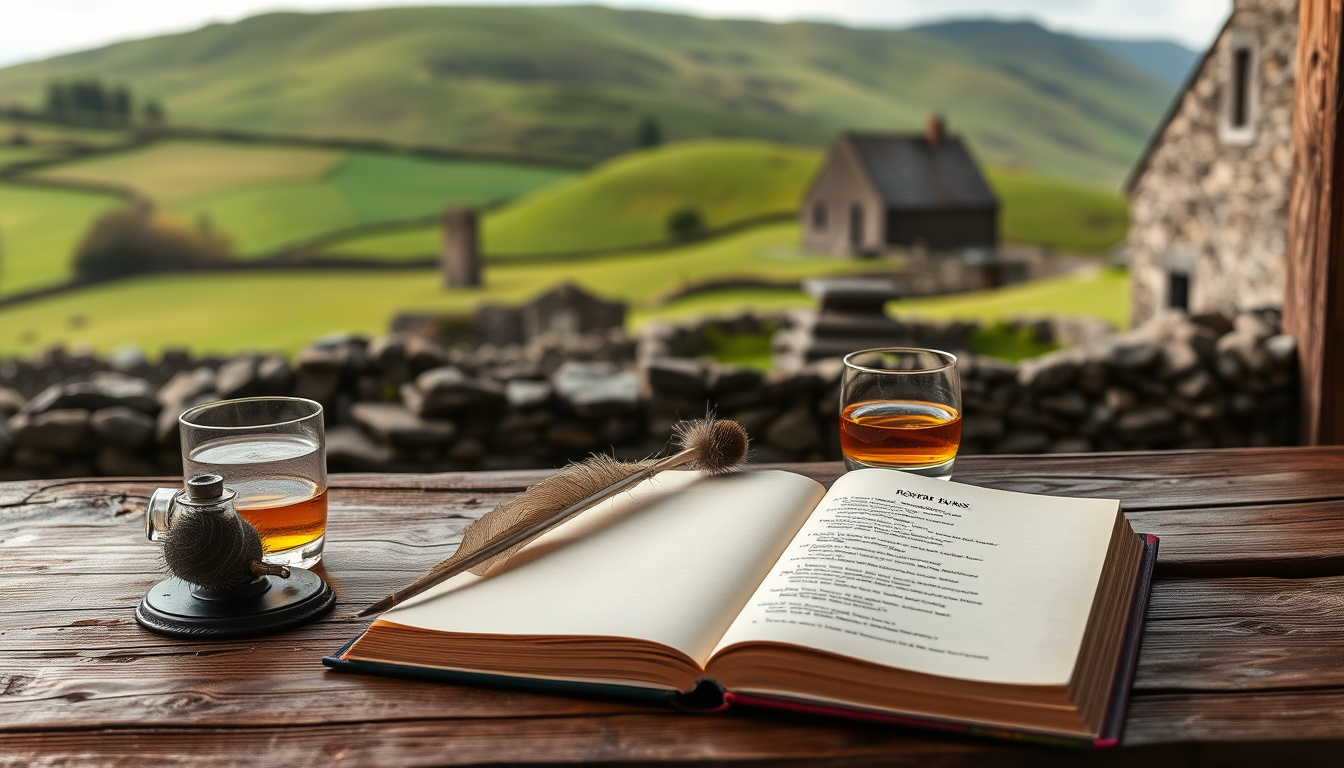
You’ve heard the name, probably sung the song at a New Year’s party. But there’s more to Robert Burns than “Auld Lang Syne” — he was a tenant farmer who became Scotland’s national poet, a controversial figure with a famously complicated personal life, and a lyricist whose work still shapes how the world sees Scottish culture.
Born: 25 January 1759 ·
Died: 21 July 1796 ·
Nationality: Scottish ·
Occupation: Poet, Lyricist, Farmer, Exciseman ·
Known as: National Poet of Scotland (Rabbie Burns) ·
Most famous work: Auld Lang Syne
Quick snapshot
- Born 25 January 1759 in Alloway, Ayrshire (Britannica)
- Published Poems, Chiefly in the Scottish Dialect, July 1786 (Britannica)
- Married Jean Armour in 1788 (National Trust for Scotland)
- Died 21 July 1796 in Dumfries (Britannica)
- Exact number of romantic partners (Britannica summary)
- Precise cause of death (rheumatic fever vs. endocarditis) (Poets.org)
- Number of illegitimate children is incomplete in records (BBC History)
- 1759-1796: Life span of 37 years (Britannica)
- 1786: Breakthrough publication (Britannica)
- 1788: Marriage to Jean Armour (National Trust for Scotland)
- Burns Night celebrated annually 25 January (Scotland.org)
- Descendants continue to preserve legacy (Britannica)
- Robert Burns Birthplace Museum open in Alloway (National Trust for Scotland)
Eight key facts about Robert Burns, one pattern: his life moved from rural poverty to international renown, but his personal and financial struggles never fully disappeared.
| Attribute | Details |
|---|---|
| Full name | Robert Burns (Rabbie Burns) |
| Born | 25 January 1759, Alloway, Scotland |
| Died | 21 July 1796, Dumfries, Scotland |
| Occupation | Poet, Lyricist, Farmer, Exciseman |
| Notable works | Auld Lang Syne, Tam o’ Shanter, To a Mouse, Address to a Haggis |
| Spouse | Jean Armour (m. 1788) |
| Children | 12 (including illegitimate) |
| Posthumous honor | National poet of Scotland |
Why is Robert Burns so famous?
Robert Burns is Scotland’s national poet — a title that carries weight far beyond literary circles. His works like Auld Lang Syne and Tam o’ Shanter are globally recognized, translated into dozens of languages, and sung or recited on every continent. He is celebrated annually on Burns Night (25 January), an event observed wherever Scots (and fans of Scotland) gather, confirming his place as a cultural ambassador (National Trust for Scotland).
His poetry captures Scottish culture, nature, and love — but also rebellion against orthodox religion and morality, which gave him a populist edge (Britannica). Burns wrote lyrics and songs in both Scots and English, bridging the gap between local dialect and international audiences (Britannica). He is associated with more than 300 songs, many of which he collected, edited, or wrote for James Johnson’s Scots Musical Museum and George Thomson’s Select Collection of Original Scotish Airs (Britannica summary).
What is Robert Burns’ most famous piece of work?
- Auld Lang Syne — sung worldwide at New Year’s Eve, it’s arguably the most recognized song in the English-speaking world (Britannica).
- Tam o’ Shanter — a narrative poem featuring supernatural elements, a drunken farmer, and a chase by witches (Britannica).
- To a Mouse — a reflection on human plans and nature, inspired by Burns destroying a mouse’s nest with his plough (Britannica).
- Address to a Haggis — a celebratory poem about Scotland’s national dish, recited at Burns Suppers (Britannica).
- A Red, Red Rose — a love poem that remains one of the most quoted in English literature (Poetry Foundation).
What is Robert Burns’ most famous quote?
Perhaps the most famous line attributed to Burns comes from To a Mouse: “The best-laid schemes o’ mice an’ men gang aft agley” (often rendered in modern English as “The best-laid plans of mice and men often go awry”). It has become a staple of English idiom, referenced by John Steinbeck in his novel Of Mice and Men (Britannica). Another contender is from Auld Lang Syne: “For auld lang syne, my dear, for auld lang syne” — a phrase that signals remembrance and fellowship (Britannica).
Burns’s most famous works celebrate community and love, yet his personal life was marked by financial instability, multiple romantic entanglements, and a reputation for rebellion. The man who wrote the world’s most sung song about friendship also struggled to maintain steady relationships.
What is Robert Burns’ most famous piece of work?
Auld Lang Syne is Burns’s most globally recognized work, sung on New Year’s Eve across the world — from Times Square to Tokyo. The song, set to a traditional folk tune, was written by Burns in 1788 and sent to James Johnson’s Scots Musical Museum (Britannica). Its opening lines — “Should auld acquaintance be forgot” — have become a universal call to remember old friends and times past.
Tam o’ Shanter is a narrative poem published in 1791, based on a folk legend of a farmer who witnesses a witches’ dance in Alloway Kirk. It’s celebrated for its vivid imagery, comic tone, and supernatural climax (Britannica). Other notable works include To a Mouse, Address to a Haggis, which is recited at Burns Suppers worldwide, and A Red, Red Rose, a love poem that remains among the most frequently quoted in English (Poetry Foundation).
Many of Burns’s works were not published for profit — he often gave away songs without payment, contributing to the Scots Musical Museum and Thomson’s Select Collection anonymously or without claiming authorship (Britannica summary). This generosity made him beloved but also kept him financially struggling.
“We’ll tak a cup o’ kindness yet, for auld lang syne.”
Robert Burns, Auld Lang Syne
The trade-off: Burns’s willingness to share his work without credit or payment cemented his folk-hero status but also meant he never fully capitalized on his own genius. His legacy, however, is far larger than any financial ledger.
Was Burns a womaniser?
The short answer is yes — but the full picture is more complicated. Burns had a famously active romantic life, with multiple relationships before and during his marriage to Jean Armour. Estimates of his lovers range from a few documented partners to over a dozen, though exact numbers remain unclear due to incomplete records (Britannica summary).
How many wives did Robert Burns have?
Burns married one woman: Jean Armour, in 1788. But the path to marriage was rocky. Jean became pregnant with his twins in 1785; Burns initially signed a document acknowledging the relationship, but then retracted it before finally marrying her three years later (National Trust for Scotland).
How many lovers did Robbie Burns have?
Biographers document relationships with several women, including Elizabeth Paton (who bore his first child), Mary Campbell (his “Highland Mary,” who died young), and Agnes Maclehose (with whom he exchanged passionate letters under the pseudonyms “Clarinda” and “Sylvander”). The total number is uncertain, but Burns’s own letters and poems suggest a pattern of intense, often short-lived affairs (Britannica).
How many illegitimate children did Robert Burns have?
Burns fathered at least 12 children in total — 9 with Jean Armour (though only 3 survived to adulthood) and at least 3 with other women, including Elizabeth Paton and Ann Park (BBC History). Some records are incomplete, so the true number may be higher.
Did Robert Burns have 12 children?
Yes, according to the BBC History and biographical consensus, Burns fathered 12 children, though only a few lived past childhood. Jean Armour bore 9 children, but only 3 survived infancy — Robert Burns (born 1786, later named as his father’s heir), Francis Wallace (who died young), and another son. The other children died in infancy or shortly after birth. Burns also acknowledged children with Elizabeth Paton and Ann Park (Britannica).
“But, och! I backward cast my e’e on prospects dreary! An’ forward, tho’ I canna see, I guess an’ fear.”
Robert Burns, To a Mouse
What illness did Robert Burns have?
Burns’s health declined rapidly in the 1790s. He suffered from a series of illnesses, likely stemming from rheumatic fever he contracted as a child. By 1796, he was bedridden, diagnosed with what modern physicians believe was bacterial endocarditis — a heart infection caused by untreated rheumatic fever (Poets.org). He died on 21 July 1796 in Dumfries, at just 37 years old.
What were Robert Burns’ last words?
According to biographers, Burns’s last words were reportedly: “Don’t let the awkward squad fire over me” — a reference to the “awkward squad,” a military term for poorly trained soldiers. Burns was reportedly concerned that the volunteer soldiers who would fire a salute at his funeral might be incompetent (Poetry Foundation). The remark, even on his deathbed, revealed his sharp wit and concern for propriety.
Where is the grave of Robert Burns?
Robert Burns is buried in St Michael’s Churchyard in Dumfries, Scotland. His original grave was a simple plot, but in 1813, a grand mausoleum was built over it after a public subscription raised funds for a more fitting monument. The mausoleum, designed by Thomas Hunt, features a relief of Burns at the plough and holds the remains of Burns, his wife Jean Armour, and several of their children (National Trust for Scotland).
“Fair fa’ your honest, sonsie face, great chieftain o’ the puddin’-race!”
Robert Burns, Address to a Haggis
Burns’s early death — at 37, just as his fame was consolidating — turned him into a romantic figure of tragically cut-short genius. For Scotland, the consequence was a national bard who never had the chance to write an older, perhaps wiser, body of work.
Are there any living descendants of Robert Burns?
Yes, living descendants of Robert Burns exist today. Burns’s surviving children carried his lineage forward, and through his son Robert Burns (born 1786), the family line continued in Scotland and abroad. Some descendants have been active in preserving his legacy, including participating in Burns Supper events and supporting the Robert Burns Birthplace Museum (Britannica).
The Burns family lineage continues in Scotland and abroad — there are records of descendants in Canada, the United States, and New Zealand. However, the exact number and identity of living descendants is not comprehensively tracked. The National Trust for Scotland, which manages the Robert Burns Birthplace Museum in Alloway, occasionally hosts events that bring together known descendants, and the trust maintains a genealogical interest in the family.
The implication: Burns’s endurance is not just literary — his physical lineage continues to connect the 18th century to the present. For Scottish heritage groups and the tourism industry in Ayrshire and Dumfries, the “living link” to Burns adds a personal dimension to the annual Burns Night celebrations.
Confirmed facts
- Born 25 January 1759
- Died 21 July 1796
- Married Jean Armour
- Published Poems, Chiefly in the Scottish Dialect
- Buried in St Michael’s Churchyard, Dumfries
What’s unclear
- Exact number of romantic partners
- Precise cause of death (rheumatic fever vs. endocarditis)
- Number of illegitimate children (some records incomplete)
en.wikipedia.org, amazon.com, bbc.co.uk, bbc.co.uk, scalar.usc.edu, poets.org, britainexpress.com, britannica.com, poetrysoup.com
Frequently asked questions
What is Burns Night and how is it celebrated?
Burns Night is celebrated annually on 25 January. It typically includes a supper featuring haggis, neeps, and tatties, recitations of Burns’s poetry including the Address to a Haggis, and the singing of Auld Lang Syne (Scotland.org).
What are the most famous poems by Robert Burns?
The most famous include Auld Lang Syne, Tam o’ Shanter, To a Mouse, Address to a Haggis, and A Red, Red Rose (Britannica).
Did Robert Burns receive any formal education?
Burns received minimal formal schooling. He was taught by his father and attended a school in Alloway briefly. His learning came mostly from reading books, including the works of Shakespeare, Pope, and the Bible (Poets.org).
What was Robert Burns’ job besides writing poetry?
Burns worked as a farmer and later as an exciseman (a tax collector on goods like whisky and beer) in Dumfries. Both jobs provided income but also caused him physical and financial strain (Poetry Foundation).
How did Robert Burns contribute to Scottish culture?
Burns collected, edited, and wrote hundreds of songs, preserving Scottish folk music and dialect. He is credited with shaping the modern identity of Scottish cultural heritage, and his works are central to Burns Night celebrations worldwide (Britannica).
Is there a museum dedicated to Robert Burns?
Yes, the Robert Burns Birthplace Museum in Alloway, managed by the National Trust for Scotland, is dedicated to his life and works. It includes his birth cottage, exhibits of his manuscripts and personal effects, and a visitor centre (National Trust for Scotland).
What is the significance of ‘Auld Lang Syne’?
Auld Lang Syne is a song about remembering old friendships and times gone by. It is sung at New Year’s Eve worldwide and has become a symbol of nostalgia and fellowship. Burns wrote the song in 1788 based on a traditional folk tune (Britannica).
For Scotland’s cultural institutions, the Burns family, and the global Scottish diaspora, the choice is clear: preserve and celebrate the complex figure of Robert Burns — the farmer, the lover, the rebel, the poet — or lose a vital link to Scottish identity itself. The annual lighting of the Burns Night supper and the singing of Auld Lang Syne prove that the legacy endures.
Related stories




Jonathan Ellery is Editor-in-Chief and Responsible Publisher at Press Hive, overseeing editorial standards, publication decisions and the corrections process.