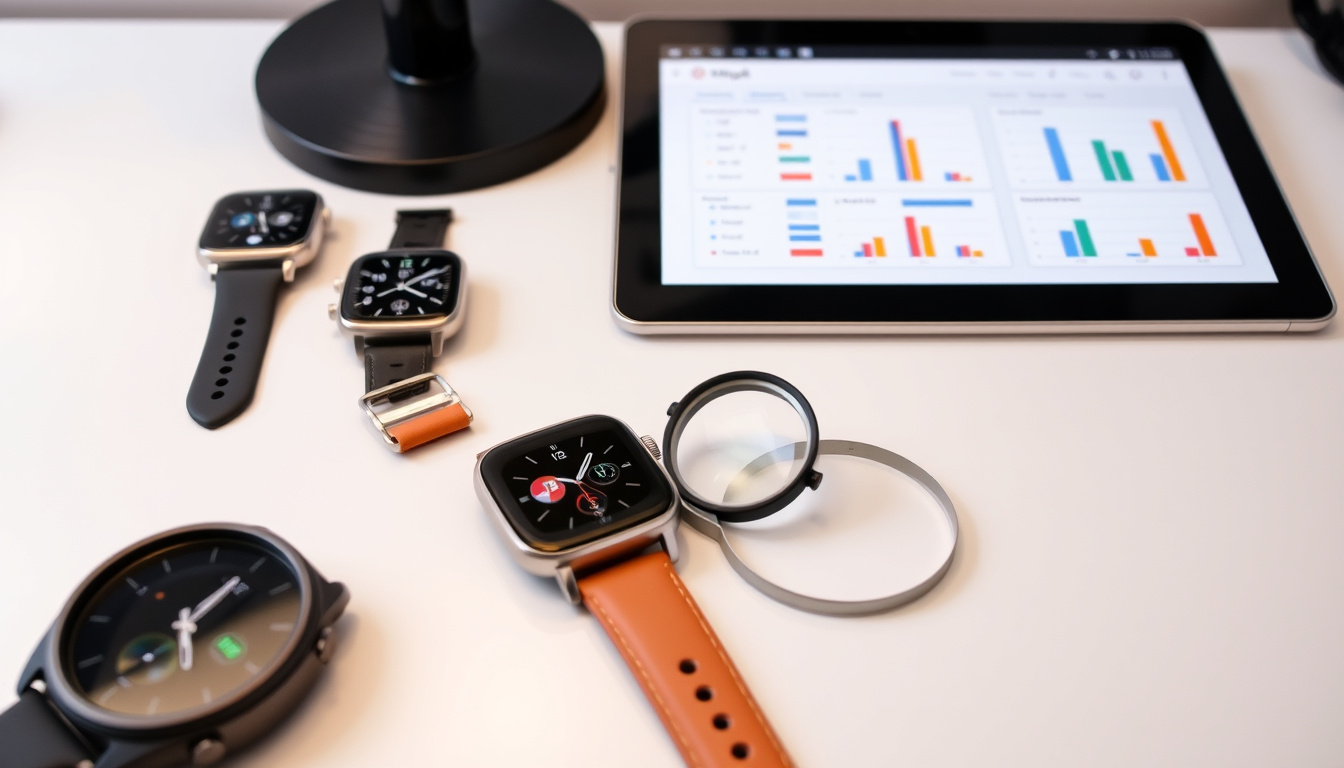
Anyone who has worn a traditional watch knows the hesitation: a smartwatch offers more but demands a charger, Bluetooth connection, and compromise on classic simplicity. Yet with 159 million units shipped in 2023, millions have decided the trade-off is worth it – and this guide cuts through the hype to help you match features to your real daily life, not someone else’s highlight reel.
Global smartwatch shipments (2023): 159 million units ·
Common price range: $50 – $1,500 ·
Average battery life: 1 – 14 days ·
Top selling brand: Apple ·
Average screen size: 1.2 – 1.9 inches
Quick snapshot
- Smartwatches reliably track heart rate and sleep patterns (Consumer Reports (nonprofit test lab))
- Apple shipped more smartwatches than any other brand in 2023 (Consumer Reports – nonprofit test lab) (Consumer Reports (nonprofit test lab))
- Most models offer 50m water resistance for swimming (John Lewis & Partners (UK retailer))
- Long-term durability of budget smartwatches under $100 remains unverified (SmartwatchFacts (niche review site))
- Whether smartwatch health tracking meaningfully improves long-term health outcomes is still debated (Consumer Reports – nonprofit test lab) (SmartwatchFacts (niche review site))
- ECG and sleep apnea detection arrived on premium watches in 2022–2024 (Consumer Reports – nonprofit test lab) (O2 (UK mobile network))
- Fall detection and satellite SOS now standard on top-tier models (O2 (UK mobile network))
- Non-invasive blood glucose monitoring is expected in premium models within 2–3 years (Consumer Reports – nonprofit test lab)
- Battery technology improvements may push average life beyond 7 days by 2027 (O2 – UK mobile network)
Five key specs, one pattern: the smartwatch market splits sharply between premium multi-day devices and budget models that trade battery life for lower cost.
| Specification | Value | Source |
|---|---|---|
| Global smartwatch shipments (2023) | 159 million units | Consumer Reports (nonprofit test lab) |
| Average price | $300 | John Lewis & Partners (UK retailer) |
| Battery life range | 1–14 days | O2 (UK mobile network) |
| Top selling brand | Apple | Consumer Reports (nonprofit test lab) |
| Screen size range | 1.2–1.9 inches | SmartwatchFacts (niche review site) |
| Water resistance rating | Up to 50m (5 ATM / IP68) | John Lewis & Partners (UK retailer) |
| Heart rate monitoring | Standard on most models | Consumer Reports (nonprofit test lab) |
| Built-in GPS | Common on premium models | MoneySavingExpert (UK consumer advice) |
What is the best smart watch to buy?
Best overall smartwatch
- Apple Watch Series 9 leads for iPhone users with deep ecosystem integration (Consumer Reports – nonprofit test lab)
- Samsung Galaxy Watch 6 offers the best Android-native experience with Wear OS (John Lewis & Partners (UK retailer))
- Garmin Forerunner 265 is the top pick for runners and multi-sport athletes (Very (UK retailer))
These three models consistently top recommendation lists because they nail the core requirements: reliable notifications, accurate health tracking, and multi-day battery life. The Apple Watch Series 9 handles texts, calls, and contactless payments seamlessly from the wrist, while the Galaxy Watch 6 matches that capability for Android users. The Garmin Forerunner 265 sacrifices some smart features for exceptional GPS accuracy and training metrics.
iPhone buyers who choose a non-Apple smartwatch lose iMessage integration and some health-data syncing. Android users who pick an Apple Watch cannot use it at all. Ecosystem lock-in is the single biggest constraint on choice.
The pattern: choosing a smartwatch starts with your phone, not your wrist.
Best budget smartwatch
- Amazfit Bip 5 offers 14-day battery life for under $80 (MoneySavingExpert (UK consumer advice))
- CMF Watch Pro by Nothing provides a premium look at a $69 price point (SmartwatchFacts – niche review site)
- Xiaomi Smart Band 8 Pro is a hybrid fitness tracker with smartwatch features under $50 (Very – UK retailer)
Budget smartwatches have improved dramatically since 2021. The Amazfit Bip 5, for instance, delivers heart-rate monitoring, GPS, and a 1.9-inch display for roughly the same price as a week of coffee. The catch: sensor accuracy is reportedly less consistent than premium models, and software update support typically ends after 12–18 months.
Best smartwatch for fitness tracking
- Garmin Epix Pro Gen 2 leads with multi-band GPS, training readiness, and body battery (Very – UK retailer)
- Apple Watch Ultra 2 offers dual-frequency GPS, diving depth gauge, and siren for safety (Consumer Reports – nonprofit test lab)
- Whoop 4.0 is a strap-only fitness wearable with strain and recovery analysis (no screen) (MoneySavingExpert – UK consumer advice)
For serious athletes, the Garmin Epix Pro Gen 2 provides metrics like training load, recovery time, and race predictor — features absent from general-purpose smartwatches. The Apple Watch Ultra 2 adds safety tools like car crash detection and fall detection, making it a strong choice for outdoor adventurers. Whoop skips the screen entirely to focus on sleep and strain data.
Is it worth buying a cheap smart watch?
Pros of cheap smartwatches
- Price: entry-level models cost $40–$100, roughly 80% less than a flagship Apple Watch (MoneySavingExpert – UK consumer advice)
- Battery life: many budget watches last 10–14 days versus 1–2 days for premium models (O2 – UK mobile network)
- Basic features: notifications, step counting, and sleep tracking are standard across the price spectrum (Consumer Reports – nonprofit test lab)
Cons of cheap smartwatches
- Sensor accuracy: budget heart-rate monitors are less reliable during high-intensity exercise (Consumer Reports – nonprofit test lab)
- Build quality: plastic cases and basic displays scratch more easily than sapphire or Gorilla Glass (O2 – UK mobile network)
- Software support: budget brands often end firmware updates after one year (SmartwatchFacts – niche review site)
Price vs quality trade-offs
- A $50 smartwatch typically lacks GPS, forcing it to rely on phone GPS for tracking (MoneySavingExpert – UK consumer advice)
- Water resistance on budget models is often IP68 (splash-proof) rather than 5 ATM (swim-ready) (John Lewis & Partners – UK retailer)
- Warranty periods on budget watches are typically 6–12 months versus 1–2 years on premium brands (SmartwatchFacts – niche review site)
The verdict: for casual users, a $60–$80 model is fine; for fitness enthusiasts, invest $250+.
How do I choose a smartwatch?
Consider compatibility with your phone
- Apple Watch requires an iPhone (Consumer Reports – nonprofit test lab)
- Samsung Galaxy Watch works best with Android but offers limited iOS support (John Lewis & Partners – UK retailer)
- Wear OS watches (e.g., Pixel Watch, Fossil) work with Android and basic iOS (Best Buy Canada (retailer tech guide))
- Garmin watches work with both platforms but lose some smart features on iOS (Very – UK retailer)
Identify key features needed
- Health tracking: heart rate, sleep, SpO2, and ECG are standard on mid-range and premium watches (Consumer Reports – nonprofit test lab)
- Notifications: all smartwatches surface texts and calls; some allow quick replies (Consumer Reports – nonprofit test lab)
- GPS: built-in GPS is essential for phone-free run tracking (MoneySavingExpert – UK consumer advice)
- Payments: NFC for contactless payments is available on most watches above $100 (John Lewis & Partners – UK retailer)
Set a budget
- Under $100: basic fitness tracking, notifications, 7–14 day battery, limited GPS (MoneySavingExpert – UK consumer advice)
- $100–$300: reliable GPS, heart-rate accuracy, NFC payments, 3–7 day battery (John Lewis & Partners – UK retailer)
- $300–$800: ECG, fall detection, premium materials, 1–3 day battery, advanced metrics (Consumer Reports – nonprofit test lab)
- $800+: titanium builds, dual-band GPS, solar charging, dive-ready water resistance (O2 – UK mobile network)
Check battery life and display
- Battery life ranges from 1 day (Apple Watch, Wear OS) to 14 days (Amazfit, Garmin) (O2 – UK mobile network)
- AMOLED displays offer vibrant colors but drain battery faster than LCD (SmartwatchFacts – niche review site)
- Always-on display mode typically cuts battery life by 30–50% (Consumer Reports – nonprofit test lab)
- Small wrists (under 6.5 inches) suit 38–42mm cases; larger wrists prefer 45mm+ (Wareable (wearable tech specialist))
A buyer who prioritizes battery life over display quality will choose a Garmin or Amazfit. A buyer who wants the best screen and app ecosystem will accept daily charging with an Apple Watch or Galaxy Watch. There is no single right answer — only the right match for your charging habits.
The decision boils down to whether you prioritize battery life or screen quality.
Can a smartwatch replace a phone?
Limitations of smartwatches as standalone devices
- Most smartwatches require a Bluetooth connection to a phone for full functionality (Consumer Reports – nonprofit test lab)
- App ecosystems on watches are limited — you cannot install Instagram, banking apps, or ride-hailing services (Consumer Reports – nonprofit test lab)
- Typing on a watch screen is impractical for anything beyond short replies (Best Buy Canada – retailer tech guide)
- Camera is absent on nearly all smartwatches (except the 2023 Samsung Galaxy Watch 6 camera band) (Best Buy Canada – retailer tech guide)
What features do smartwatches offer without a phone?
- Music playback: store and play Spotify or Apple Music playlists offline via Bluetooth headphones (Consumer Reports – nonprofit test lab)
- GPS tracking: record runs, walks, and cycles without bringing your phone (MoneySavingExpert – UK consumer advice)
- Heart rate and sleep tracking: all core health metrics work independently of the phone (Consumer Reports – nonprofit test lab)
- Contactless payments: NFC payments work with stored cards even without phone nearby (John Lewis & Partners – UK retailer)
Which smartwatches have cellular connectivity
- Apple Watch Series 9 (LTE model) costs $100 extra and requires a separate cellular plan (Consumer Reports – nonprofit test lab)
- Samsung Galaxy Watch 6 LTE offers standalone calling and data for around $80 more than the Bluetooth model (John Lewis & Partners – UK retailer)
- Garmin Forerunner 945 LTE adds satellite messaging and emergency texting without a phone plan (O2 – UK mobile network)
- LTE models drain battery 20–30% faster than Bluetooth-only versions (O2 – UK mobile network)
What are the negatives of smart watches?
Battery life
- Apple Watch and Wear OS watches require daily charging, which is inconvenient for sleep tracking (Consumer Reports – nonprofit test lab)
- Battery degradation is noticeable after 2–3 years, with some watches losing 30% of original capacity (O2 – UK mobile network)
- Always-on display mode can cut battery life in half on OLED models (SmartwatchFacts – niche review site)
Privacy concerns
- Smartwatches continuously collect health data — heart rate, location, sleep patterns — which is stored by manufacturers (Consumer Reports – nonprofit test lab)
- Data-sharing policies vary by brand; some sell anonymized health data to third-party research firms (MoneySavingExpert – UK consumer advice)
- Microphone and camera access on some models raises incidental recording risks (Best Buy Canada – retailer tech guide)
Durability and water resistance
- Screen cracks are common on non-sapphire models; repair costs can approach half the watch price (O2 – UK mobile network)
- Water resistance degrades over time — gaskets dry out, and swim tracking is not recommended on watches older than 2 years (John Lewis & Partners – UK retailer)
- Budget watches often lack official water resistance ratings beyond IP68 (splash-proof) (John Lewis & Partners – UK retailer)
Cost of repairs
- Out-of-warranty screen replacement on an Apple Watch Ultra costs $499 (Consumer Reports – nonprofit test lab)
- Battery replacement on most smartwatches is not user-serviceable and costs $50–$100 (O2 – UK mobile network)
- Budget watches are often cheaper to replace than repair — the economics favor disposal (SmartwatchFacts – niche review site)
The trade-off: convenience comes at the cost of privacy, battery discipline, and repair bills.
Three top models, one comparison: the choice between Apple, Samsung, and Garmin comes down to phone compatibility and fitness priorities.
| Feature | Apple Watch Series 9 | Samsung Galaxy Watch 6 | Garmin Forerunner 265 |
|---|---|---|---|
| Price | $399 – $499 | $299 – $399 | $449 |
| Battery life | Up to 18 hours | Up to 40 hours | Up to 13 days |
| Display | 1.9-inch OLED, 2000 nits | 1.5-inch AMOLED, 2000 nits | 1.3-inch AMOLED, 1000 nits |
| Phone compatibility | iPhone only | Android (best), iOS (limited) | Android & iOS |
| Health sensors | ECG, SpO2, temperature, heart rate | ECG, SpO2, temperature, heart rate | Heart rate, SpO2, training metrics |
| Built-in GPS | Yes (L1+L5) | Yes (L1+L5) | Yes (multi-band) |
| Water resistance | 50m (WR50) | 50m (IP68) | 50m (10 ATM) |
| NFC payments | Apple Pay | Samsung Pay | Garmin Pay |
The implication: the Apple Watch Series 9 is the best smartwatch for iPhone users but offers the worst battery life. The Garmin Forerunner 265 dominates battery endurance but lacks ECG and on-wrist cellular options. The Galaxy Watch 6 sits in the middle — the best Android smartwatch, but not the best fitness tracker.
Eight key specs, one pattern: the most important technical specifications for smartwatch buyers center on battery, display, and water resistance — not processor speed or storage.
| Specification | Detail | Why it matters |
|---|---|---|
| Battery life | 1–14 days depending on model and usage | Determines whether you charge daily or weekly |
| Display type | AMOLED, LCD, or e-ink | AMOLED is vivid but drains battery; e-ink lasts weeks |
| Display brightness | 500–2000 nits | Higher nits = better outdoor readability |
| Water resistance | IP68 (splash) to 10 ATM (dive) | 5 ATM or higher is needed for swimming |
| GPS | Single-band vs multi-band | Multi-band is more accurate in cities and forests |
| Heart rate sensor | Optical (green LED) vs ECG | ECG detects atrial fibrillation; optical is for continuous tracking |
| Storage | 4GB – 32GB | Larger storage allows offline music playback |
| Operating system | watchOS, Wear OS, Tizen, Garmin OS | Determines app availability and ecosystem lock-in |
| Processor | S9, Exynos W930, or similar | Faster processors enable smoother animations and app loading |
| RAM | 1GB – 2GB | More RAM prevents app reloads and lag |
The trade-off: buyers who prioritize battery life will choose larger, less stylish watches with LCD displays. Buyers who want the best screen and fastest performance will accept daily charging. No single watch excels at both.
Upsides
- Convenient notifications and quick replies from your wrist
- Continuous health monitoring (heart rate, sleep, SpO2)
- GPS tracking for runs and rides without carrying a phone
- Contactless payments without reaching for a wallet
- Fall detection and SOS safety features on premium models
Downsides
- Daily charging is required for most premium models
- Screen scratches and cracks are expensive to repair
- Health data privacy varies by manufacturer
- Battery degrades significantly after 2–3 years
- Budget watches lack accurate sensors and software updates
Step-by-step: How to choose your smartwatch
- Check your phone. iPhone users should consider Apple Watch first. Android users should look at Samsung Galaxy Watch or Wear OS devices. Garmin works with both. (Consumer Reports – nonprofit test lab)
- Define your primary use. Fitness tracking? Notifications? Health monitoring? Each use case favors a different brand and price tier. (John Lewis & Partners – UK retailer)
- Set a realistic budget. Under $100 gets you basics. $100–$300 gets you reliable GPS and heart rate. $300+ gets you ECG, premium build, and extended battery. (MoneySavingExpert – UK consumer advice)
- Compare battery life. If you dislike daily charging, choose a Garmin, Amazfit, or Coros model with 7–14 day battery. (O2 – UK mobile network)
- Check water resistance. For swimming, look for 5 ATM or IP68. For diving, 10 ATM or higher. (John Lewis & Partners – UK retailer)
- Read warranty and support terms. Budget brands often offer 6-month warranties; premium brands offer 1–2 years. Factor in the cost of accidental damage cover. (SmartwatchFacts – niche review site)
- Try the fit. Visit a store if possible. A 38–42mm case suits smaller wrists; 45mm+ suits larger wrists. The watch should sit flat and not slide. (Wareable – wearable tech specialist)
Confirmed facts
- Smartwatches reliably track heart rate and sleep patterns (Consumer Reports – nonprofit test lab)
- Apple Watch is the market leader with the largest app ecosystem (Consumer Reports – nonprofit test lab)
- Most smartwatches require a phone for full functionality (Consumer Reports – nonprofit test lab)
- Water resistance to 50m is suitable for swimming (John Lewis & Partners – UK retailer)
- Fall detection and SOS are available on premium models (O2 – UK mobile network)
What’s unclear
- Long-term durability of budget smartwatches under $100 (SmartwatchFacts – niche review site)
- Impact of smartwatch health tracking on long-term health outcomes (Consumer Reports – nonprofit test lab)
- Whether budget heart-rate sensors are accurate enough for medical use (Consumer Reports – nonprofit test lab)
“Budget smartwatches under $100 have improved, but their heart-rate sensors are still less accurate during high-intensity exercise compared to models from Apple, Garmin, or Samsung.”
Consumer Reports (nonprofit test lab)
“The most important factor in choosing a smartwatch is making sure it works with your phone. An Apple Watch won’t work with an Android phone, and many Android watches offer limited features with an iPhone.”
For buyers in the UK and US, the smartwatch market offers clear choices but no universal winner. The decision comes down to a single question: what do you want your watch to do when you are not looking at your phone? The answer determines whether you will be satisfied with a budget model or need a premium device.
Frequently asked questions
How often should I charge my smartwatch?
It depends on the model. Apple Watch and most Wear OS watches need daily charging. Garmin and Amazfit watches last 5–14 days. Budget watches often last 7–14 days because they use simpler displays and fewer sensors. (O2 – UK mobile network)
Can I use a smartwatch without a smartphone?
You can use a smartwatch without a phone for GPS tracking, music playback (via Bluetooth headphones), heart rate monitoring, and contactless payments. However, you need a phone for initial setup, app downloads, and most notifications. LTE models offer limited standalone calling and data. (Consumer Reports – nonprofit test lab)
What is the difference between a smartwatch and a fitness tracker?
A smartwatch runs apps, shows notifications, and often supports payments and voice assistants. A fitness tracker (like a Fitbit or Whoop) focuses on step counting, sleep tracking, and heart rate with a simpler display and longer battery life. Smartwatches are more versatile; fitness trackers are more specialized and typically cheaper. (Consumer Reports – nonprofit test lab)
Are smartwatches safe for swimming?
Smartwatches rated 5 ATM or IP68 are safe for swimming in pools and the sea. However, water resistance degrades over time — gaskets can dry out after 2–3 years. Avoid pressing buttons underwater and rinse the watch with fresh water after swimming in salt water. (John Lewis & Partners – UK retailer)
Do smartwatches need a data plan?
Bluetooth-only smartwatches do not need a data plan — they connect to your phone. LTE models require a separate cellular plan, typically costing $5–$15 per month. Most carriers offer shared data plans that add a smartwatch to your existing phone line. (O2 – UK mobile network)
How accurate are smartwatch heart rate monitors?
Optical heart rate sensors on premium smartwatches (Apple, Garmin, Samsung) are accurate within 2–5% for resting and moderate exercise. Accuracy drops during high-intensity interval training and for users with darker skin tones or tattoos. ECG sensors on Apple Watch and Galaxy Watch are clinically validated for atrial fibrillation detection. (Consumer Reports – nonprofit test lab)
What operating systems do smartwatches use?
The main smartwatch operating systems are watchOS (Apple), Wear OS (Google/Samsung), Tizen (older Samsung models), and Garmin OS. watchOS is exclusive to Apple Watch. Wear OS works with Android and limited iOS. Garmin OS works with both platforms. The OS determines which apps and watch faces are available. (Consumer Reports – nonprofit test lab)
Related stories




Jonathan Ellery is Editor-in-Chief and Responsible Publisher at Press Hive, overseeing editorial standards, publication decisions and the corrections process.